If back or leg pain has lasted beyond a short flare, the useful question is often when to try non-surgical bulging disc care before anyone talks about an operation. A disc bulge can irritate a nearby nerve, but the scan label alone does not decide the next step. Many people improve with time and conservative care. Others need a faster medical review because weakness, bowel or bladder changes, or rapidly worsening symptoms are not a reason to wait.
Schedule a free consultation with DRX Chicago
This guide is about timing. It is not a catalog of every treatment. For that comparison, start with DRX Chicago’s bulging disc treatment options in Chicago, and use the spinal conditions hub if the symptom may be sciatica, stenosis, or a herniation instead. Here, the goal is to know when a non-surgical trial is reasonable, what “long enough” means, and which warning signs should skip the wait.
When to try non-surgical bulging disc care before surgery?
In brief: Try non-surgical care first when pain is stable, strength is intact, and there is no emergency nerve problem. A short, structured trial is the usual starting point, not a promise that the bulge will disappear.
A bulging disc means the outer wall of the disc has pushed outward while staying intact. It is not the same as a herniation, where inner disc material has pushed through a tear. Either finding can be painful, and either can be found on a scan in someone who feels fine. That is why DRX Chicago starts with the person, not the MRI label.
Non-surgical care is the right first conversation when:
- Pain is bothersome but not rapidly getting worse.
- You can walk, and leg or arm strength is close to normal.
- Bowel and bladder control are unchanged.
- You have not yet had a focused plan that matches the exam, not just rest and pain pills.
Published reviews of lumbar disc herniation, a related disc problem, describe most acute cases improving without surgery, often over about six to eight weeks, unless red-flag symptoms appear. A narrative review of non-surgical care for lumbar disc herniation with nerve pain also treats nonoperative care as the usual first line, while noting that evidence strength differs by method. Those papers are about herniation, not a guarantee for every bulge. They still support a simple point: surgery is not the automatic first step when the exam is stable. See the MedlinePlus overview of herniated disk care and the AANS patient page on herniated discs.
DRX Chicago sees this pattern in Lakeview, Lincoln Park, and greater Chicago. People arrive after weeks of pain, a scan that says “bulge,” and advice that jumps from medication to surgery. A candidacy visit can sit between those two points.
How long should you try non-surgical bulging disc care?
In brief: A reasonable trial is often about four to eight weeks of active care when symptoms are stable. Waiting without a plan is not the same thing as treatment.
Time alone is a weak plan. Short rest can calm a flare. Prolonged rest usually makes stiffness and deconditioning worse. A useful trial has a start date, a goal, and a check-in.
For stable symptoms, clinicians often look at progress across several weeks, not several days. Pain that is slowly easing, sleep that is returning, and walking that is getting easier are signs the trial is doing something. Pain that is flat, or strength that is slipping, is a reason to change the plan rather than repeat the same weeks.
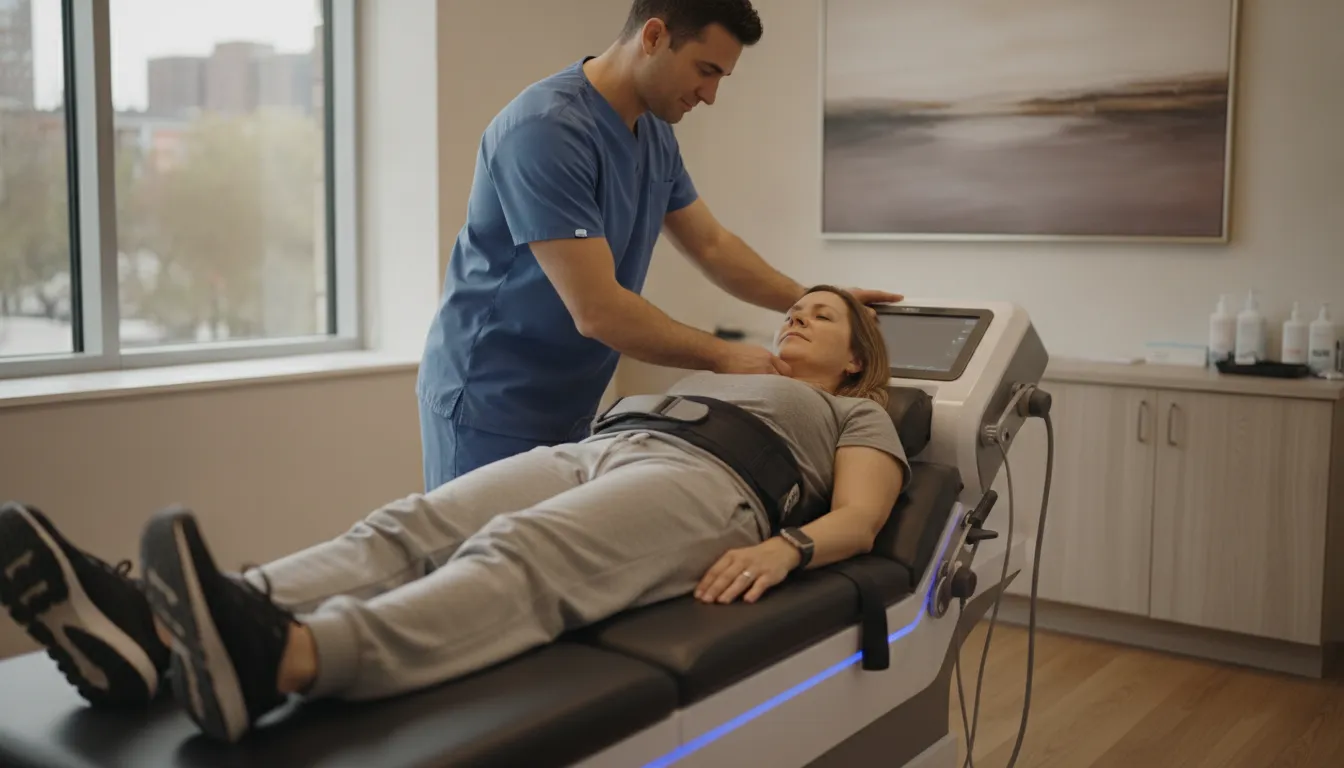
At DRX Chicago, computer-controlled decompression with the DRX9000 is one option inside that window, and only after an evaluation. A typical program is 20 to 28 sessions over four to seven weeks, about 30 to 45 minutes each, with visits more frequent at the start and less frequent later. That schedule is a protocol for qualified candidates. It is not a cure timeline, and it is not appropriate for every bulge.
The DRX9000 is FDA cleared through the 510(k) pathway. Clearance means the device may be marketed for its stated use. It is not the same as a promise that you will improve. The FDA description of premarket notification explains that distinction.
Which warning signs mean you should not wait?
In brief: Do not trial non-surgical care first if you have progressive weakness, saddle numbness, or new trouble controlling bowel or bladder. Those signs need urgent medical care, not another week of home stretches.
Most bulging-disc pain is not an emergency. A few patterns are. Get same-day medical care, and do not wait for a decompression consult, if you notice:
- New or worsening weakness in a leg or foot, such as the foot slapping when you walk.
- Numbness in the groin, inner thighs, or saddle area.
- New loss of bowel or bladder control, or trouble starting urination.
- Pain after a major fall or accident, especially with a history of osteoporosis or cancer.
- Fever with spine pain, which can signal infection.
These patterns can point to cauda equina compression, fracture, tumor, or infection. Non-surgical spinal decompression is not the treatment for those problems. DRX Chicago screens for them before anyone is placed on the table.
Other findings do not always require the emergency department, but they should shorten the trial. Progressive numbness, pain that wakes you every night, or symptoms that keep you from working after a careful plan are reasons to be rechecked, not reasons to “give it more time” with no new information.
What does a Chicago evaluation check before treatment?
In brief: A useful visit compares your story, your exam, and your imaging. It also looks for reasons decompression would be unsafe.
DRX Chicago’s evaluation is meant to answer three questions: Is this pain likely coming from the disc level on the scan? Is there a reason to refer you out first? If decompression is considered, is it safe to try?
Expect a history of how the pain started, what makes it better or worse, and what you have already tried. The exam looks at movement, nerve tension, reflexes, sensation, and strength. Imaging is interpreted against that exam. A bulge at a level that does not match your symptoms may not be the cause of the pain.
Contraindications that can rule out DRX9000 care include pregnancy, severe osteoporosis, spinal fracture, spinal tumor, active spinal infection, ankylosing spondylitis, and surgical hardware at the level being treated. A prior surgery elsewhere in the spine is not always a stop. Hardware at the treatment level is. The clinic’s notes on who is not a candidate and who may be a candidate spell out that screen in plain language.
The condition page for bulging discs explains how DRX Chicago thinks about the disc itself. Use that page for the condition. Use this article for the timing decision.
How do you know a non-surgical trial is enough?
In brief: Judge the trial by function, not by whether the MRI wording changed. Better walking, better sleep, and steady strength matter more than a perfect scan.
A trial has done its job when everyday tasks are moving in the right direction and no new nerve warning has appeared. You do not need to be pain-free to call that progress. You do need a direction.
Ask these questions at the follow-up:
- Is my strength the same or better than at the first visit?
- Can I walk farther, sit longer, or sleep with fewer wake-ups?
- Did the plan change because I stalled, or did we repeat the same care?
- Is there a clear point at which you would refer me for injection or surgical opinion?
Published clinical figures for qualified DRX9000 candidates include about 76 to 88 percent clinical success, about 80 percent average pain reduction, and MRI-measured disc height increases of about 1.0 to 1.6 mm. Those are group results. They are not a prediction for you. DRX Chicago does not promise that a bulge will retract, that pain will stop, or that surgery will never be needed.
If the trial fails, that result is still useful. It tells you and your clinicians that more of the same is unlikely to help. For some people the next step is a different non-surgical tool. For others it is a surgical consultation. The comparison of decompression and back surgery is there when you reach that fork. It should not replace the trial when the trial was never really done.
| Situation. | Reasonable next step. | Do not treat it as. |
|---|---|---|
| Stable pain, normal strength, and no bowel or bladder change. | A structured non-surgical trial with a check-in in several weeks. | An emergency, or a reason to book surgery first. |
| Pain easing, with walking and sleep improving. | Continue the plan and recheck function. | Proof the disc is fixed on imaging. |
| No change after an active plan of several weeks. | Re-evaluation and a different next step. | A reason to repeat the same weeks unchanged. |
| Progressive weakness, saddle numbness, or new bowel or bladder trouble. | Same-day medical care. | A decompression trial. |
| Qualified after screening, with disc-related pain still limiting life. | Discuss whether DRX9000 fits, alongside other care. | A guaranteed retraction of the bulge. |
What should you ask before you commit to a plan?
In brief: Ask what the visit is deciding, how progress will be measured, and what would make the clinic stop and refer you.
A good consult can answer these without a hard sell:
- Which finding on my exam matches the bulge, and which findings do not?
- Is anything on my history a reason to avoid decompression?
- What should improve in the first few weeks if this plan fits?
- What symptom would make you send me elsewhere the same day?
- What does the program cost as a package, and what might insurance cover besides the decompression itself?
Most insurance does not cover the decompression therapy code. Consultation, exam, and some supportive care may be covered, depending on your plan. Programs at DRX Chicago are typically quoted in a range rather than as a single public price, and CareCredit is available for people who want to finance care. Ask for the figure that applies to you. Do not rely on a number from another clinic’s site.
If your main question is whether an adjustment is safe, read the separate guide to a bulging disc chiropractor visit. If you want the wider set of Chicago options, use the treatment options article. This page stays on the timing question: when to try non-surgical bulging disc care, and when not to.
Frequently Asked Questions
Can a bulging disc be treated without surgery?
Often, yes, when strength is stable and there is no emergency nerve problem. Many people improve with time plus active care such as guided exercise, symptom control from the right clinician, and, for qualified candidates, spinal decompression. Surgery is a later discussion if function does not improve or warning signs appear.
How long should I try non-surgical care before considering surgery?
For stable symptoms, a focused trial of about four to eight weeks is a common window. The clock should start when real care starts, not when you first felt pain and then waited. Progressive weakness or bowel and bladder changes should not wait out that window.
Will non-surgical care put a bulging disc back to normal?
Do not count on the MRI wording changing. The practical goal is less pain and better function, with a disc that is less irritated. Some qualified decompression patients show small measured increases in disc height. That is not the same as a guarantee that your bulge will look normal.
Is spinal decompression the same as waiting it out?
No. Waiting without a plan is passive. Decompression, when appropriate, is a scheduled series of computer-controlled sessions after a screening exam. It is still non-surgical, and it is still not right for every person with a bulge on a report.
Who should skip non-surgical decompression entirely?
People with pregnancy, severe osteoporosis, spinal fracture, spinal tumor, active spinal infection, ankylosing spondylitis, or surgical hardware at the level to be treated should not be started on DRX9000 care. Urgent symptoms such as saddle numbness or new bowel or bladder loss need emergency medical care first.
Talk with DRX Chicago about whether non-surgical care fits your bulge
DRX Chicago, part of Advanced Spine & Sports Care, sees patients at 2828 N Clark St in Chicago. Call 773-868-0347 or use the contact page to ask for an evaluation. Dr. Jason Ingham, DC, CCSP, leads the clinical team. Bring your imaging and a short note of what you have already tried. The visit should tell you whether a non-surgical trial is timely, or whether you need a different kind of care first.