A disc injury can jeopardize everything an athlete has worked hard for: the training, the competitions, and even their sense of self-identity. When faced with such a setback, the initial concern for many athletes isn’t about the specifics of their spinal injury; it’s whether they will return to peak performance. A common question most athletes ask isn’t what happened to my spine, it’s will I ever get back to playing sports & athletic training at full strength?
Recovery varies by the type of disc injury, symptoms, activity demands, and clinical findings. A qualified evaluation can help determine which non-surgical options may be appropriate.
At DRX Chicago in Chicago’s Lakeview neighborhood, Dr. Jason Ingham, DC, CCSP is one of the few Certified Chiropractic Sports Physicians practicing in the city. He has helped hundreds of athletes recover from bulging and herniated disc injuries using non-surgical spinal decompression with the DRX 9000.
Schedule a free consultation with DRX Chicago to discuss your spinal disc injury treatment options. Call 773-868-0347 or visit our contact page. Candidacy for DRX9000 is determined after a clinical evaluation and imaging review.
What Is Spinal Disc Injury Treatment for Athletes?
Why Do Athletes Develop Spinal Disc Injuries?
The spine is designed to absorb force, but athletic training pushes that capacity to its limit.
Repetitive axial loading, explosive rotational movements, and high-impact landings all place compressive stress on the intervertebral discs. Over time, or even in a single traumatic moment, that stress can cause the disc’s gel-like center (nucleus pulposus) to push against the tough outer layer (annulus fibrosus).
The result is a bulge or full herniation.
Research published in Sports Illustrated and cited by the Rothman Institute found that MRI imaging reveals lumbar disc degeneration or herniation in up to 85% of Olympic athletes. A 2021 systematic review in the Orthopaedic Journal of Sports Medicine reported that symptomatic lumbar disc herniation affects athletes at rates as high as 75%. This isn’t a rare injury. It’s one of the most common spinal conditions in active people.
Which Sports May Increase the Risk of Spinal Disc Injuries?
Sports with the highest risk of spinal disk injuries include
- American Football: Known for the highest total number of severe spine injuries, including herniated discs and cervical cord damage, often due to high-impact tackling.
- Rugby: Similar to football, frequent high-impact collisions and scrums lead to significant risks of cervical and lumbar disc injuries.
- Weightlifting: Activities like squats and deadlifts place extreme axial pressure on the lumbar spine; poor form significantly increases the risk of disc herniation.
- Gymnastics: Repetitive hyperextension, trunk rotation, and high-impact landings predispose athletes to disc degeneration and herniation.
- Golf: Professional golfers have some of the highest incidences of back injury due to the repetitive, high-velocity torsional stress (twisting) of the golf swing.
- Hockey (Ice): Frequent collisions and “checking” can cause traumatic spinal injuries, with high rates of lumbar and cervical issues.
- Wrestling: The combination of awkward falls, sudden impacts, and intense twisting makes spinal disc injuries more prevalent.
- Cycling: While often lower impact, repetitive forward-leaning positions can strain the lumbar spine, and accidents involving motor vehicles are a leading cause of traumatic spinal fractures.
- Extreme Sports (Skiing/Snowboarding): High-speed maneuvers and falls often lead to severe cervical and thoracic spine traum
- Basketball: Basketball is consistently ranked as one of the most common high-risk, injury-prone sports, frequently cited alongside football, soccer, and hockey in terms of emergency department visits. The sport is considered high-risk due to its fast-paced nature, constant in-game contact, and the high impact of jumping and landing on hard courts.
What Is the Difference Between a Bulging Disc and a Herniated Disc?
These terms get used interchangeably, but they’re not the same injury.
- A bulging disc occurs when the disc protrudes outward but the outer layer remains intact.
- A herniated disc (sometimes called a ruptured disc or slipped disc) involves a tear in the annulus fibrosus, allowing the inner disc material to push through. Herniations tend to cause more acute nerve root compression, producing radiating pain, numbness, or weakness down the leg (sciatica) or arm.
Bulging and herniated discs may respond differently, and recovery time varies with the injury and nerve involvement. A clinical evaluation helps determine appropriate care.
What Does a Disc Injury Feel Like?
Symptoms depend on which disc is affected and which nerve root is compressed. Athletes with a lumbar (lower back) disc injury typically experience:
- Pain that spikes when coughing, sneezing, or bearing down
- Leg weakness or instability, especially during training
- Sharp or aching lower back pain that worsens with bending or twisting
- Radiating pain, tingling, or numbness into the buttock, thigh, calf, or foot
It’s common for athletes to push through early warning signs. That’s a mistake.
Pre-treatment symptom severity is the single strongest predictor of return-to-play success, according to research published in the American Journal of Sports Medicine. Early intervention shortens recovery dramatically.
How Does Non-Surgical Spinal Disc Treatment Work at DRX Chicago?
Think of it like this. When you stretch too hard, too fast, your muscles automatically tighten up to protect themselves.
That’s your body’s built-in defense system, and it’s the same reason traditional spinal traction often falls short. Pull the spine too aggressively and the surrounding muscles contract, limiting how much decompression can actually happen. You’re working against your own body.
The DRX 9000 takes a different approach. Instead of forcing the spine to decompress, it uses gentle, computer-controlled oscillating traction. Almost like a warmup set before the main lift. The surrounding muscles relax first. Then, once the body stops guarding, the system creates negative pressure inside the disc, essentially drawing it back into its natural shape.
For athletes, that matters for two reasons.
- Pain relief: First, the pressure on the compressed nerve root reduces almost immediately, which means faster pain relief.
- Tissue healing: Second, that same negative pressure creates a pumping effect that pulls oxygen, water, and nutrients back into a disc that’s been starved of them. If you’ve ever been told your disc is “dehydrated” or “degenerating,” this is the mechanism that begins to reverse that.
> A retrospective cohort study published in BMC Musculoskeletal Disorders found that patients undergoing the DRX 9000 treatment protocol experienced a pain reduction from an average of 6.2 to 1.6 on a 10-point scale over six weeks, with measurable increases in disc height on CT scans.
Treatment length and symptom response vary. DRX Chicago typically uses 30 to 45 minute sessions over several weeks, with frequency and duration determined after evaluation.
| Important Note on Patient Selection
Proper patient selection matters. Dr. Ingham performs a thorough examination, including MRI review, to confirm eligibility before recommending the DRX 9000. Not every disc injury qualifies, which is exactly why that evaluation process protects patients and improves outcomes. |
Can Athletes with a Disc Injury Return to Sport?
Some athletes return to sport with conservative care, but the appropriate plan depends on the diagnosis, symptoms, sport, and guidance from a qualified clinician.
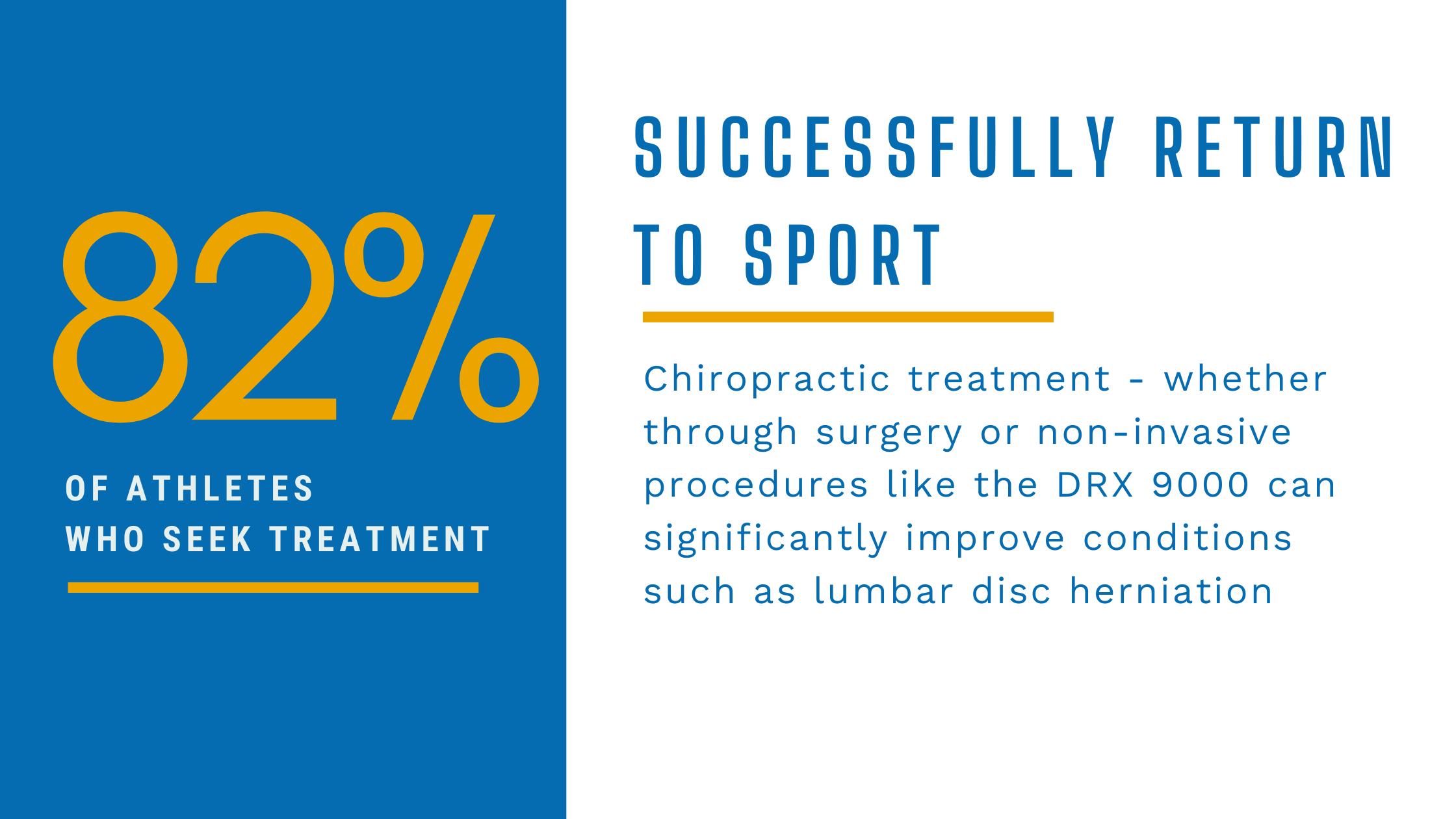
The Professional Athlete Spine Initiative, a study of 342 elite professional athletes diagnosed with lumbar disc herniation, found that 82% successfully returned to sport after treatment, with an average continued career length of 3.4 years post-injury.
Critically, there was no statistically significant difference in return-to-play rates between athletes who had surgery and those who pursued conservative care.
Medical Journal Citations in conjunction with a premier NFL cohort analysis found non-operative patients returned to play in an average of 3.6 months versus 8.7 months for those who underwent surgery.
For amateur and recreational athletes in Chicago, the math is even more favorable. Without the pressure of a contract or a roster spot, you have more time to let non-surgical treatment work, and more to gain from avoiding surgical recovery and its associated risks.
What Can Athletes Expect at DRX Chicago in Lakeview?
> DRX Chicago is located in a state-of-the-art 5,000 sq ft facility at 2828 N Clark St, easily accessible from Lincoln Park, Wrigleyville, Roscoe Village, and Bucktown, with free validated garage parking.
Dr. Ingham holds both his Doctorate of Chiropractic and a Certified Chiropractic Sports Physician (CCSP) designation, a credential specifically designed for treating active patients.
Your first visit includes:
- A comprehensive sports-focused physical examination
- Review of any existing imaging (or referral for MRI if needed)
- A clear explanation of whether you’re a good candidate for DRX 9000 treatment
Beyond spinal decompression, your recovery plan may include physical therapy for athletes, corrective exercise programming, and muscle stimulation therapy — all available in-house. This multi-modal approach is what separates a sports-focused injury clinic from a general chiropractic office.
Frequently Asked Questions
| How long does DRX 9000 treatment take for athletes? |
| DRX 9000 Sessions are 30–45 minutes, typically scheduled daily for the first two weeks, then tapering over a total 5–6 week protocol. Most athletes see meaningful pain reduction by week two, with the full course of treatment complete in about 6 weeks. |
| Is non-surgical spinal decompression safe for active athletes? |
| Yes, non-surgical spinal decompression is safe for properly selected candidates. The DRX 9000 is FDA-cleared and has been used by neurologists, orthopedic surgeons, and sports chiropractors worldwide. Dr. Ingham performs a thorough pre-treatment exam to confirm each patient is an appropriate candidate before beginning. |
| Do I have to stop training completely during disc injury treatment? |
| Not necessarily. Dr. Ingham will advise you on activity modification based on your specific injury and sport. Many athletes continue low-impact training during treatment. The goal is protecting the healing disc while maintaining as much conditioning as possible. |
| What’s the difference between a bulging disc and a herniated disc in terms of recovery time? |
| Bulging and herniated discs may respond differently, and recovery time varies with the injury and nerve involvement. A clinical evaluation helps determine appropriate care. |
What Is the Next Step for Spinal Disc Injury Treatment?
Every week without treatment is another week your disc isn’t healing, and another week further from the sport you love. The athletes who recover fastest are the ones who act early.
DRX Chicago offers a free initial consultation to evaluate your disc injury, review your imaging, and tell you candidly whether the DRX 9000 is right for you. Explore our full range of sports injury treatments in Chicago or schedule your appointment online today.
Ready to discuss your recovery plan? Schedule a free consultation with DRX Chicago or call 773-868-0347. We can review your symptoms and imaging, explain whether non-surgical care may be appropriate, and outline the next step.