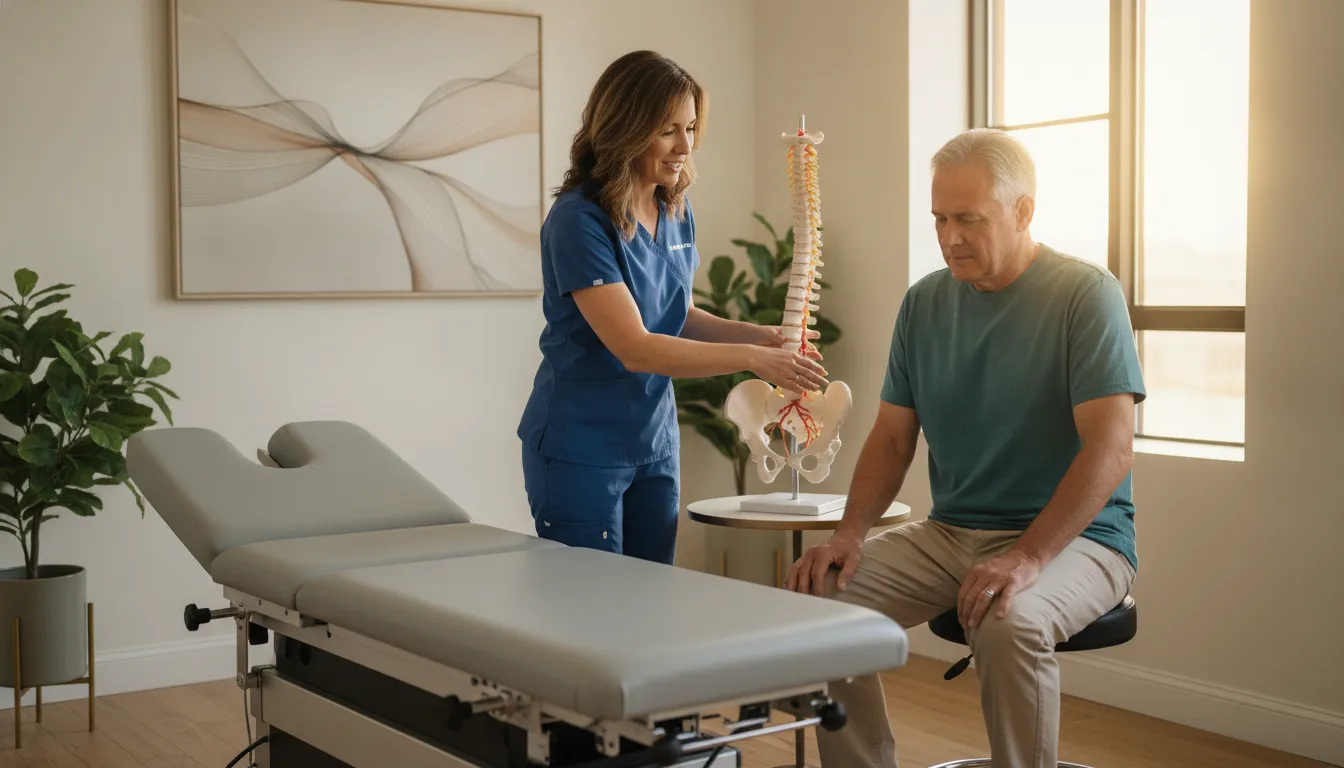
If you are comparing sciatica treatment Chicago options, pain can turn an ordinary walk, commute, or night of sleep into a constant negotiation. Symptoms may travel from the lower back through the buttock and down the leg. Finding relief starts with understanding what is irritating the nerve, rather than treating every case the same way.
Schedule a free consultation to discuss your sciatica symptoms with DRX Chicago.
For broader context, read about spinal conditions and back pain treatment options in Chicago.
For Chicago patients, the right sciatica treatment depends on the cause, symptom severity, and clinical findings. DRX Chicago may discuss conservative care, physical therapy, medical treatment, or supervised decompression for qualified candidates. An evaluation helps identify an appropriate path and whether urgent medical attention is needed.
At DRX Chicago, the process is designed to connect your symptoms with a practical treatment plan. The FDA-cleared DRX9000 may be considered when disc-related pressure is a possible contributor, but candidacy is never assumed. First, it helps to understand why sciatic pain follows such a recognizable path through the leg.
What Is Sciatica and Why Does the Pain Travel Down Your Leg?
Answer capsule: Sciatica is pain, tingling, numbness, or weakness caused by irritation of a lower spinal nerve root that contributes to the sciatic nerve. Symptoms often travel from the low back or buttock down one leg. A herniated disc is common, but spinal narrowing and other conditions can look similar, so evaluation matters.
The sciatic nerve carries signals between the lower spine and the leg. When one of its nerve roots becomes irritated, the resulting symptoms may follow the nerve’s path rather than staying in one spot. This is why a problem in the lower back can be felt in the buttock, thigh, calf, or foot. Sciatica usually affects one side, although symptom patterns can vary.
People describe the sensation in different ways. It may be sharp, burning, or electric. It may also be a deep ache that worsens with certain movements. Other possible symptoms include:
- Tingling or pins-and-needles in the buttock, leg, or foot.
- Numbness in part of the leg or foot.
- Weakness that makes the leg or foot feel difficult to control.
- Pain that becomes more noticeable with coughing, sneezing, sitting, or bending.
Having pain in the leg does not automatically mean you have sciatica. Hip disorders, muscle injuries, peripheral nerve problems, and other spinal conditions can cause overlapping complaints. Sciatica is primarily diagnosed clinically, using your history and a physical examination to look for signs of nerve-root irritation. Imaging may be considered when the presentation is severe, persistent, unusual, or does not improve as expected.
Seek prompt medical attention for severe or worsening weakness, or loss of bowel or bladder control. Numbness around the groin or inner thighs also warrants urgent assessment. Seek care after a serious injury, especially when pain is severe. Fever, unexplained weight loss, or a history of cancer combined with new back or leg pain also deserves urgent medical review. These signs do not establish a diagnosis. They can indicate a need to rule out problems requiring emergency care.
For less urgent symptoms, persistent or disruptive radiating pain still merits professional assessment. A clinician can consider the likely source, review your neurological status, and discuss appropriate next steps without assuming that one treatment fits every patient.
How Do You Compare Sciatica Treatment Chicago Options?
Answer capsule: The best starting point depends on the cause, severity, and duration of symptoms. Options may include activity changes, exercise, physical therapy, medication, chiropractic care, or supervised decompression for qualified candidates. Persistent, severe, or worsening symptoms call for reassessment rather than an automatic move to one treatment.
For patients comparing sciatica treatment in Chicago, the goal is not to choose the most aggressive option. It is to match the intervention to the suspected cause and your individual presentation. The overview below can help you understand where common options fit, but it does not replace an examination by an appropriate medical professional. For broader context, review DRX Chicago’s Chicago back pain treatment guide before narrowing your options.
| Option | What it may involve | When it may fit |
|---|---|---|
| Self-care and activity modification | Gentle movement, avoiding activities that clearly worsen symptoms, and short-term symptom management. | Often a reasonable first step for mild symptoms without red flags. Prolonged bed rest is generally not the goal. |
| Physical therapy and exercise | Individualized mobility, strengthening, posture, and movement strategies guided by a qualified therapist. | Useful when restoring function and improving movement tolerance are priorities. Exercises should match the cause and symptom response. |
| Chiropractic care | Evaluation and hands-on or movement-based care selected for the patient’s condition and tolerance. | May be considered as part of conservative management when a qualified provider determines it is appropriate. |
| Medication or injections | Pain or inflammation management, and in some cases targeted injections, through an appropriate medical provider. | May help manage significant symptoms or support participation in rehabilitation. The medication and procedure should be medically evaluated. |
| Supervised spinal decompression | At DRX Chicago, a clinical evaluation determines whether supervised DRX9000 decompression is suitable for a qualified candidate. | May be considered when disc-related pressure is a suspected contributor and non-surgical care is appropriate. It is not suitable for everyone. |
| Surgery | A surgical procedure selected by a qualified specialist for a clearly indicated structural problem. | Reserved for situations where symptoms, neurological findings, or the underlying condition make surgical care medically indicated. |
Conservative treatment commonly comes first because many people recover with self-care and non-invasive approaches. Mayo Clinic notes that treatment depends on the cause, while severe pain may require medical care. Review the medical overview of sciatica diagnosis and treatment for additional context.
Supervised decompression is one possible pathway, not a universal answer. DRX Chicago describes the DRX9000 as using computer-controlled decompression intended to create negative intradiscal pressure, but candidacy must be established through evaluation. If symptoms persist despite conservative care, or if weakness, numbness, or other concerning changes develop, seek timely medical assessment so the plan can be reassessed.
If your symptoms are affecting daily life, contact DRX Chicago to discuss your evaluation options.
How Does the DRX9000 Address a Possible Source of Sciatic Nerve Pressure?
Answer capsule: For a qualified candidate with disc-related nerve pressure, the DRX9000 uses computer-controlled logarithmic decompression and controlled tension-relaxation cycles. The intended mechanism is negative intradiscal pressure that may promote disc hydration and retraction of herniated or bulging material. It is not a guaranteed cure or a fit for every cause of sciatica.
DRX Chicago focuses on the possible structural contributor rather than treating the location of pain alone. A herniated or bulging disc in the lower back can affect a nearby nerve root, producing pain, tingling, numbness, or weakness that travels into the buttock and leg. Decompression cannot determine the cause by itself, however. A clinical evaluation must first consider your symptoms, examination findings, medical history, and any available imaging before a provider can assess whether this approach makes sense.
How is decompression different from ordinary traction?
Ordinary traction generally stretches the spine through a pulling force. The DRX9000 approach is designed to do more than apply a sustained stretch. According to DRX Chicago’s clinical explanation, decompression creates negative intradiscal pressure of -100 to -200 mm Hg. This is intended to rehydrate and retract herniated or bulging discs. Standard traction does not create that negative intradiscal pressure. That distinction is central to the proposed mechanism, because the goal is to address pressure within the disc as a possible contributor to nerve irritation.
The treatment does not physically remove a disc or promise that every patient will avoid surgery. Sciatica may also arise from spinal stenosis, inflammation, or another condition that requires a different form of care. Severe or rapidly worsening weakness, loss of bladder or bowel control, saddle numbness, or other urgent warning signs require prompt medical attention rather than a routine decompression appointment.
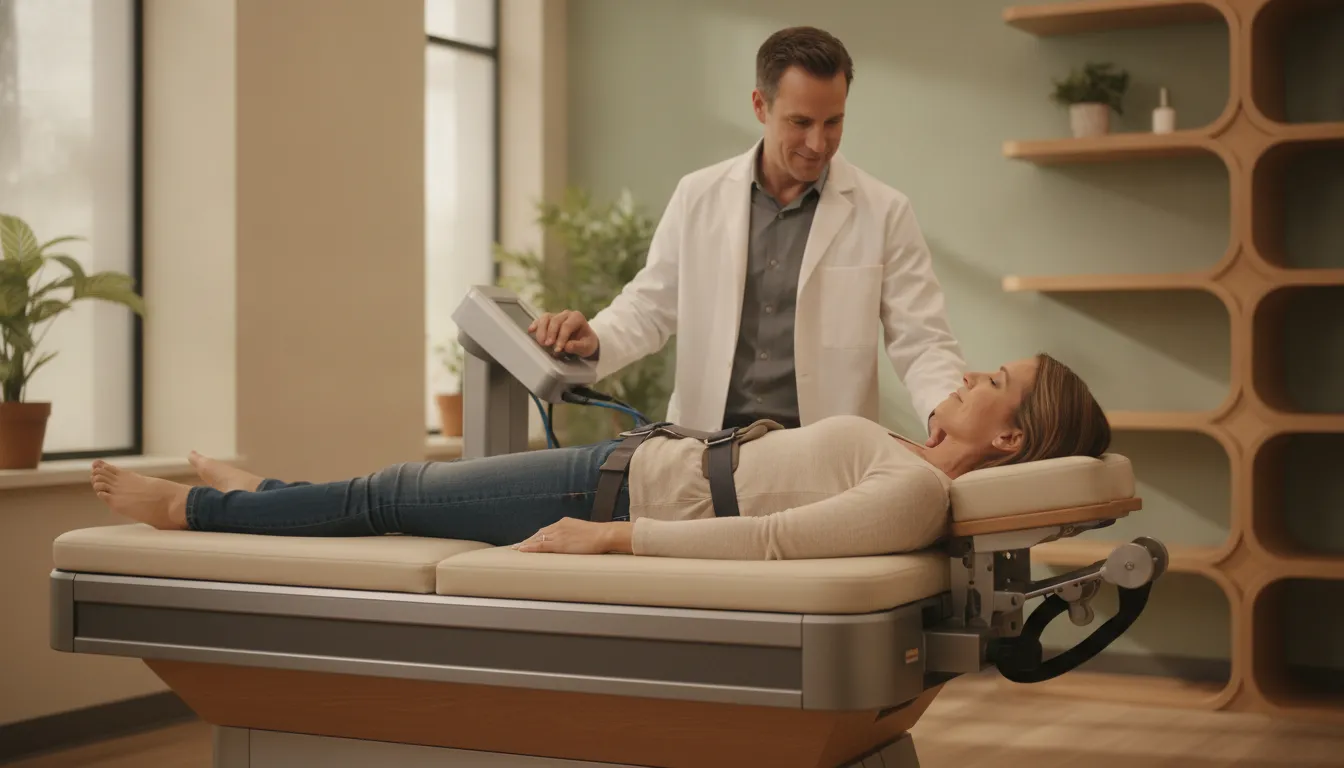
For a plain-language overview of the equipment and treatment process, see how the DRX9000 works. You can also review DRX Chicago’s clinical results information for context about reported outcomes. The key question is not whether decompression is universally best. It is whether a careful evaluation supports it for your specific anatomy, symptoms, and health history.
How Many Sessions Might Sciatica Treatment Take, and When Could Relief Begin?
Answer capsule: A typical DRX9000 plan may involve 20 to 28 sessions over 4 to 7 weeks, with each session lasting about 30 to 45 minutes. Relief varies by cause, symptom duration, severity, health, and candidacy. The schedule is a framework, not a promise of a particular result.
At DRX Chicago, the number of visits is a treatment framework, not a promise of a particular result. Progress should be assessed throughout care so the plan can be adjusted when symptoms, function, or clinical findings do not respond as expected.
- Begin with a baseline assessment. Before treatment starts, the clinician reviews the history of your sciatic symptoms and establishes a reference point for pain, numbness, weakness, mobility, and daily activities. This helps distinguish a temporary change in symptoms from meaningful improvement and helps determine whether decompression is a reasonable option.
- Follow the scheduled treatment progression. When a qualified candidate begins care, the usual protocol is 20 to 28 sessions distributed across 4 to 7 weeks. Each visit generally lasts 30 to 45 minutes. Frequency may be graduated over the course of care, rather than remaining identical from the first appointment to the last.
- Track symptoms and function between visits. Clinicians can monitor whether pain travels less far down the leg, whether sitting or walking becomes easier, and whether numbness or weakness changes. These functional details matter because feeling temporary pain relief is not the only measure of progress. Persistent, worsening, or newly concerning symptoms should prompt reassessment rather than simply adding more sessions.
- Allow time for an individual response. Some people notice changes early, while others require more of the treatment course before judging the response. A disc-related problem, nerve irritation, muscle guarding, and other contributing factors can affect timing. The goal is not to force a deadline, but to evaluate whether symptoms and function are moving in a clinically appropriate direction.
- Interpret outcome figures in context. DRX Chicago’s customer-reported clinical context cites 76% to 88% clinical success for qualified candidates and 95% patient satisfaction. It also reports an average pain reduction of 80% and MRI-observed disc-height increases of 1.0 to 1.6 mm. These figures describe reported or observed outcomes in selected populations, not guaranteed results for every person seeking sciatica treatment.
Because sciatica can have different causes, an evaluation remains important if relief does not begin, symptoms worsen, or neurological changes develop. The appropriate next step may be a revised conservative plan or referral for medical care, depending on the findings.
How Does a Sciatica Evaluation at DRX Chicago Determine Candidacy?
Answer capsule: DRX Chicago evaluates symptoms, medical history, physical and neurological findings, and imaging when appropriate. The team also screens for contraindications before considering decompression. This process helps identify the likely source of nerve irritation, safety concerns, and whether non-surgical care is reasonable for your situation.
Your evaluation begins with a conversation about where the pain travels, how long it has been present, and whether you have numbness, weakness, or changes in function. The clinician may also ask what treatments you have already tried and how your symptoms affect walking, work, sleep, and daily activities. This history helps distinguish a disc-related pattern from other causes of leg or back pain.
The physical examination adds information that symptoms alone cannot provide. It may include an assessment of movement, reflexes, strength, sensation, and signs of nerve irritation. Sciatica is primarily diagnosed through patient history and physical examination, so this clinical picture matters even when imaging is not immediately available. When appropriate, the team may review existing imaging or recommend imaging to better understand a suspected disc problem and guide the next step.
What safety factors are reviewed?
Candidacy is not automatic. Dr. Jason Ingham and Dr. Erin Schey review relevant health conditions and treatment history before recommending a plan. Screening includes contraindications such as pregnancy, severe osteoporosis, spinal fractures, tumors, infections, surgical hardware at the treatment level, and ankylosing spondylitis. A finding that rules out decompression does not mean your symptoms should be ignored. It means another form of medical evaluation or care may be more appropriate.
Severe, rapidly worsening, or unusual symptoms require prompt medical attention rather than waiting for a decompression consultation. Red-flag symptoms can signal a condition that needs urgent assessment. The safest approach is to seek medical care when symptoms are severe or accompanied by concerning neurological changes, then share that evaluation with the appropriate providers.
What should you know about insurance and payment?
Most health insurance plans do not cover the decompression therapy itself. However, a consultation, examination, and some supportive therapies may be covered, depending on your plan and benefits. Coverage should be confirmed with your insurer before treatment. CareCredit may also be an option for eligible patients who want to review financing choices.
For more detail, review these spinal decompression candidacy and insurance questions and the guide to spinal decompression safety and side effects. Patients in Lakeview, Lincoln Park, and throughout greater Chicago can use that information to prepare for a discussion. But only an individualized evaluation can determine whether this approach fits their needs. No treatment can guarantee a particular outcome.
Schedule a free consultation with DRX Chicago before choosing a sciatica treatment plan.
Frequently Asked Questions
What is the best treatment for sciatica in Chicago?
The best option depends on what is irritating the sciatic nerve and how severe or persistent your symptoms are. Conservative care may include activity changes, physical therapy, chiropractic care, or medication through a medical provider. If symptoms continue, an evaluation can help determine whether supervised non-surgical spinal decompression or another approach is appropriate. Mayo Clinic notes that treatment depends on the cause and severity of sciatica.
Can chiropractic care help with sciatica pain?
Chiropractic care may help some people by addressing contributing spinal or movement problems and supporting mobility. Your response depends on the underlying cause, so care should follow a clinical history and examination rather than assume every case is the same. Severe, worsening, or unusual symptoms may require evaluation by a medical provider.
Is non-surgical spinal decompression effective for sciatica?
Non-surgical spinal decompression may help qualified candidates when disc-related changes contribute to nerve pressure. DRX Chicago uses computer-controlled decompression as part of a supervised care plan, but it is not guaranteed to work for everyone. Candidacy is determined after reviewing your symptoms, health history, examination findings, and any appropriate imaging.
How long does sciatica treatment take to show results?
Timing varies because sciatica can have different causes and each person responds differently. Some people notice changes during a course of care, while others need more evaluation or a different treatment plan. A typical DRX9000 protocol may involve 20 to 28 sessions over 4 to 7 weeks, with progress reviewed throughout the course.
Do I need surgery for sciatic nerve pain?
Not necessarily. Many people improve with non-surgical care, but surgery can be medically appropriate when symptoms are severe, persistent, or linked to a condition that requires surgical treatment. Seek urgent medical attention for new bowel or bladder problems, saddle numbness, or significant leg weakness rather than delaying care for a routine treatment consultation.
Ready to Discuss Your Sciatica Treatment Options?
Understanding the possible source of your symptoms is an important first step. A consultation gives you an opportunity to discuss your sciatica, learn about evaluation and candidacy, and decide whether the DRX Chicago pathway fits your needs.