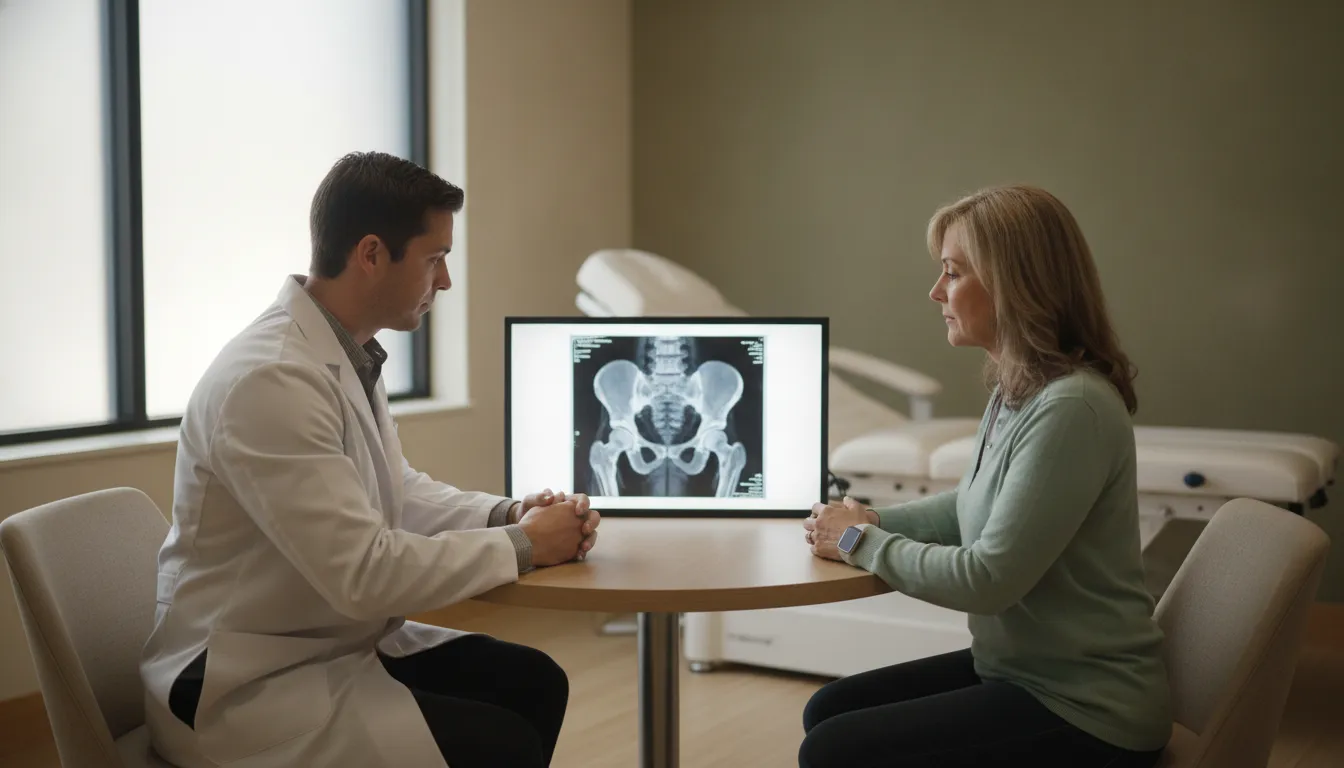
Most back pain does not start with a scan. The useful first step is a short list of imaging back pain care questions: what each test can and cannot show, which symptoms make imaging urgent, and which records a clinician actually needs. A picture of a disc is not the same thing as a plan.
Call (773) 868-0347 to schedule a free consultation and review any imaging you already have.
DRX Chicago is a Lakeview clinic, at 2828 N. Clark Street, that evaluates back and neck pain before recommending care. The team looks at symptoms, history, the exam, and scans that already exist. If you want the wider map of disc, sciatica, and stenosis problems considered for non-surgical care, start with the spinal conditions page. The FDA-cleared DRX9000 is one possible next step for some disc-related problems. It is not offered because a report mentions a bulge, and it is not the right fit for every patient.
What Should Imaging Back Pain Care Questions Cover First?
Start with three questions: what problem are we trying to rule out, will the result change the next step, and do I already have a recent scan that answers it? Those three keep an X-ray, CT, or MRI tied to a decision instead of a worry.
Bring that list to any visit, including one at DRX Chicago. Ask what symptom or finding would make imaging urgent this week. Ask which test fits that question, whether X-ray, CT, or MRI. Ask what you will do differently if the scan is normal, and what you will do if it only shows a common age-related change. Ask whether an older scan can be compared, how recent it is, and who will explain the report in plain language.
The American College of Physicians has advised that routine X-ray, CT, or MRI for low back pain does not improve health for patients who are not in a higher-risk group. Imaging is more useful when there are severe or progressive nerve problems, a suspected serious condition, or a plan that depends on the pictures. The AAFP review of acute low back pain makes the same point: aside from recent trauma, most people with new uncomplicated pain do not need imaging unless the history shows a red flag.
A normal scan can still leave you in pain, because muscle strain, joint irritation, and early disc injury do not always show up clearly. An abnormal scan can also describe changes that are common in people who feel fine. The question is whether the finding matches how you move, where pain travels, and what the exam shows.
What Does Each Scan Show, and What Does It Miss?
X-ray shows bone. CT shows bone in more detail. MRI shows discs, nerves, and soft tissue. None of them measures how much pain you feel.
| Question | X-ray | CT | MRI |
|---|---|---|---|
| Best at | Bone alignment and fractures. | Bone detail and hardware. | Discs, nerves, and canal. |
| Often misses | Disc herniation. | Fine nerve detail. | How much it hurts. |
| Practical limit | Weak for routine pain. | More radiation. Needs a reason. | Some metal blocks it. |
Plain films are not a routine first test for low back pain, with an exception for trauma, including lower-velocity trauma in someone at risk for an osteoporotic fracture. When red-flag findings call for imaging, MRI is the preferred method, and CT is the next choice if MRI cannot be done. The same AAFP review of acute low back pain is the source for that split.
Ask which finding would matter. A report that says “degenerative disc” or “mild bulge” is common with age. It does not, by itself, prove that the disc is the cause of today’s pain. The AAOS overview of low back pain notes that degenerative changes can begin in the 30s and still leave many people active and comfortable.
If you already have an MRI and want to know what before-and-after disc measurements can and cannot prove, read what MRI scans show around DRX9000 care. That page covers scan comparison after treatment. It is a different question from whether you need a new scan before you choose a provider.
When Is Imaging Urgent, and When Can It Wait?
Imaging is urgent when the history points to danger, not when pain is simply severe. Severe pain is a reason to be examined. It is not, by itself, a reason to order every test on the menu.
Ask for same-day medical care, and expect imaging to be part of that visit, if bladder or bowel control changes or numbness shows up in the saddle area. Go the same day if leg weakness is getting worse or a foot starts to drag. Fever with back pain, or pain plus unexplained weight loss, also belongs in urgent care. So does back pain after a significant fall, crash, or other trauma. A history of cancer, intravenous drug use, or weak bone makes new or changing pain more urgent. Pain that wakes you and keeps intensifying, without a clear mechanical cause, should not wait on a routine appointment.
Those patterns are the sort of red flags the AAFP review says need prompt evaluation, imaging, and often specialty input. Do not wait on a chiropractic appointment to sort them out. Go to urgent or emergency care first.
Outside those patterns, time is useful information. Acute low back pain means pain lasting up to about four weeks. Many nonspecific cases settle with staying as active as you can and simple measures such as heat, without a scan. The same AAFP review suggests considering imaging and lab work when pain is still there beyond about eight weeks despite appropriate care. That is a prompt to reassess, not a deadline that forces an MRI.
Repeat imaging is its own question. ACP’s advice is to repeat a scan because symptoms are new or clearly changing, not because a calendar page turned. If your pain feels the same and an older MRI already shows the level in question, ask whether a new scan would change anything.
Which Questions Should You Ask Before You Schedule the Test?
Ask who is ordering the test, why that test, and what decision it will change. A useful order has a clinical question attached to it.
Walk through these steps before you book.
- Name the single question.
- Ask why not a simpler test.
- Ask if contrast is needed.
- Report metal, pregnancy, or kidney issues.
- Ask who reviews the report.
- Ask the next step either way.
Tell the imaging center about implants before the appointment. Ask when the report will be ready. A normal scan and an abnormal scan should each have a next step, or the test is not ready to order.
Write the answers down. Reports are dense, and the impression line at the end is the part to review with a clinician, not a sentence to treat as a diagnosis on its own. Ask which findings match your symptoms and which ones are incidental. Incidental means the picture shows it, and it may not be the thing that hurts.
Also ask about duplicates. If a hospital or another clinic imaged the same region in the last few months, bring the disc or the portal login. A second MRI of an unchanged problem rarely adds a new decision, and it can delay the evaluation you actually need.
DRX Chicago does not sell imaging packages and does not read a scan in place of an exam. At a consultation, the team can tell you whether existing films are enough to discuss candidacy, or whether a specific missing view would change that discussion. The visit itself does not guarantee that decompression will be recommended.
How Should You Read a Report Without Scaring Yourself?
Match the words on the report to the body part that hurts, the side, and what the exam found. A finding at a level that does not fit your symptoms is a question, not a verdict.
These phrases show up often, and they are easy to over-read. Degenerative disc disease means age-related wear. It can be painless, and it is not a verdict that you need a procedure. A bulge is a broad extension of the disc, while a herniation is more focal. Either one matters most when it lines up with nerve symptoms such as sciatica. Stenosis means narrowing around the cord or a nerve. Mild narrowing on a scan can still leave you walking fine, while worsening leg weakness is a different story. If the report says nerve contact or impingement, ask whether that root matches the location of your pain. Unremarkable, or no acute finding, means the scan did not show a dangerous structural cause. Your pain can still be real.
Bring the report to someone who will put it next to the exam. At DRX Chicago, that review is part of candidacy screening for non-surgical decompression. Disc findings are considered with how you walk, your strength, your reflexes, and your health history. A scan that shows a tumor, fracture, infection, or hardware at the level in question is a reason to pause, not a reason to start a decompression plan. Those limits are spelled out on the DRX9000 contraindications page.
If leg pain is the main problem and you want the condition explained before you talk about scans, the sciatica care page is the place for that. This article stays on the imaging questions, not on a full sciatica treatment plan.
What Should You Bring to a Chicago Back Pain Evaluation?
Bring the pictures, the reports, a short symptom timeline, and a list of what you have already tried. The disc is more useful than a verbal summary of what someone told you the MRI said.
A practical packet for a DRX Chicago visit starts with the MRI or X-ray report, plus the disc or image-sharing link. Include the date, body region, and where the study was done. Note when the pain started, what makes it worse, and whether it travels past the knee or into the arm. Mention weakness, numbness, or any change in bladder or bowel control. List prior chiropractic visits, physical therapy, injections, or surgery, along with your medicines and whether you are pregnant or might be. Write down the questions you still want answered after reading the report.
The clinic is in Lakeview, with patients also coming from Lincoln Park and the rest of Chicago. Hours run Monday through Thursday in a morning block and an evening block, Friday morning, and Saturday morning. You do not need a completed MRI to start the conversation. If you have one, it gets reviewed. If you do not, the exam still tells the team whether imaging should come before any talk of the DRX9000.
The DRX9000 is FDA-cleared, not described as FDA-approved, for spinal decompression in selected patients with serious low back pain. Clearance is not a promise that a scan finding will improve. Published clinic outcomes, including 76 to 88 percent success in qualified candidates, apply only after that screening. They are not a forecast for someone who has not been examined.
For how a first visit is structured, see what happens at a free spinal decompression consultation.
How Do Imaging Results Change the Care Conversation?
A useful scan narrows the next step. It does not pick the treatment for you. The care conversation should still start with your goals, your exam, and the risks of doing more.
Ask these questions once the report is in hand. Does this finding explain the pain, or is it a common change you should not chase? Is there a serious problem that needs a different kind of doctor first? If the finding is a disc issue that matches the symptoms, what conservative options exist before surgery? Would spinal decompression even be considered, or does something on this scan rule it out? What would you watch, and when would you repeat imaging?
At DRX Chicago, decompression is discussed only after that screen. Pregnancy, severe osteoporosis, fracture, tumor, infection, surgical hardware at the treatment level, and ankylosing spondylitis are reasons to look elsewhere. A matching disc herniation or bulge, sciatica, or longer-lasting mechanical back pain may be a reason to talk about a plan. The plan is still individualized. A typical course, when someone is a candidate, runs about 20 to 28 sessions over four to seven weeks, with sessions of about 30 to 45 minutes. That schedule is a range from evaluation, not a package you select off a scan.
Surgery is a separate decision, made with a surgeon, when nerve function is failing or when a structural problem will not be managed any other way. Most people asking imaging back pain care questions are not in that group. They need to know whether a picture would help, and what to do with the picture they already have.
If you want a plain comparison of evaluation, safety, time, and provider questions that are not about scans, read how to compare spine care choices. Keep the imaging checklist on this page so the two articles do not answer the same question.
Call (773) 868-0347 if you want DRX Chicago to review your report before you book another scan. You can also take the candidacy survey.
Frequently Asked Questions
Do I need an MRI before I see someone for back pain?
Often, no. If you do not have red-flag symptoms, an exam comes first. Bring an MRI if you already have one. Do not delay a visit only to get a new scan that may not change the plan.
Can an X-ray show a herniated disc?
No. An X-ray shows bone. Disc material and nerve compression are MRI questions. An X-ray can still matter after trauma or when a clinician is worried about fracture or alignment.
What if my MRI sounds worse than I feel?
Ask which lines match your symptoms and which are common wear. Disc bulges and degenerative changes show up in people without pain. The exam decides whether a finding is the one to treat.
Will DRX Chicago order my MRI?
The clinic reviews imaging as part of an evaluation at 2828 N. Clark Street. Whether a new scan is needed depends on your history and exam, not on a blanket rule. Serious red flags belong in emergency care first.
Does a bad MRI mean I need surgery or decompression?
Neither one follows from the report alone. Some findings need a surgeon. Some fit a conversation about non-surgical decompression after screening. Some need time and simpler care. A consultation does not guarantee a recommendation.