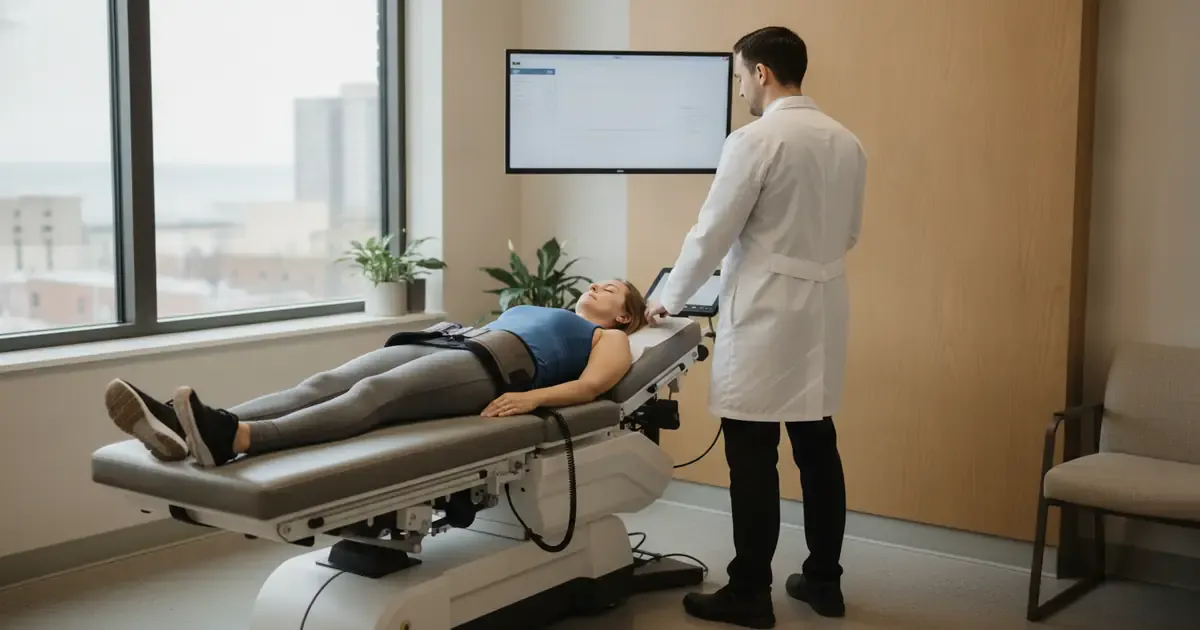
When a spinal disc loses water, it may also lose some of its normal height and cushioning. That is why Chicago patients ask what computer-controlled spinal decompression is meant to do for the disc, and what it cannot promise.
Spinal disc hydration decompression is the idea that controlled unloading and negative pressure inside a disc may encourage fluid to move back in. DRX Chicago uses an FDA-cleared DRX9000 for that goal. More fluid or more disc height is not guaranteed.
Schedule a candidacy evaluation at DRX Chicago.
A session uses a measured, cyclic pull rather than one constant yank. The point is to lower the load on the disc while the tissues respond. The words behind that process matter, because a mechanism is not the same thing as a result.
What does spinal disc hydration decompression mean?
Spinal disc hydration decompression is a plain question dressed in clinical words. Can lowering the pressure inside a disc let fluid move back in? A disc is mostly water, especially in the softer center that sits between the bones and shares the load. Sitting, bending, and lifting squeeze that center all day. When the squeeze eases, fluid can move the other way. That is the whole idea.
It means using controlled unloading to lower pressure inside a disc so water and nutrients have a better chance to move back in. It is a mechanism, not a promise that pain will stop.
Negative intradiscal pressure is the phrase clinicians use for that drop. Intradiscal means inside the disc. Negative means the pressure inside is lower than the pressure around it, closer to a gentle unloading than to more squeezing. In 1994, Ramos and Martin measured that drop at L4-5 in one person on a vertebral axial decompression table. As the pull increased, pressure inside the disc fell below -100 mm Hg. You can read the intradiscal pressure study. It shows a pressure change. It does not show that every disc refills, and it was not a test of the DRX9000.
A disc is not a sponge you can always refill, and water alone does not repair every tear. The shape of the disc, the source of the pain, and the rest of your health still decide whether this is even the right conversation. For the broader definition of the therapy, see what non-surgical spinal decompression is. At DRX Chicago in Lakeview, we use an FDA-cleared DRX9000 only after an exam. Cleared is not the same as approved, and no table is a cure.
How can negative pressure change fluid inside a disc?
The pull is more specific than “stretch the back.” On the DRX9000, the computer changes the force along a logarithmic curve. You are positioned so the muscles are less likely to guard and fight the pull. The aim is a controlled unload, not a sudden tug.
DRX Chicago describes a target negative pressure of about -100 to -200 mm Hg. In theory, that drop lets fluid, nutrients, and oxygen move toward the disc. It does not promise the disc returns to its original shape.
A better-hydrated disc has more room for that exchange and may tolerate sitting and lifting differently. Retraction of a bulge or herniation can be a goal of the same unload. A goal is not a promise that every bulge will pull back in or that leg pain will vanish. Whether the table belongs in your plan depends on the exam, the likely pain source, and anything that would make the pull unsafe.
The 1994 pressure reading is the clearest published number we have, and it has limits. It was one disc, on a VAX-D table, not on a DRX9000, and it did not measure how much water returned. We treat it as support for the pressure idea, not as proof that your MRI will look different. If you want the session itself, see how a DRX9000 session works. If you have been offered an ordinary traction table, why this differs from a traction table explains the mechanical gap. A traction table does not create the same negative pressure inside the disc.
What do studies show about disc height and herniation size?
Clinic numbers and published trials answer different questions. For people who qualified, DRX Chicago’s own tracking describes a 76 to 88 percent clinical success range. The same tracking describes about an 80 percent average drop in pain, MRI disc-height gains of 1.0 to 1.6 mm, and 95 percent patient satisfaction. Those are ranges from qualified candidates. They are not a forecast for the next person through the door. Diagnosis, imaging, health, and how you respond all move the result.
A published 2022 trial found a larger drop in herniation size with decompression than with a no-pull control. It measured herniation size, not milliliters of water, and natural healing still happened in both groups.
Disc height and herniation size are not the same measurement, and neither one is a count of water. In spinal disc hydration decompression, fluid movement is the proposed reason a herniation might look smaller later. It is not proof that every disc drinks back a set amount of fluid. A herniated disc still needs its own exam. Loss of height over years is the story on our page about degenerative disc disease, which is a different article from this one.
Choi and colleagues studied 60 people with a subacute lumbar herniated disc. Everyone was offered 10 sessions over eight weeks. Half received real decompression. Half followed the same setup with no traction force. The herniation index, an imaging measure of the herniated portion, fell about 27.6 percent with decompression and about 7.1 percent in the control group. About 26.9 percent of the decompression group had more than a 50 percent drop in that index. None of the control group did. Leg pain and disability also improved earlier with the real pull. The Choi et al. 2022 study is worth reading for the methods and the limits. Cleveland Clinic’s overview of spinal decompression therapy is a useful plain-language companion, and the device we use is FDA-cleared through the 510(k) pathway, not FDA-approved.
| Measure | Decompression | Control |
|---|---|---|
| Average index change | Down about 27.6%. | Down about 7.1%. |
| Over a 50% drop | About 26.9% of people. | None in that group. |
A smaller herniation on MRI is encouraging. It is not a promise that yours will shrink, or that pain tracks the picture one for one. The control group also improved some, which is why we do not talk as if time itself does nothing. An exam is how we put your images next to your symptoms.
Who should ask about disc hydration, and who should not?
Spinal disc hydration decompression is a fair question when disc-related low back or leg pain has lasted more than a few weeks and basic care has not settled it. Sitting, bending, or lifting that brings the same ache, with or without pain into the buttock or leg, is the pattern we screen for at DRX Chicago. The pattern does not put you on the table. It means the disc is worth a real look.
Ask about it if disc pain has lingered and simple care has not helped. Do not pursue it in pregnancy, with severe osteoporosis, a fracture, a tumor, an infection, ankylosing spondylitis, or hardware at the level we would treat.
We start with history, an exam, and imaging when you have it. An MRI can show a bulge, a herniation, or a disc that has lost height. It cannot say that lowering pressure will refill that disc. At our Lakeview office, 2828 N Clark Street, Dr. Jason Ingham, DC, CCSP, and Dr. Erin Schey, DC, use that picture to decide whether a computer-controlled plan belongs in the conversation at all. The Lakeview and Lincoln Park care path is built around that screen.
If you are comparing this with care you already tried, we walk through four steps before anyone gets on the table.
- We ask what you have already tried, and what changed. That includes physical therapy, chiropractic care, medication, or injections.
- We match the exam to the MRI, when you have one, so we are not treating a picture that does not match the pain.
- We screen for reasons decompression would be the wrong tool, then we say so out loud.
- Only then do we talk about a session length, a visit range, and what better would look like for you in the next few weeks.
That order matters. A dry disc on a report is not a treatment plan. People come to DRX Chicago from Lakeview, Lincoln Park, and the rest of the North Side because they want that screen before they commit to 4 to 7 weeks of visits. We have used the DRX9000 across more than 14,500 treatments in 25-plus years of practice. Volume is a reason to ask better questions. It is not a reason to skip the screen.
Some findings take decompression off the table. Pregnancy, severe osteoporosis, a spinal fracture, a tumor, an infection, ankylosing spondylitis, and surgical hardware at the level we would treat are reasons to stop and choose another route. That is not the full list. Read who is not a candidate before you plan a week around a protocol that may not fit.
If you do qualify, the shape of care is a range. A session is often 30 to 45 minutes. A program is often 20 to 28 visits over 4 to 7 weeks, tightened or stretched to the disc and to how you respond. How many visits you need is its own question, covered in how many spinal decompression sessions. Most people keep working. That is usual, not a rule.
Cost should be plain before you start. Most insurance does not cover the decompression therapy itself. A consultation, an exam, and supportive care such as chiropractic or rehab may be covered, and CareCredit is one way patients spread a program over time. We put your own numbers on paper at the visit. The plan is not the same for every disc, so an article is the wrong place for a quote.
Frequently asked questions
Can spinal decompression rehydrate a disc?
It might help fluid move back in by lowering pressure inside the disc. DRX Chicago describes a target around -100 to -200 mm Hg with the DRX9000. A 1994 measurement on a different table fell below -100 mm Hg in one disc. That supports the pressure idea. It does not prove your disc will refill or that pain will stop.
Is disc height the same as disc hydration?
No. Height is the space the disc holds between two bones. Hydration is how much fluid is in it. A disc can look a little taller on MRI without anyone measuring the water. Our clinic has reported MRI height gains of 1.0 to 1.6 mm in qualified candidates. That is a range, not a promise for you.
Does a smaller herniation mean the disc drank water back in?
Not necessarily. The 2022 trial found a larger drop in herniation size with real decompression than with no pull. The authors measured the herniated portion, not milliliters of fluid. Natural healing also showed up in the control group, so time is part of the story.
How is this different from lying on a traction table?
A basic traction table pulls in a simpler way and can make the muscles guard. The DRX9000 changes the force on a curve so the pull can reach the disc instead of being fought by the muscles. The comparison lives on our traction-table page. The two are not the same treatment.
Who should skip decompression even if a disc looks dry?
Skip it, and tell us, if you are pregnant, have severe osteoporosis, a spinal fracture, a tumor, an infection, ankylosing spondylitis, or surgical hardware at the level we would treat. A dry-looking disc is not a reason to ignore those limits. We decide after the exam, not from a photo alone.
What is a sensible next step?
If disc pain is still running your week, the useful next step is an evaluation, not a guess about how much water a disc can regain. DRX Chicago can review your history, exam, and imaging at our Lakeview clinic and tell you plainly whether computer-controlled decompression belongs in the plan.
Schedule your candidacy evaluation with DRX Chicago.
You can also call us at (773) 868-0347. We are at 2828 N Clark Street, with the entrance on the lower level off Clark, and the office is open Monday through Friday, 8:30 a.m. to 7 p.m.