If you have persistent back pain in Chicago, you may hear spinal decompression and traction described as though they are the same treatment. They are related approaches, but the way force is applied can be meaningfully different, especially when care is designed around a specific disc level.
The key difference in drx9000 vs traction table treatment is control and targeting. A traditional traction table generally applies a broader longitudinal stretch. While the FDA-cleared DRX9000 uses computer-controlled logarithmic decompression designed to target the affected disc and create negative intradiscal pressure. That makes it a non-surgical option worth evaluating for some patients with herniated or bulging discs, sciatica, or related conditions, but candidacy still requires a clinical assessment. Learn more about DRX9000 spinal decompression.
DRX Chicago has more than 25 years of experience helping Chicago-area patients understand their non-surgical options. To see why the distinction matters, it helps to start with what a conventional traction table actually does and where its limitations may arise.
How Traditional Traction Tables Work and Their Limitations
Traditional traction tables generally use a straightforward mechanical approach: the patient is positioned on the table. A longitudinal pulling force then gently stretches the spine along its length. Depending on the device and clinical protocol, that force may be applied continuously or in repeated cycles. The goal is to reduce compression and create temporary space between spinal structures.
That general stretch can be appropriate for some patients, but it does not automatically equal targeted spinal decompression. Standard traction tables operate on a broad basis and may not consistently create the negative intradiscal pressure associated with advanced decompression methods. Traditional traction may not reliably achieve targeted negative intradiscal pressure, which is an important distinction when comparing treatment technologies.
Why continuous pulling force can be limited
The body may respond to a sustained stretch with a protective muscle-guarding reflex. Muscles surrounding the spine can tighten when they sense a prolonged or uncomfortable pulling force. That response may limit how much force can be comfortably delivered to the intended spinal segment, even when the table is functioning as designed.
Intermittent traction changes the force pattern by alternating tension and release. This can feel more tolerable than one uninterrupted pull, and the release periods may help reduce some guarding. However, cycling the force does not by itself make the traction targeted to a specific disc or guarantee a measurable pressure change inside that disc. The actual effect depends on the equipment, positioning, force settings, and the patient’s condition.
What this means when comparing treatment options
These limitations do not mean traditional traction is useless, nor do they prove that one approach is right for every patient. A randomized trial found that conventional motorized traction and DRX9000-based spinal decompression both improved pain and function in patients with lumbar disc herniation. Without a statistically significant difference between the groups: view the published study. The practical difference is primarily in the intended mechanism and level of control.
For someone researching DRX9000 vs traction table, the key question is whether a general spinal stretch matches the clinical objective. DRX Chicago evaluates candidacy before recommending care, rather than assuming that any traction-based treatment is suitable for every back-pain patient.
What Makes the DRX9000 Mechanically Different
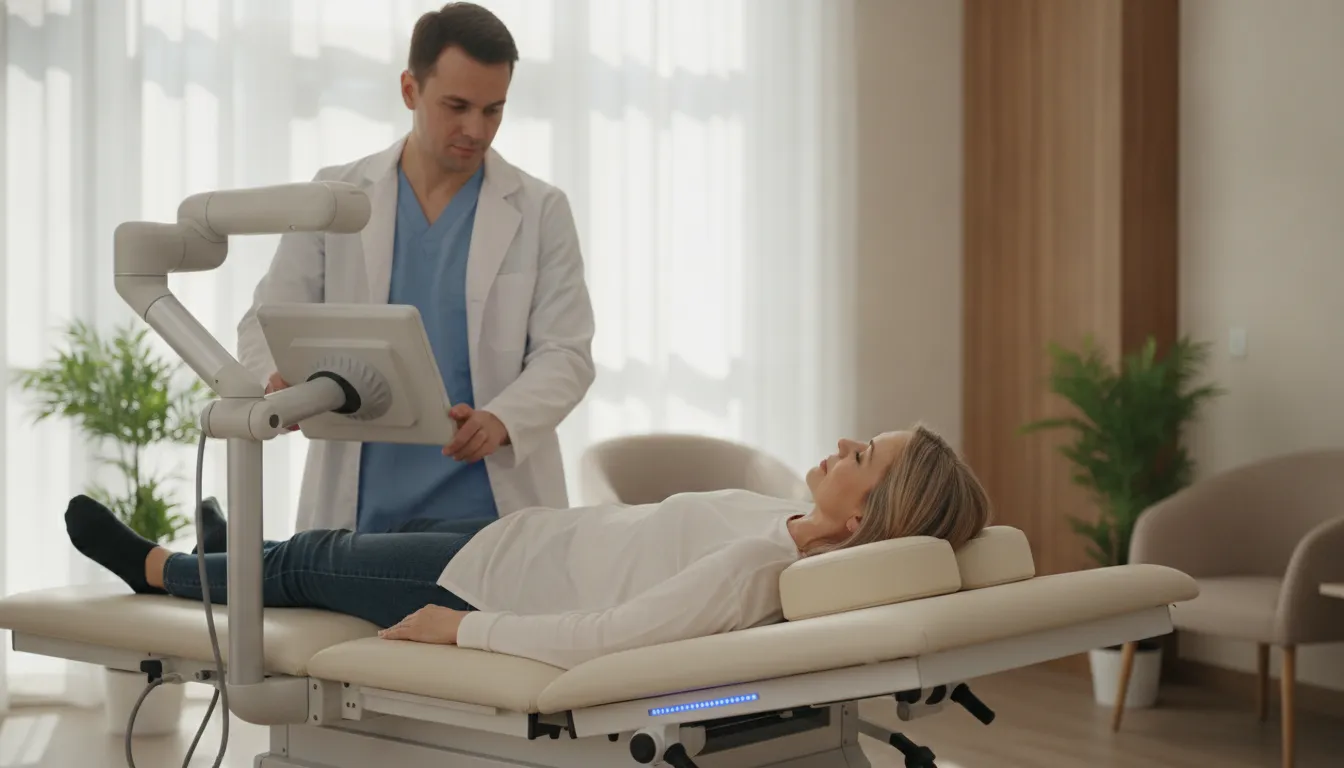
DRX Chicago uses the DRX9000 to deliver a more targeted form of spinal decompression than a basic traction table. The distinction is not simply the name of the equipment. It is how the system applies and modulates force. And whether the treatment is directed toward a specific disc level rather than delivered as a general pull along the spine.
The DRX9000 uses computer-controlled, logarithmic decompression. Instead of applying one continuous stretch, the system varies the force through a programmed curve designed to isolate the affected disc. This controlled pattern can create negative intradiscal pressure as low as -160 mmHg, according to the manufacturer’s clinical description and DRX Chicago’s technology guide. That pressure difference is central to the decompression model because it may encourage fluid movement into a compressed disc and help reduce the mechanical stress associated with bulging or herniated disc material.
In practical terms, the goal is to influence the disc environment, not merely lengthen the surrounding spinal structures. A targeted cycle may be used to create space around a selected level, support disc hydration, and encourage retraction of herniated or bulging material. These are treatment aims, not guarantees. A comprehensive evaluation is still necessary to determine whether a patient is an appropriate candidate and whether the suspected pain generator matches the level being treated.
How does targeted disc-level treatment differ from a general pull?
Many traction tables apply longitudinal force to the spine in a broad, non-specific manner. That approach can have a place in conservative care, but it does not automatically produce the same intradiscal pressure change or level-specific loading pattern. The DRX9000 is designed to use patient positioning and computer-controlled force changes to focus treatment on the identified disc level.
This distinction matters when symptoms are associated with a particular herniated or degenerative disc. If the treatment is only a generalized stretch, the force may not be concentrated where the clinical evaluation indicates it is needed. With decompression, the intended mechanical effect is more specific: reduce compression at the selected level while using a controlled cycle rather than a single sustained tug.
Patients who want a deeper explanation can review how DRX9000 technology works, including the role of negative intradiscal pressure. The system is also FDA-cleared, which distinguishes it from the broad category of non-specific traction devices. Although FDA clearance does not mean the treatment is appropriate for every condition or person.
The clearest way to understand the DRX9000 vs traction table question is to compare the intended mechanism. Traditional traction generally emphasizes spinal stretching. The DRX9000 emphasizes computer-controlled, logarithmic decompression directed at a specific disc level, with the aim of changing pressure within the disc and supporting a more targeted treatment plan.
Why Logarithmic Force Curves Matter for Disc Healing
DRX Chicago uses a computer-controlled force pattern designed to work with the way the body responds to stretching. Instead of applying one constant pull and holding it, the DRX9000 gradually increases force, reaches the prescribed level, and then relaxes it in a controlled cycle. This pattern is called a logarithmic force curve.
The distinction matters because the spine is surrounded by muscles and connective tissues that protect it when they sense a sudden or excessive load. A constant or abrupt pull may trigger those muscles to tighten. That protective response, often called muscle guarding, can make treatment uncomfortable and limit how much force reaches the intended spinal segment. The machine may be pulling, but the body’s resistance can reduce the practical effect at the disc.
A gradual ramp gives the tissues time to adapt as the force builds. The computer-controlled cycle can then vary the load instead of asking the body to tolerate a single unchanging stretch. When the force is reduced, the surrounding muscles have an opportunity to relax before the next cycle begins. The goal is not to overpower the body’s protective response. It is to deliver a measured stimulus that is more comfortable and more focused.
How gradual loading supports a targeted approach
The DRX9000’s decompression protocol is intended to concentrate its effect at a selected disc level rather than create only a general longitudinal stretch through the spine. The logarithmic pattern is part of that larger design. By controlling how force is introduced and released, the system aims to create conditions that support negative intradiscal pressure. DRX Chicago describes pressures reaching approximately -160 mm Hg during the decompression cycle.
That pressure change is relevant because it may encourage fluid movement into a compressed disc and help create space for bulging or herniated material to retract. These are mechanical goals, not promises of a guaranteed result. Disc healing depends on the underlying condition, overall health, candidacy, and adherence to the full treatment plan.
For patients comparing a DRX9000 with a conventional traction table, the force curve helps explain why the two approaches should not automatically be treated as identical. Both involve controlled spinal loading, but the timing, relaxation phases, and intended disc-level effect can differ. A qualified evaluation is still necessary to determine whether this type of non-surgical decompression is appropriate.
Patient Experience Comparison: Traction vs. DRX9000
For many people, the practical question is not simply whether a table stretches the spine. It is what the session feels like, how precisely the treatment is directed, and whether the plan fits the condition being evaluated. Patients who visit DRX Chicago often arrive after trying basic physical therapy, standard chiropractic adjustments, medication, or other conservative care without enough relief. That history makes the difference between a general stretch and a carefully planned decompression approach especially relevant.
The comparison below describes typical treatment design, not a promise about how every patient will respond. Traction can be appropriate in some situations. And a published randomized trial found that both conventional motorized traction and DRX9000-based spinal decompression improved pain and function in people with lumbar disc herniation. Without a statistically significant difference between groups. Read the study summary on PubMed.
| Traction | DRX9000 | |
|---|---|---|
| Force delivery | Often applies a more general longitudinal pulling force. The amount of force delivered to a painful area can be affected by muscle guarding and the patient’s tolerance. | Uses computer-controlled, logarithmic decompression that gradually varies the force. The system is designed to create negative intradiscal pressure as low as -160 mmHg. |
| Disc targeting | May stretch multiple spinal structures at once rather than isolating one specific disc level. | Can be programmed to focus treatment on the evaluated disc level and the patient’s clinical presentation, when the patient is an appropriate candidate. |
| Muscle guarding | A pulling sensation may trigger protective muscle tightening in some patients, which can limit comfort or the force that can be tolerated. | The gradual force curve is intended to reduce the abrupt loading that can contribute to guarding. Comfort still varies, and the clinician adjusts care to the patient’s response. |
| Session protocol | Session frequency and duration depend on the table, provider, diagnosis, and treatment plan. There is no single standard schedule across all traction programs. | A typical plan includes 20 to 28 sessions over 4 to 7 weeks, with each visit lasting about 30 to 45 minutes. Frequency may progress from daily visits to three, then two visits per week. |
| Comfort | Some patients describe a straightforward stretch, while others may find the pulling sensation uncomfortable. Positioning and force tolerance matter. | The treatment is non-invasive and performed while the patient is positioned on the table. The controlled approach is designed for a more comfortable experience, but candidacy and individual tolerance remain important. |
In short, the patient experience depends on more than the table’s name. A proper evaluation considers symptoms, imaging when appropriate, medical history, and contraindications before recommending care. The DRX Chicago team can explain whether targeted decompression is suitable for your situation and what a complete treatment plan would involve.
What the Research Says About DRX9000 vs. Traction Table
When patients compare DRX9000 vs. traction table treatment, the most responsible answer is not that one approach wins every clinical test. The strongest direct comparison identified in the research is a single-blind randomized controlled trial involving patients with lumbar disc herniation. It found that both conventional motorized traction and DRX9000-based non-surgical spinal decompression improved pain and functional status. The researchers reported no statistically significant difference in outcomes between the groups after treatment. Read the published trial on PubMed.
That result matters because it keeps the comparison honest. DRX Chicago should not claim that DRX9000 has been proven superior to conventional traction in head-to-head randomized trials. A comparable result does not mean the treatments are mechanically identical, however. It means that, in this study and patient population, both approaches produced meaningful improvement. The treatment decision still depends on the patient’s diagnosis, examination findings, goals, and response to prior care.
What additional outcomes are reported?
Clinic-reported outcomes provide a broader view of the patient experience, although they should not be confused with results from a controlled trial. DRX Chicago reports 95% patient satisfaction, clinical success rates of 76% to 88% among qualified candidates, and an average pain reduction of 80%. These figures describe reported results within a selected clinical population, not a guarantee for every person with back pain.
Imaging findings can add another perspective. Reported MRI measurements show disc-height increases of approximately 1.0 to 1.6 millimeters in treated patients. Disc height is only one clinical measure, and it does not by itself prove that symptoms will resolve. A complete evaluation is still necessary to determine whether a patient is an appropriate candidate and to screen for conditions that may make decompression unsuitable.
How should patients interpret the evidence?
The evidence supports a measured conclusion: motorized traction can help some people, and DRX9000 has a distinct computer-controlled decompression protocol intended to target an affected disc. The published trial does not establish DRX9000 as universally better. Its potential value lies in the treatment design, the clinical protocol, and the way care is tailored to qualified patients.
Patients who want a wider technology comparison can review how DRX9000 decompression compares to other technologies. A Chicago spine specialist can then connect the research to your imaging, symptoms, and medical history rather than treating a device label as the diagnosis.
Talk to a DRX Chicago specialist about whether non-surgical decompression is right for you.
Frequently Asked Questions
What is the difference between DRX9000 spinal decompression and traditional traction tables?
Traditional traction generally applies a longitudinal stretch to the spine. The DRX9000 uses computer-controlled, logarithmic decompression to target a specific disc and create negative intradiscal pressure, reported as low as -160 mmHg. The two approaches may feel similar to a patient, but their force patterns and intended mechanical effects are different.
Does traditional traction provide the same benefits as the DRX9000?
Not necessarily. Both treatments may help manage back pain and improve function, but the DRX9000 is designed specifically for disc-focused decompression rather than general spinal stretching. Evidence should still be interpreted honestly: one randomized trial found that conventional motorized traction and nonsurgical spinal decompression both improved outcomes, with no statistically significant difference between groups. Read the randomized trial.
How does the DRX9000 create negative intradiscal pressure compared to traction tables?
The DRX9000 gradually ramps and releases force through a computer-controlled logarithmic curve while isolating the targeted spinal level. This approach is intended to reduce the muscle-guarding response that can limit a simple stretch and promote disc-focused decompression. The exact setting depends on your evaluation and treatment plan.
Who may be a candidate for DRX9000 treatment?
It may be considered for some people with herniated or bulging discs, sciatica, degenerative disc disease, or spinal stenosis who want a nonsurgical option. Candidacy is not automatic. A comprehensive evaluation must screen for factors such as pregnancy, severe osteoporosis, fracture, tumor, infection, surgical hardware at the treatment level, or ankylosing spondylitis.
Schedule Your Free Consultation With DRX Chicago
Choosing between a traditional traction table and DRX9000 decompression depends on your symptoms, goals, and clinical evaluation. A consultation can help clarify whether targeted, non-surgical care is appropriate for your condition and answer your questions about the process. To discuss your options, schedule your free consultation with DRX Chicago.