Running with a bulging disc near Chicago’s Lakefront Trail doesn’t automatically mean your training has to stop. Whether it’s safe to hit the trails this week depends on your specific disc and the severity of your spinal condition. Learn how to tell if it’s safe for you to hit the running trails this week.
This guide covers what the research actually shows, exploring how to tell if you’re a candidate to keep training, and when it’s worth exploring options such as non-surgical spinal decompression therapy for runners.
Running with a (Bulging or Herniated) Disc Condition
Here is the good news: a bulging disc is fundamentally different and less severe, than a herniated disc. Because your disc’s outer layer is still fully intact, the standard “stop running” advice is often overly cautious.
A bulging disc means your spinal disc’s outer layer is pushed out of place but remains intact, unlike a herniated disc which has torn and leaked. Because a bulging disc is fundamentally less severe, the blanket medical advice to “stop running” is often overly cautious. Many runners can safely continue training with the right phased approach and clinical evaluation.
Most people assume a herniated disc is the exact same thing as a bulging disc. However, they cause different symptoms and are fundamentally different conditions.
How Bulging Discs Differ From Disc Herniations
To understand the difference, picture a water balloon sitting between two books, with a little weight pressing down on it:
The Bulging Disc: If you squeeze the books together, the balloon bulges out on one side, but it still holds the water in. Nothing is leaking. That’s a bulging disc. Your spinal disc’s outer layer (annulus fibrosus) is still intact, but it’s pushed a bit out of place. In your spine, this means the disc’s tough outer layer (annulus fibrosus) is pushed out of place, but remains fully intact.
The Herniated Disc: A herniated disc goes a step further. In your spine, a herniation means the outer layer has actually torn, allowing the inner gel-like material to leak and press directly against your nearby nerves. This is what causes the sharp, radiating pain or sciatica often associated with severe back injuries.
In our water balloon analogy, the balloon has split open, allowing the inner material to leak and press directly on nearby nerves. This is what causes the sharp, radiating back pain people associate with spinal disc problems.
It’s not a reason to ignore your body, but it is a reason to get a precise answer rather than relying on a one-size-fits-all rule you found online. If this sounds like your current situation, a proper evaluation at DRX Chicago in Lakeview can clarify exactly where your disc stands before you drastically alter your marathon training or Lakefront routines.
Can You Keep Running With a Bulging Disc? Signs to Watch For

Yes, in most cases, if your symptoms match the pattern below. Whether running with a bulging disc is safe for you comes down to what your body is telling you, not just what your MRI says.
You can likely keep running if:
- Your pain stays localized to the low back
- You have no numbness, tingling, or weakness down the leg
- It improves within a day of activity, rather than getting worse
3 Signs you should pull back and get reassessed if:
- Leg symptoms intensify with each run
- Morning stiffness isn’t improving week over week
- Pain lingers well past 24 hours after a run instead of settling down
Neither pattern is a full diagnosis on its own. Leg numbness or radiating pain deserves a closer look regardless of which pattern fits you. That can point to nerve involvement, not just a muscle strain. If that’s part of your symptom picture, it’s worth understanding how pinched nerves and sciatica get evaluated and treated before you resume training near the lakefront.
What the Research Says About Running & Spinal Disc Health
The science here is more encouraging than most runners expect. There’s one important caveat, though.
- A study published in Scientific Reports found that long-distance runners had thicker, better-hydrated lumbar discs than non-runners. The effect was strongest in the part of the disc most linked to herniation.
- Researchers tracking first-time marathoners found something similar. Sixteen weeks of marathon training produced no worsening of existing disc degeneration, even in runners who already had early degenerative changes.
- A more conservative study of middle-aged male runners, published in PLOS ONE, found mixed results. Disc height and shape were better, but hydration wasn’t significantly different.
Now, all of that evidence describes structurally intact lumbar discs.
Once the annulus is compromised, the loading math changes. This can happen as a bulge progresses. Each running stride sends real force through the lumbar spine.
A disc that’s already under strain doesn’t always handle that force the way a healthy one does. That’s the gap between “running is good for discs in general” and “running is fine for my specific disc right now.” Only a clinical evaluation can close that gap.
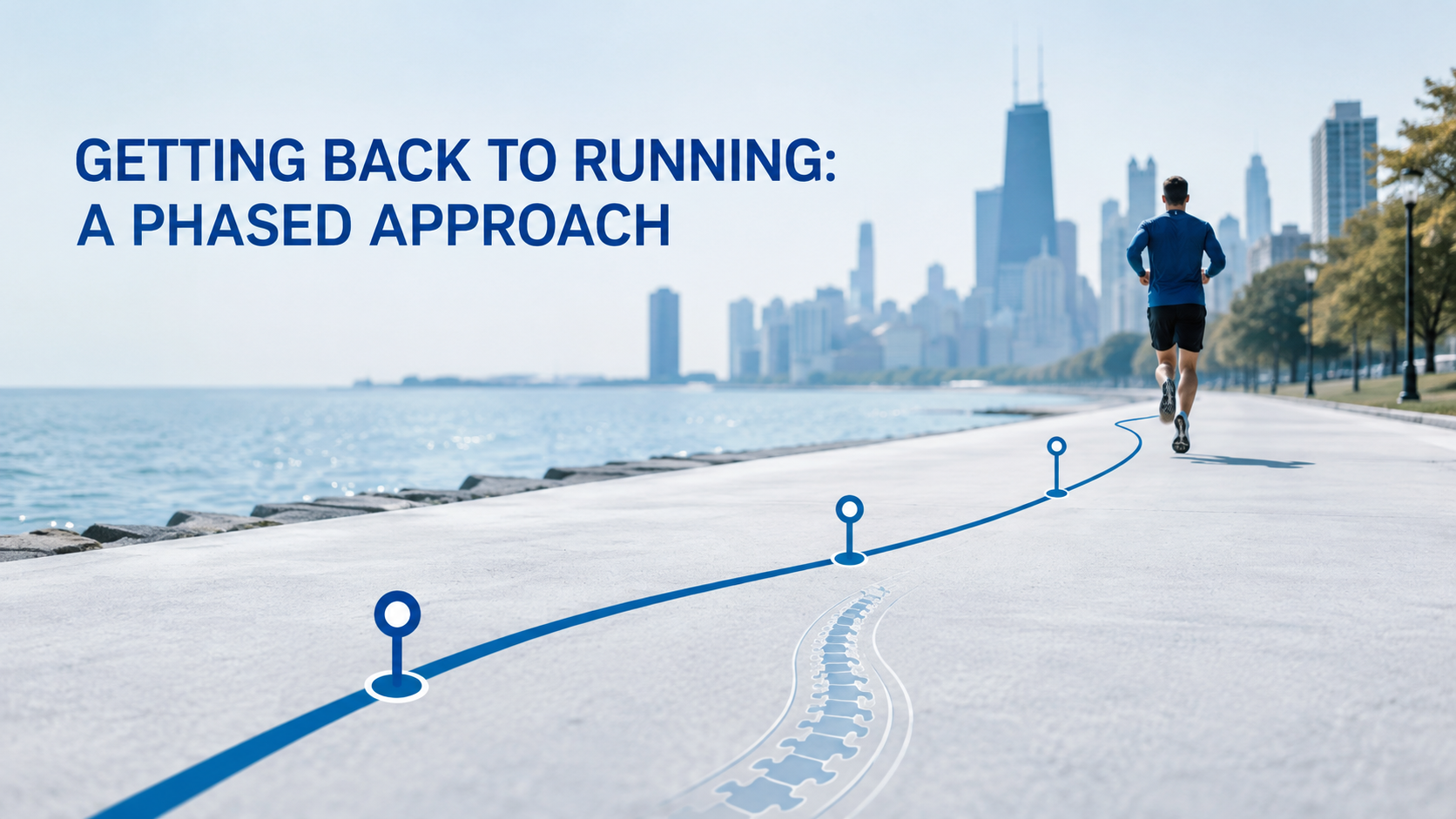
Getting Back to Running With Bulging Disc: Phased Approach
Sports physical therapy research on disc injuries points to a phased approach, which comprises 3 key elements::
- Start with movements that avoid rotation and heavy forward bending
- Progress to controlled rotational loading as symptoms settle
- Return to full training only once the spine tolerates that load without a flare
A practice-based study of 100 athletes with disc herniation found that 79% returned to their sport. The average timeline was about five months into conservative treatment. The strongest predictor of success wasn’t how intense their sport was. It was how severe their symptoms were before treatment started.
If you’re used to logging miles with the Lakeview Run Club or training out of Fleet Feet Lakeview, that timeline can feel discouraging. Patience matters more than pace here. A structured, phased plan tends to get runners back faster than pushing through pain or avoiding activity altogether.
What’s the Best Non-Surgical Treatment to Relieve Bulging & Herniated Discs in Chicago?
Most disc bulges respond to conservative treatment first. That’s genuinely good news.
Chiropractic adjustments and physical therapy are also a reasonable first step for most runners dealing with a mechanical, recent disc issue.
For disc conditions that don’t fully resolve with adjustments and rest alone, non-surgical spinal decompression is worth exploring next. It’s a step to consider before jumping straight to surgery.
A case series published in the Journal of Contemporary Chiropractic found meaningful improvement in both pain and MRI-measured disc height among patients treated with decompression. It’s worth being upfront, though: this was a case series, not a randomized clinical trial. It points toward a promising option, not a guarantee.
Most runners wait longer than they should before getting this evaluated. That’s understandable. Nobody wants to hear “you might need to change your training.” But the earlier a compromised disc gets assessed, the more options tend to stay on the table.
>Find out right now if you’re a candidate for DRX9000 spinal decompression – it only takes 5 minutes to complete.
Common Questions Runners Ask
Will running turn my bulging disc into a herniation?
It’s possible if the disc is already under strain. But running itself isn’t the direct cause the way it’s sometimes portrayed. Progression depends more on the condition of the annulus than on the activity alone. That’s exactly why a proper evaluation matters more than a generic rule.
How long before I can run again?
On average, it can take a couple of weeks before you can start running at a moderate or relaxed pace. For runners who respond well to conservative treatment, a phased return over several weeks to a few months is typical. The severity of symptoms at the start tends to predict that timeline, not the sport itself.
Do I need an MRI before I start running again?
You don’t always need an MRI before you start running again. But if leg symptoms, numbness, or weakness are present, imaging helps clarify whether the disc’s outer layer is still intact. That’s the exact detail that determines how much running load it can currently handle.
Is the DRX9000 Spinal Decompression instead of rest going to get me back faster?
For some runners, yes, particularly when adjustments and rest alone haven’t resolved symptoms. It’s not a universal shortcut. But it’s a reasonable next step worth discussing rather than defaulting straight to surgery.
Find Out More About Your Spinal Health & Wellness
Maybe you’re training for the Chicago Marathon. Maybe you just want easy miles along the lake again.
Either way, running with a bulging disc comes down to your specific disc. It’s not a one-size-fits-all rule.
A consultation at DRX Chicago with Dr. Ingham or Dr. Schey helps determine whether continuing to run, adjusting your training, or exploring non-surgical spinal decompression is the right path for your situation.