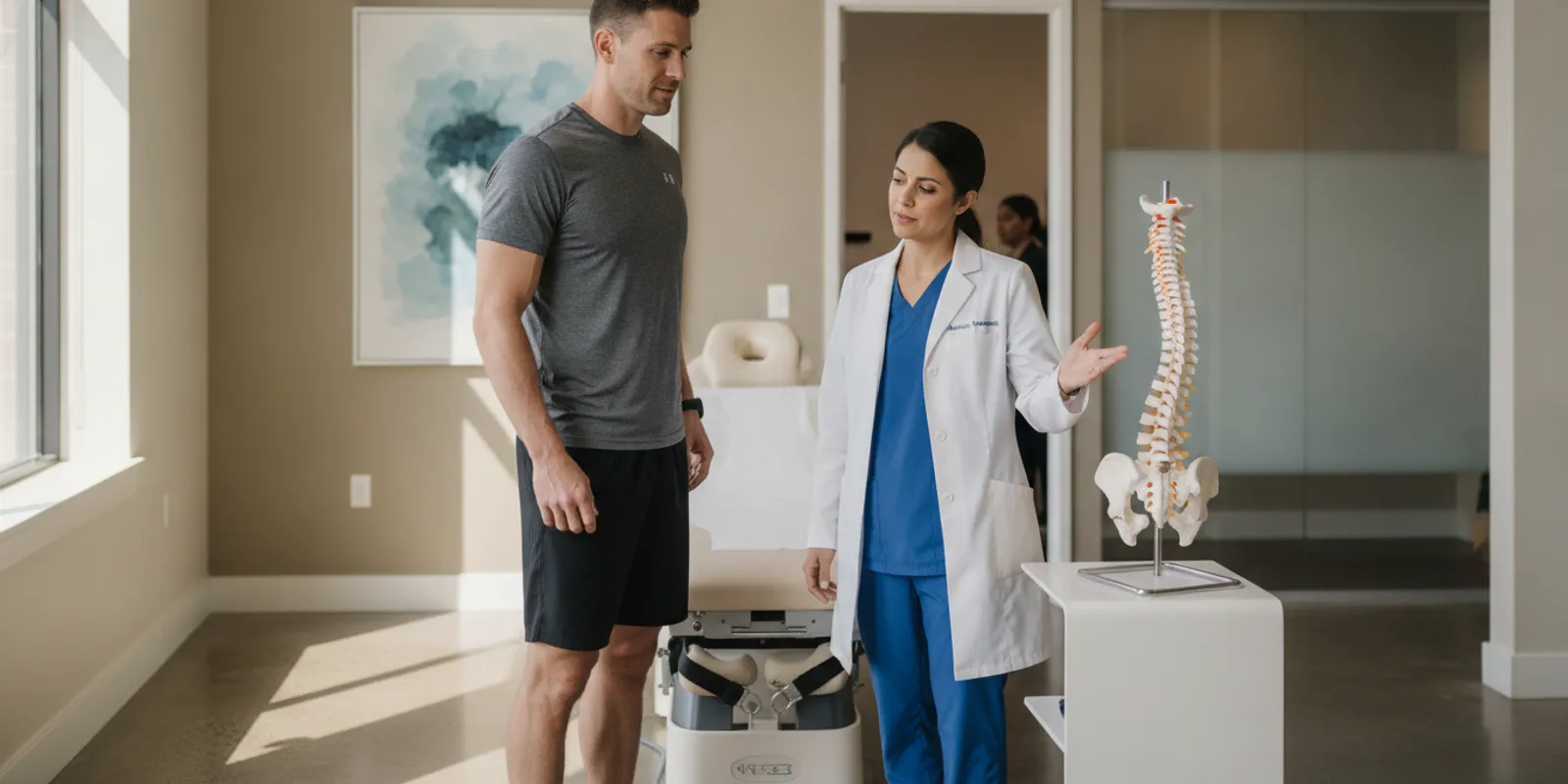
Athletes with persistent back pain, radiating leg symptoms, or a diagnosed disc problem may wonder whether spinal decompression belongs in a recovery plan. Spinal decompression for athletes is a treatment option to discuss when symptoms appear related to spinal discs or nerve irritation; it is not a substitute for diagnosis, progressive rehabilitation, or sport-specific training. At DRX Chicago, candidacy for the FDA-cleared DRX9000 is determined through an individual evaluation.
Schedule your free consultation to discuss your back symptoms and goals.
How does spinal decompression for athletes fit into performance recovery?
For an athlete, recovery is not simply getting through a treatment session. It means understanding what is causing symptoms, choosing care that matches the diagnosis, and building a safe path back to training. Spinal decompression may be considered when an evaluation indicates that a disc-related problem could be contributing to back pain or radiating symptoms. It does not directly build strength, restore sport skills, or guarantee a return to competition.
DRX Chicago uses the DRX9000, a non-invasive spinal decompression system. During treatment, the device applies computer-controlled, graduated pulling forces intended to decompress targeted spinal segments. The clinic describes its mechanism as creating negative intradiscal pressure, which may promote disc hydration and retraction of herniated or bulging disc material. A clinician must determine whether that approach makes sense for an individual athlete; a machine setting cannot establish a diagnosis on its own.
This distinction matters because an athlete’s back symptoms can have several sources. A disc finding on imaging does not automatically explain pain, and a sore back after practice does not prove a disc injury. Muscle, joint, hip, training-load, and other factors can overlap. Start with an assessment rather than trying to match a treatment to a symptom label.
Which athletes might ask about spinal decompression?
Athletes who have persistent back pain or symptoms that travel into a buttock or leg may want to ask a qualified clinician whether a spinal evaluation is appropriate. This can include recreational athletes and competitive participants in sports that involve repeated loading, rotation, impact, or prolonged positions. It is the evaluation—not the sport alone—that determines whether decompression is worth discussing.
DRX Chicago’s information about sports injury care and its guide to herniated discs can help readers understand related topics. Symptoms such as radiating pain, tingling, numbness, or weakness deserve clinical attention, especially if they persist or affect normal movement. A clinician can consider the symptom pattern, medical history, examination findings, and any appropriate imaging together.
Spinal decompression is not a general performance-enhancement service. It is not intended to make a healthy athlete faster, increase lifting capacity, or serve as routine injury prevention. If the main concern is a recent sports injury, sudden pain, or a change in strength or sensation, seek an appropriate assessment before returning to hard training.
Can spinal decompression for athletes prevent an injury?
No treatment can promise that an athlete will avoid future injuries. The phrase “injury prevention” should be understood carefully: spinal decompression may be considered for certain diagnosed back or disc-related symptoms, but it does not replace proven basics such as suitable conditioning, skill work, recovery, and sensible training progression. Nor does choosing decompression mean that an athlete is protected from a new injury.
A useful plan separates three goals:
- Address current symptoms: identify likely causes and choose care suited to the athlete’s health and findings.
- Restore capacity: build mobility, strength, coordination, and tolerance for the movements required by the sport.
- Manage future risk: review training load, technique, rest, and other relevant factors with appropriate professionals.
Decompression, if appropriate, addresses only part of that larger picture. Athletes should not use reduced pain alone as proof that a spine is ready for maximal lifting, contact, sprinting, or repeated competition. Progression back to sport should reflect function and clinical guidance, not a calendar date or a single treatment response.
How is the DRX9000 different from ordinary traction?
Both approaches apply a pulling force, but the treatment method and intended mechanics are not identical. DRX Chicago describes the DRX9000 as using computer-controlled logarithmic decompression to target spinal segments and create negative intradiscal pressure. Conventional traction applies a more general pulling force and does not create that same negative pressure mechanism, according to the clinic’s treatment description. These mechanical differences do not prove that one treatment is right for every person.
| Question | DRX9000 decompression | Conventional traction |
|---|---|---|
| How is force applied? | Computer-controlled, graduated decompression with treatment parameters selected for the individual. | Traction applies pulling force, generally without the DRX9000’s computer-controlled decompression pattern. |
| What mechanism is described? | DRX Chicago describes negative intradiscal pressure intended to promote disc hydration and retraction of disc material. | It does not create the same negative intradiscal pressure mechanism described for DRX9000 treatment. |
| Does the method guarantee results? | No. Suitability and response vary; a clinician first evaluates candidacy. | No. The effect depends on the person, the reason for symptoms, and the treatment approach. |
| What should an athlete ask? | Ask why it may fit the diagnosis, what the plan includes, and how progress and return to sport will be assessed. | Ask what condition the traction is intended to address and how it fits the rest of care. |
For a fuller explanation of the distinctions, see DRX Chicago’s comparison of DRX9000 and traction tables. The most useful choice is not based on a device name alone. It is based on the clinical question, the person’s health, and a realistic plan for recovery.
What happens during an evaluation and treatment plan?
At DRX Chicago, the process starts with a comprehensive evaluation to determine whether a person is an appropriate candidate. The clinician considers symptoms, history, examination findings, and relevant diagnostic information. If the findings do not support decompression—or a different issue needs attention—the treatment should not be assumed to be suitable.
When a person is considered a candidate, the clinic describes a typical treatment program as 20–28 sessions over 4–7 weeks, with sessions lasting about 30–45 minutes. Frequency is graduated, commonly moving from daily sessions to three times weekly and then twice weekly. An athlete’s actual plan and activity guidance should be individualized. These general protocol details are not a promise that every patient will need the same schedule or have the same response.
- Discuss the sport and symptoms. Be ready to explain when pain began, where it travels, which movements provoke it, and what training has changed.
- Review the clinical findings. Ask how the assessment relates symptoms to a possible disc or nerve issue and whether additional evaluation is appropriate.
- Confirm candidacy and the plan. Understand the intended goal, schedule, possible limitations, and how progress will be reviewed.
- Coordinate activity carefully. Clarify what activity is reasonable during care and how to progress back to sport without treating symptom relief as automatic clearance.
Learn more about how DRX9000 spinal decompression works, and review the clinic’s information on who may be a candidate. Athletes can also read about the time involved in a treatment program before deciding what questions to bring to an appointment.
For athletes, it can help to describe the problem in sport-specific terms. Note whether symptoms appear during a sprint, a loaded hinge, a golf swing, a long drive, or after practice. Explain how long the symptom lasts and whether it changes with rest or particular movements. These details do not diagnose the cause, but they give the clinician a clearer starting point than simply saying that your back hurts.
Also bring a concise record of previous evaluation and care, including relevant imaging reports if available, medication or treatment history, and any known restrictions. Tell the clinician about upcoming competitions and the demands of your position or sport. That context can support a realistic discussion of timing, but an event date should not determine whether a treatment is safe or appropriate.
What safety and candidacy questions should athletes ask?
Spinal decompression is not appropriate for everyone. DRX Chicago lists pregnancy, severe osteoporosis, spinal fractures, tumors, infections, surgical hardware at the treatment level, and ankylosing spondylitis among contraindications that require screening. The full medical history matters, and clinicians may identify other reasons to avoid or modify treatment.
Before beginning, ask direct questions: What findings support this option for me? Are there reasons I should not receive it? What symptoms would mean I should stop and contact the clinic? How will the plan account for my sport and current training? What other care or rehabilitation may be needed? The clinic’s page on DRX9000 contraindications offers additional context, but it cannot replace an individual medical review.
Seek urgent medical care for serious warning signs such as new or rapidly worsening weakness, loss of bowel or bladder control, or numbness in the groin or saddle area. Severe symptoms after a collision or fall also warrant prompt assessment. Do not delay urgent care in order to arrange a routine decompression consultation.
How should athletes think about recovery beyond treatment?
Recovery generally involves more than a single modality. Depending on the cause of symptoms, a plan may involve appropriate movement, rehabilitation exercises, adjustments to training, sleep, nutrition, and follow-up with clinicians. A systematic review discussing nutrition and injury prevention and recovery notes the roles researchers have considered for nutrients and dietary patterns; it does not establish spinal decompression as an athletic performance or injury-prevention intervention. Read the review on nutritional considerations for injury prevention and recovery.
Keep goals concrete and measurable with your care team. Examples include tolerating a specific range of motion, completing daily activities more comfortably, or gradually returning to a defined training task. The right measures depend on the individual and should be selected with a qualified clinician. Do not use a general success statistic as a prediction of your own result.
A useful check-in is to compare your current function with your starting point. Are you able to sit through a commute, bend, walk, or complete a light practice drill with fewer limitations? Are symptoms stable later that day and the next morning? Share both improvements and setbacks rather than reporting only your best day. This can help the care team decide whether the plan is meeting its stated goals or needs reassessment.
Return to sport is a separate decision from completing a decompression session or treatment series. Depending on the injury and sport, an athlete may need a gradual progression from daily activity to basic movement, controlled sport drills, full practice, and competition. The steps and criteria should be individualized; persistent or worsening symptoms are a reason to pause and seek guidance, not to push through a preset timeline.
DRX Chicago reports 25+ years in practice and more than 14,500 DRX9000 treatments performed. The clinic also reports clinical success rates of 76–88% for qualified candidates, 95% patient satisfaction, and an average pain reduction of 80%. These are clinic-reported figures, not guarantees, and an athlete’s individual outcome may differ. A careful evaluation remains essential.
What should athletes know about cost and insurance?
Most insurance does not cover the spinal decompression treatment itself. Consultation, examination, and supportive therapies may have different coverage, so ask the clinic and your insurer to confirm benefits for the specific services involved. Do not assume that a treatment is covered simply because an office accepts insurance for other care.
Exact treatment costs depend on the plan, so contact DRX Chicago directly for current details rather than relying on a general estimate. The clinic notes CareCredit financing as an option. Ask what the proposed program includes, what payment choices are available, and how the plan would change if the evaluation does not support decompression.
To understand the range of conditions the clinic discusses, visit its spinal conditions guide. You can also review the DRX Chicago treatment FAQs and learn about the clinic before deciding whether to request an evaluation.
Contact DRX Chicago to ask whether an evaluation fits your symptoms and athletic goals.
Frequently asked questions about spinal decompression for athletes
Can I keep training during DRX9000 treatment?
Activity guidance depends on your condition, symptoms, and treatment plan. Ask the clinician what training is appropriate and how to progress. Do not assume that you are cleared for full sport because you completed a session or feel less pain.
Does spinal decompression improve athletic performance?
It is not a performance-enhancement treatment. It may be considered for certain people with back or disc-related symptoms after evaluation, but it does not replace strength, conditioning, skill practice, or sport-specific rehabilitation.
Is the DRX9000 FDA approved?
The DRX9000 is FDA cleared, not FDA approved. FDA clearance does not mean that it is appropriate for every athlete or that a particular result is assured.
How do I know if I am a candidate?
A comprehensive evaluation is needed. The clinician reviews your symptoms, medical history, and findings, and screens for contraindications. Contact DRX Chicago to discuss an assessment rather than trying to determine candidacy from a symptom checklist.
For an athlete with persistent back symptoms, the sensible next step is a diagnosis-led conversation about options, safety, and return-to-sport expectations. Spinal decompression may be worth discussing for some people, but an individualized evaluation—not a promise of faster performance or injury prevention—should guide the decision.