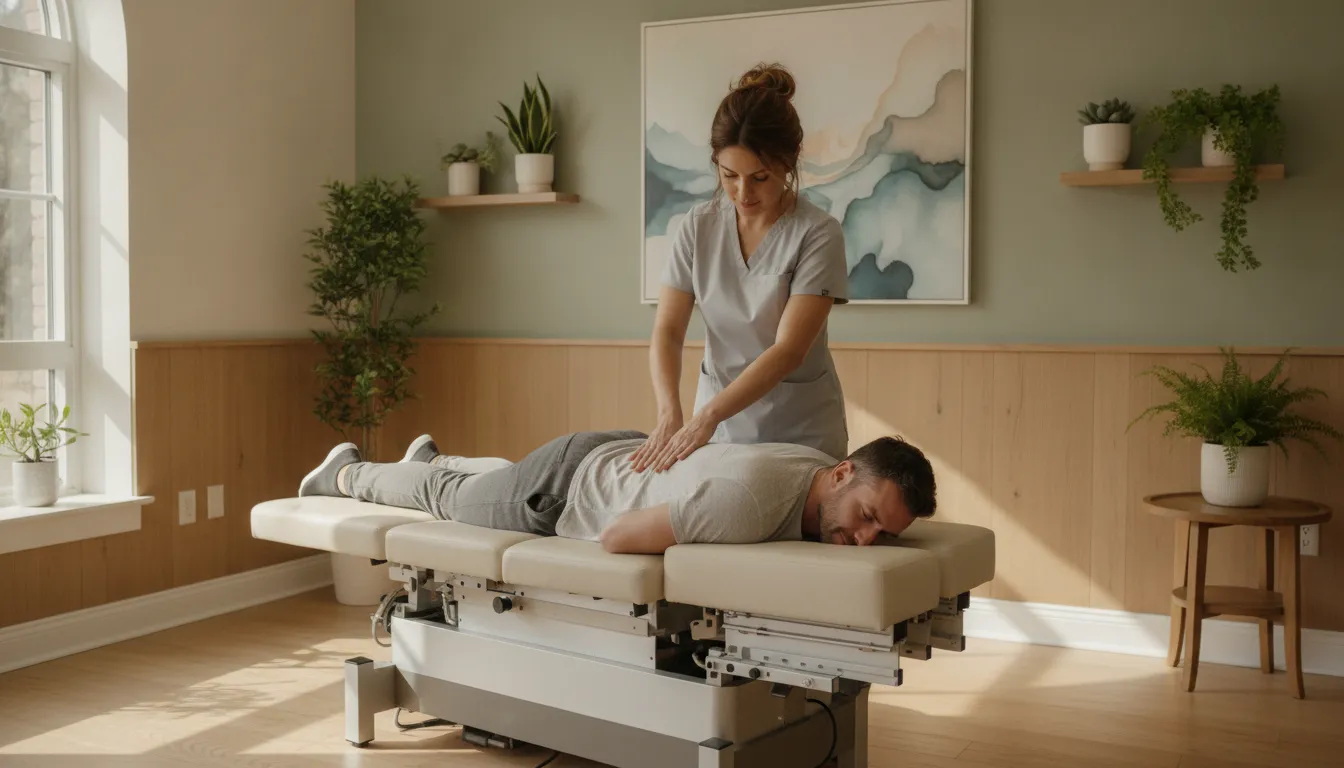
A herniated disc is not simply a piece of tissue pressing on a nerve. Changes in pressure and fluid balance inside the disc can affect its ability to absorb load, maintain height, and support the surrounding spine. That is why understanding the mechanics behind non-surgical decompression matters for patients who want options beyond surgery.
Schedule a free consultation to find out if DRX9000 can help your herniated disc
For a herniated disc, negative intradiscal pressure herniated disc treatment aims to create a lower-pressure environment inside the disc. This may encourage retraction of displaced material and support rehydration. DRX Chicago uses computer-controlled DRX9000 decompression to produce approximately -100 to -200 mm Hg of negative intradiscal pressure. This is a mechanism-based approach, not a guarantee of healing, and candidacy requires a thorough clinical evaluation.
The pressure inside a disc helps determine how it handles compression and movement. Before examining how the DRX9000 changes that pressure, it helps to understand the role normal intradiscal pressure plays in disc health. For a broader overview of the technology, see DRX9000 spinal decompression therapy.
What Is Intradiscal Pressure and Why It Matters for Disc Health
DRX Chicago explains intradiscal pressure as the pressure inside an intervertebral disc, the flexible cushion between two spinal bones. Each disc has a strong outer ring called the annulus fibrosus and a softer, water-rich center called the nucleus pulposus. Together, these structures help maintain space between the vertebrae and distribute force when you walk, bend, lift, or sit.
A healthy disc depends on a workable balance between internal pressure, hydration, and the strength of its surrounding tissues. Water within the nucleus helps the disc resist compression, while the outer ring contains that pressure and helps preserve disc height. When the disc loses hydration or its structure becomes weakened, it may absorb loads less effectively. Changes in pressure can then contribute to disc wear, bulging, or herniation, particularly when combined with age-related degeneration or repeated strain.
How does pressure support the disc’s shock-absorbing role?
Think of the disc as a small hydraulic cushion rather than a solid block. When force travels through the spine, pressure inside the disc helps spread that force across the disc surface instead of concentrating it at one point. This does not make the spine immune to injury, but it gives the disc an important role in protecting nearby vertebrae and allowing controlled movement.
Disc hydration naturally changes throughout the day. Spinal loading can push fluid out of the disc, while periods of reduced loading allow fluid exchange to occur. If a disc remains compressed, dehydrated, or damaged, its internal environment may not support normal height and motion as well as it once did. That is one reason disc-related symptoms can involve both localized back pain and irritation near a spinal nerve.
What does negative intradiscal pressure mean for a herniated disc?
For readers researching negative intradiscal pressure herniated disc treatment, the key concept is controlled pressure reduction inside the disc space. The DRX9000 is designed to create a negative intradiscal pressure environment, typically between -100 and -200 mm Hg, through computer-controlled spinal decompression. This mechanism is intended to reduce compressive loading and support the conditions associated with disc rehydration and the movement of bulging or herniated material away from an irritated area.
Negative pressure is not a guarantee that every disc will heal or that every patient is a candidate. Disc condition, symptoms, imaging findings, and other health factors must be evaluated together. A comprehensive assessment helps determine whether decompression is appropriate and whether another form of medical care is needed.
How Does the DRX9000 Create Negative Pressure in the Disc Space?
DRX Chicago uses the FDA-cleared DRX9000 to apply a controlled decompression force to the targeted spinal segment. The goal is not simply to pull the spine apart. Through computer-controlled logarithmic decompression, the system creates a negative intradiscal pressure environment, typically between -100 and -200 mm Hg. For a herniated disc, this pressure change is the central mechanism that distinguishes decompression from ordinary stretching or traction.
The device can apply up to 200 pounds of distraction force, but treatment is not based on maximum force alone. The system adjusts the loading pattern for the patient’s response and the targeted level of the spine. Bio-feedback monitoring occurs up to 1,000 times per second, helping the treatment remain controlled rather than relying on a fixed, one-size-fits-all pull. This level of monitoring is intended to support a consistent treatment response while accounting for changes in resistance during a session.
Why does the treatment use logarithmic decompression?
Logarithmic decompression gradually increases the distraction force instead of applying it abruptly. That gradual pattern helps the clinician and device manage the mechanical load more precisely. As the targeted disc space is unloaded, pressure inside the disc can fall into the negative range required for the decompression effect. The process is designed to be therapeutic and measured, not a forceful stretch that patients must simply tolerate.
DRX9000 treatment also uses cyclic loading. A typical cycle applies approximately 60 seconds of decompression followed by 30 seconds of relaxation. Repeating these phases creates alternating periods of unloading and recovery, rather than holding the spine under one continuous pull. This pattern is part of how the system delivers computer-guided treatment over a series of controlled cycles.
How is decompression different from standard traction?
Standard motorized traction may lengthen or mobilize the spine, but it does not produce the same negative intradiscal pressure mechanism. That distinction matters because the pressure environment, not spinal movement by itself, is intended to support disc retraction, rehydration, and nutrient diffusion. Research summarized in the clinical literature describes negative pressure as a defining feature of nonsurgical spinal decompression, while conventional traction does not create that pressure inside the disc.
Decompression versus standard traction at a glance
| Feature | DRX9000 spinal decompression | Standard motorized traction |
|---|---|---|
| Creates negative intradiscal pressure | Yes, typically -100 to -200 mm Hg | No |
| Computer-controlled loading | Logarithmic profile with bio-feedback up to 1,000 times/second | Usually a fixed or simple pull |
| Cyclic loading phases | 60 seconds decompression, 30 seconds relaxation | Typically continuous |
| Primary mechanism | Pressure change inside the disc space | Spinal lengthening and stretching |
To see how these components fit together with patient evaluation and treatment planning, review DRX9000 spinal decompression therapy. A negative pressure approach may be appropriate for some qualified patients. But candidacy must be determined through a comprehensive evaluation that considers the diagnosis, symptoms, imaging, and relevant contraindications.
How Does Negative Intradiscal Pressure Retract Herniated Disc Material?
DRX Chicago uses computer-controlled decompression to create a carefully measured pressure change inside the targeted disc. At peak loading, the DRX9000 can produce negative intradiscal pressure of approximately -100 to -200 mm Hg. For a person researching negative intradiscal pressure herniated disc treatment, the important point is how that pressure changes the mechanical environment around displaced disc material.
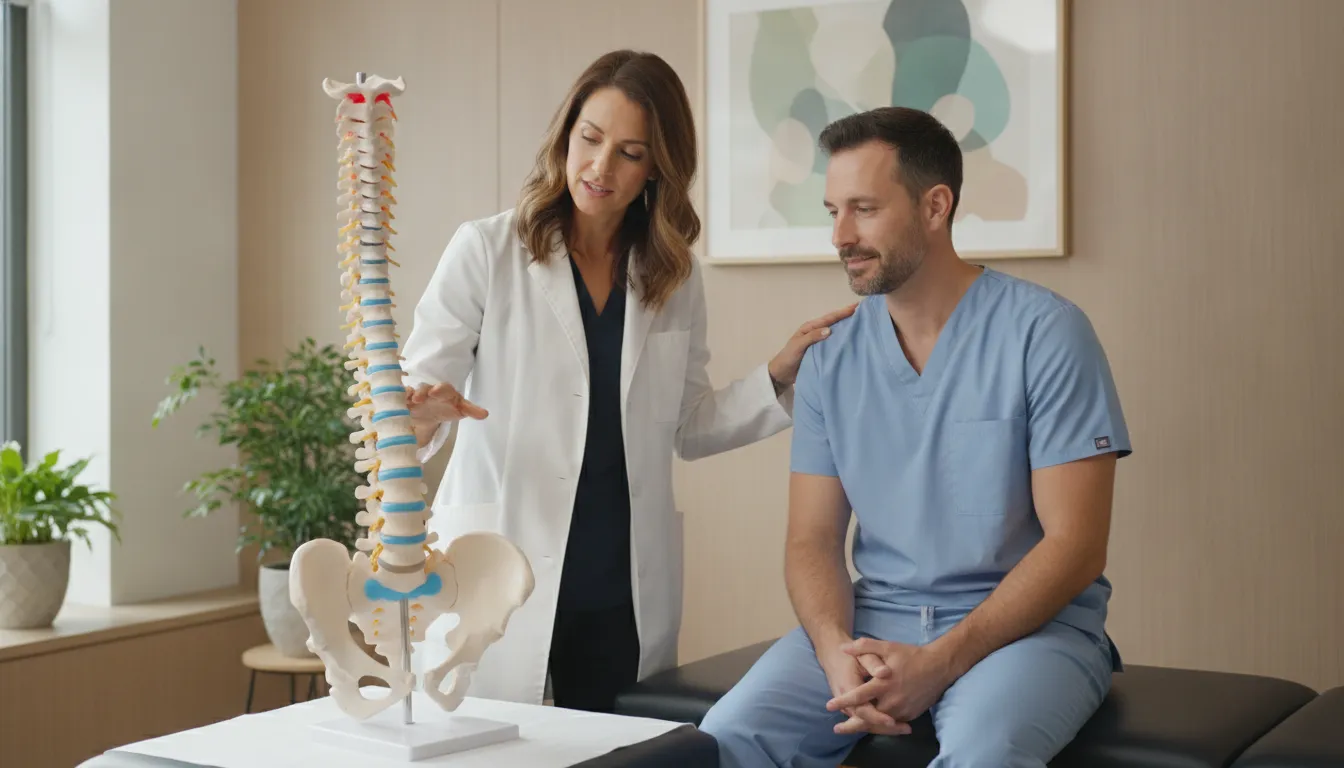
A herniated disc develops when the softer inner material pushes through a weakened or torn portion of the tougher outer ring. If the protruding material occupies space near a spinal nerve, it may contribute to radiating pain, numbness, tingling, or weakness. Decompression does not force every herniation back into place, and it is not appropriate for every patient. However, reducing pressure within the disc can create conditions that may encourage displaced material to move toward the disc space instead of remaining pushed outward.
How does negative pressure encourage retraction?
The process can be compared to a gentle vacuum, although the disc is a living structure rather than an empty container. During the distraction phase, the vertebral segments are separated in a controlled, gradual pattern. This reduces compressive loading and lowers pressure within the disc. The resulting pressure gradient may gently draw bulging or herniated material back toward the lower-pressure center of the disc, where it can be supported by the surrounding annulus.
This is a mechanical explanation, not a promise of an immediate cure. Disc material may be displaced, inflamed, or chemically irritating even when the visible protrusion is modest. A comprehensive evaluation is necessary to determine whether the symptoms, imaging findings, and physical examination are consistent with decompression treatment. Patients can learn more about evaluation and options for treating herniated disc pain before deciding whether to proceed.
How is decompression different from ordinary traction?
Conventional traction generally applies a pulling force along the spine, but it does not reliably create the same negative intradiscal pressure. That distinction matters because simple lengthening of the spinal column is not identical to changing pressure inside a disc. Published clinical literature describes negative pressure as a distinguishing mechanism of nonsurgical spinal decompression, while standard traction does not produce that same intradiscal environment (review of nonsurgical spinal decompression mechanisms).
Repeated, controlled loading may also give the disc time to respond between cycles. As pressure decreases, fluid movement and disc rehydration may support changes in disc dimensions. Clinical materials used by DRX Chicago report MRI-verified disc height increases of approximately 1.0 to 1.6 millimeters and reductions in disc herniation of up to 77% in appropriate cases. These findings describe observed changes, not guaranteed results for an individual patient.
How Does Negative Pressure Promote Disc Hydration and Nutrient Absorption?
DRX Chicago explains disc rehydration through a basic feature of spinal anatomy: an intervertebral disc does not have a direct blood supply like muscle or skin. Instead, much of its nutrition depends on diffusion through surrounding tissues and the vertebral endplates. When a disc is compressed for long periods, fluid is pushed out and the disc can lose height, reducing its ability to distribute load comfortably.
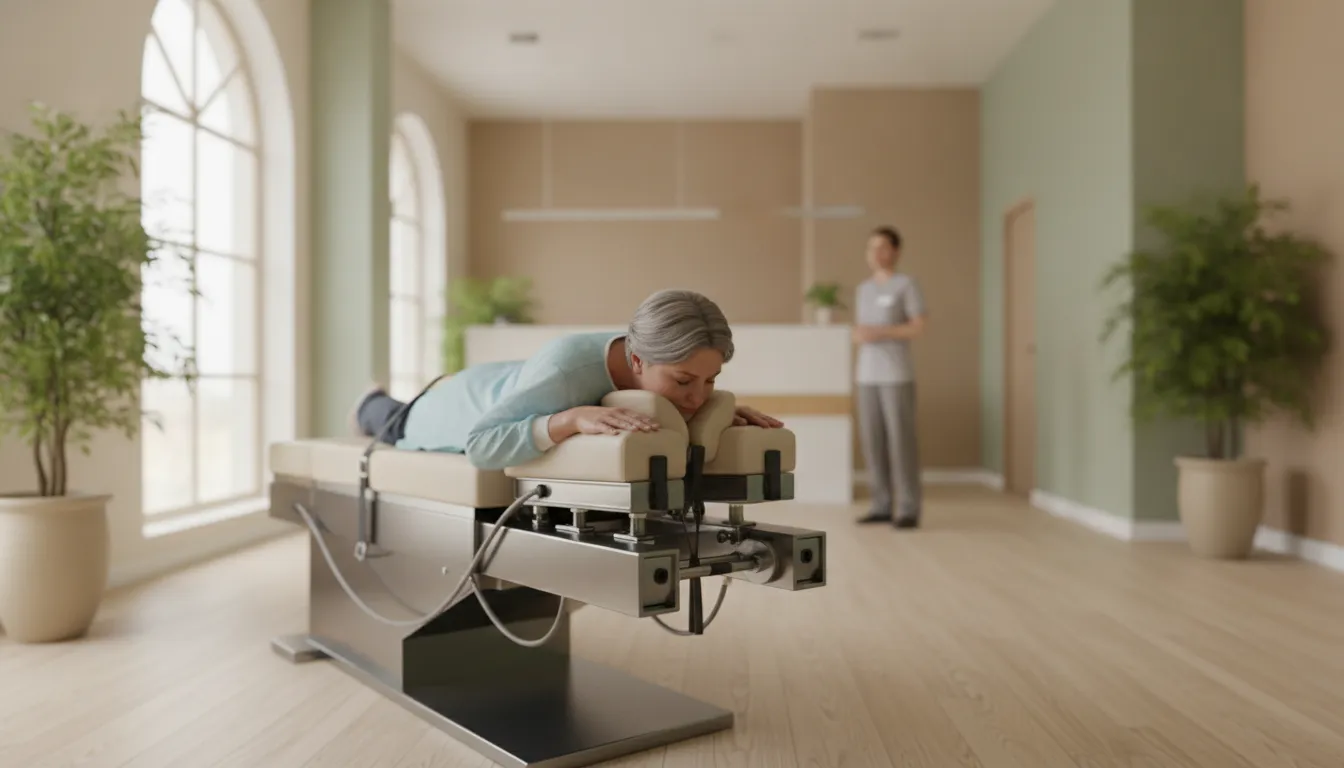
Decompression changes that pressure environment. The DRX9000 applies computer-controlled distraction and relaxation cycles that reduce compression within the treated disc space. This creates negative intradiscal pressure, which encourages fluid to move back toward the disc and supports the diffusion of nutrients and oxygen. The pressure shift is not a guarantee of healing, and it does not make every patient a candidate. But it provides a physiologic explanation for why decompression differs from ordinary traction.
How does diffusion support a disc with no direct blood supply?
Diffusion is the movement of dissolved substances from an area of higher concentration toward an area of lower concentration. In a healthy disc, this process helps deliver nutrients and remove metabolic waste through the tissues around the disc. Movement is slower than it is in highly vascular tissue, so repeated loading and unloading can matter. The alternating phases of decompression may help create conditions in which fluid exchange can occur rather than keeping the disc under constant compression.
For a patient researching negative intradiscal pressure herniated disc treatment, the important point is that the goal is not simply to pull the spine apart. The goal is to create a pressure change inside the disc space. That change can support rehydration while other parts of treatment address movement, muscular support, and the factors contributing to pain.
What can rehydration change mechanically?
As a disc takes on fluid, its internal structure may better support its normal shock-absorbing role. Restored hydration can help the disc maintain or recover some of its height, which may improve how forces are distributed across the spine. DRX Chicago materials report MRI-verified disc height increases of approximately 1.0 to 1.6 millimeters in appropriate cases. Rehydration has also been observed as increased signal on T2-weighted MRI, an imaging pattern associated with greater water content.
These imaging changes should be interpreted alongside symptoms, examination findings, and the underlying condition. A more hydrated disc is not automatically a pain-free disc, and decompression is not appropriate for every cause of back or leg pain. A comprehensive evaluation helps determine whether the findings and symptoms fit a decompression approach. For a deeper explanation of the technology and treatment process, review spinal decompression therapy before discussing candidacy with a qualified provider.
What Evidence Supports Pressure-Based Disc Healing?
DRX Chicago’s approach is grounded in more than a proposed mechanism. Published research has examined both the pressure changes produced during axial decompression and the clinical outcomes that may follow for people with lumbar disc herniation. Taken together, these findings support decompression as a serious non-surgical option, while still recognizing that results depend on diagnosis, candidacy, and the individual patient.
A foundational 1994 Journal of Neurosurgery study on vertebral axial decompression and intradiscal pressure investigated how decompressive loading affects pressure within the disc. This line of research is important because it connects the treatment process to a measurable biological variable. The goal is not simply to pull on the spine. It is to create conditions that may reduce internal disc pressure and support the disc’s ability to respond to controlled unloading.
More recent clinical research has examined whether those mechanical changes correspond with meaningful patient outcomes. In a randomized study of 60 people with subacute lumbar herniated discs, 30 participants received nonsurgical spinal decompression and 30 served as a nondecompression comparison group. The decompression group received ten treatments over eight weeks, allowing researchers to compare pain, disability, and imaging findings rather than relying only on subjective impressions.
The results were notable. At two months, the decompression group had significantly lower leg-pain intensity than the comparison group, with a reported p-value of 0.028. Disability scores were also significantly lower at two and three months, with p-values of 0.023 and 0.019. These findings suggest that the treatment may influence both symptoms and day-to-day function, not just a patient’s perception of pain during a single visit.
Imaging results added another layer of evidence. The herniation index changed by an average of -27.6% in the decompression group, compared with -7.1% in the nondecompression group, a statistically significant difference of p=0.017. Approximately 26.9% of patients receiving decompression showed more than a 50% reduction in the herniation index, while none in the comparison group reached that threshold. The full randomized trial is available through PubMed Central.
These results do not mean every herniated disc will respond in the same way, and they do not establish decompression as a guaranteed cure. They do show why the concept of negative intradiscal pressure herniated disc treatment merits careful clinical discussion. The proposed pressure change has a physiological basis, and controlled studies have reported improvements in pain, disability, and herniation measurements.
DRX Chicago’s reported clinical data for qualified candidates include a 76% to 88% success rate, an average pain reduction of 80%, and 95% patient satisfaction. Those figures should be interpreted alongside a comprehensive evaluation that screens for contraindications and determines whether decompression is appropriate. Among non-surgical decompression options, the DRX9000 has one of the strongest published evidence bases, but responsible care begins with matching the treatment to the right patient.
Talk to the DRX Chicago team about your herniated disc and book a free consultation today
Frequently Asked Questions
How does negative intradiscal pressure help a herniated disc?
It temporarily lowers pressure inside the disc space, which may encourage displaced disc material to move inward and create conditions that support fluid and nutrient exchange. This can reduce mechanical irritation around nearby nerve roots, but response depends on the disc injury, overall health, and individual candidacy.
What pressure does the DRX9000 create during treatment?
The DRX9000 is designed to create a computer-controlled negative intradiscal pressure environment, typically reported at approximately -100 to -200 mm Hg. The treatment uses controlled loading and relaxation rather than a constant pull, with the goal of applying decompression gradually and comfortably. DRX Chicago evaluates whether this approach is appropriate for each patient.
How does negative pressure promote disc rehydration?
Reduced internal pressure can help draw fluid toward the disc and support diffusion of nutrients through surrounding tissues. Rehydration may improve the disc’s ability to handle load, although it is not an instant repair and cannot guarantee that a herniation will resolve. A clinician should interpret MRI findings alongside symptoms and physical examination results.
What is the difference between traction and spinal decompression?
Both approaches apply a distraction force to the spine, but decompression protocols are intended to use computer-controlled, cyclic loading to create negative intradiscal pressure. Standard motorized traction does not produce that same negative-pressure environment, according to a published review of nonsurgical spinal decompression mechanisms (PMC review). The terms are sometimes used interchangeably, so ask which technology and protocol a clinic actually uses.
Ready to Explore Your Options?
A comprehensive evaluation can help determine whether DRX9000 spinal decompression is appropriate for your herniated disc and goals. If you would like to discuss your symptoms and candidacy with the DRX Chicago team, schedule a free consultation to find out if DRX9000 can help your herniated disc.