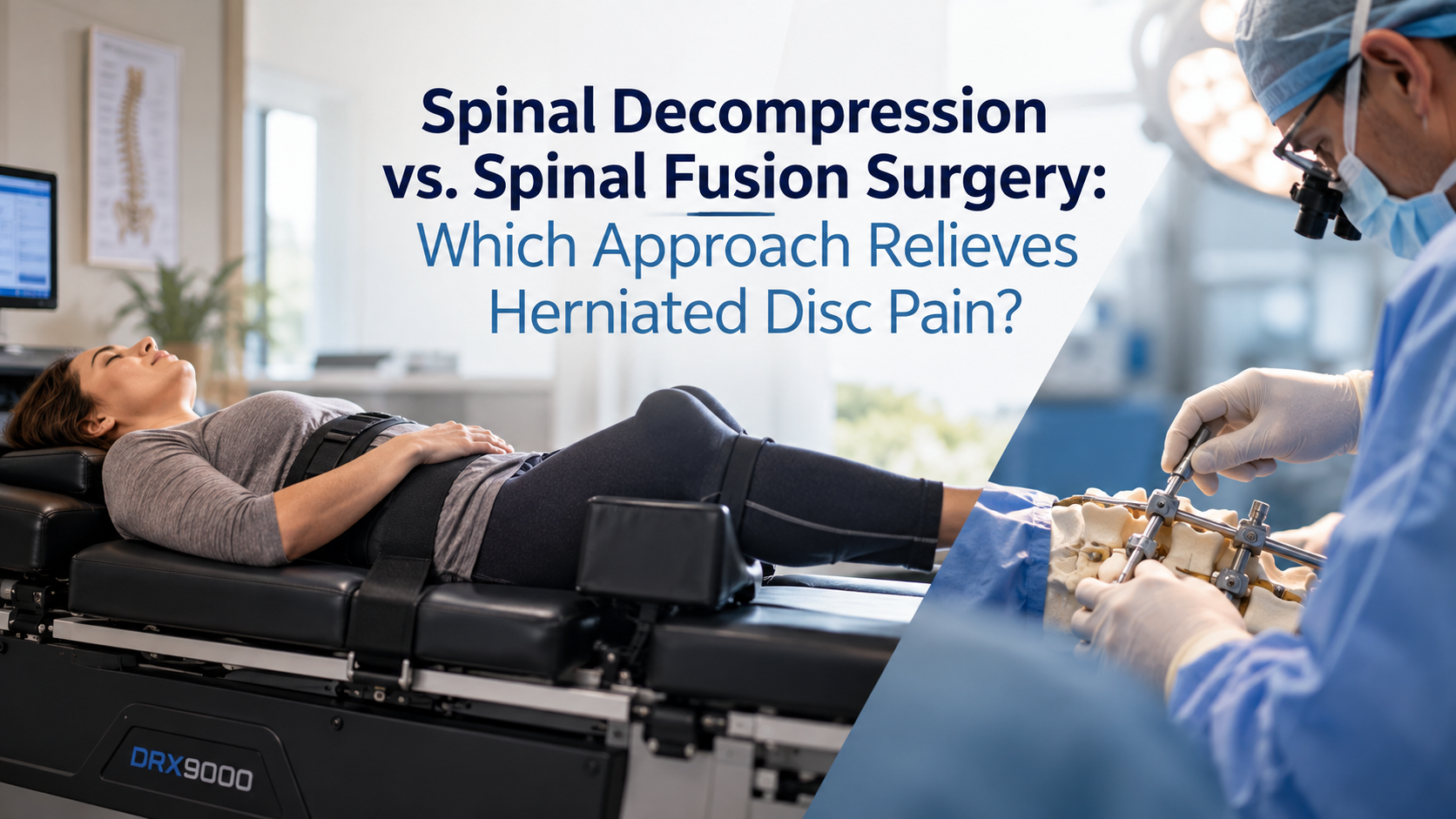
For a herniated disc, spinal decompression vs spinal fusion is rarely a close call. Fusion joins vertebrae together, and it is not the usual surgery for a herniated disc. Most people should try non-surgical care first, including non-surgical spinal decompression, before any surgical operation becomes necessary.
In fact, most cases don’t require a surgical intervention to relieve or fix a herniated disc. Advanced technologies and procedures today, like the DRX9000 spinal decompression can do more than enough for your herniation.
Spinal Decompression vs Spinal Fusion At A Glance
Spinal decompression and spinal fusion do very different jobs, and the word “decompression” covers two of them. Decompression takes pressure off a nerve. Fusion joins two or more vertebrae so they can’t move.
You have three options for dealing with a herniated disc:
| Option | What it does | Where it fits for a herniated disc |
|---|---|---|
| DRX9000 Non-surgical spinal decompression | A motorized table gently stretches the spine in cycles to lower pressure inside the disc | Recommended non-surgical option before surgery |
| Microdiscectomy | A surgeon removes the piece of disc pressing on the nerve | The most common surgery for a single herniated disc, usually considered after non-surgical care has not worked |
| Spinal fusion | A surgeon joins vertebrae so they heal into one solid bone | Rarely needed for a routine herniated disc. Saved for specific cases. |
Note: Spinal fusion is not a stronger version of the other two treatments. It solves a different problem.

Do You Need Spinal Fusion for a Herniated Disc?
Most herniated disc cases do not require spinal fusion surgery. If surgery is the best and only option after trying various methods of non-surgical treatment, the standard surgery is a discectomy, and spine surgeons don’t recommend adding a fusion to it.
A 2014 guideline from neurosurgery groups also say a discectomy remains the surgery of choice. It also says that adding a fusion to a routine discectomy is not recommended. Newer research has also followed through with this data.
Fusion can make sense in some situations, though. Based on limited evidence, the same guideline says it may be an option when a herniated disc comes with:
- Severe wear and tear in the spine
- A disc that herniates again, along with instability or chronic back pain
- Spinal instability, meaning the bones move more than they should
If none of those sound like you, fusion is probably not the right treatment.
Risks of Spinal Fusion
Fusion also comes with trade-offs. Your bone can take several months to become solid, and smokers are more likely to have a fusion that doesn’t fully heal.
A review of fusion studies found extra wear on the neighboring spinal level in about 27% of lumbar fusions. That doesn’t prove the fusion caused it, since some of it may be normal aging. Still, it’s worth considering the costs and risks should you opt for a surgical treatment.
There’s also one more risk to choosing fusion surgery immediately.
A patient who’s had surgical fusion or metallic hardware can’t be treated on the DRX9000. In other words, once hardware goes in, non-surgical methods are typically off the list, making it a good reason to try non-surgical spinal decompression BEFORE a fusion, not after.
The neck is different. Anterior cervical discectomy and fusion (ACDF) is the most common surgery for a pinched nerve in the neck, so fusion comes up more often there. Even so, most people with a pinched nerve in the neck get better over time.
A neck herniation deserves its own assessment, and if you’ve been dealing with neck pain recently or for quite some time, our neck pain page is a good place to start.

Why Most Herniated Discs Get Better Without Surgery
Most herniated discs get better on their own, and many actually shrink.
The American Academy of Orthopaedic Surgeons says most people feel better within a few weeks or months without an operation. That’s hard to believe when the pain is bad enough to keep you up at night.
The main reason comes down to how your body reacts to a disc that has pushed out of place.
What your body does after a disc herniates
Researchers believe three things are going on:
- Your body treats the leaked disc material like debris. The soft center of a disc is normally sealed inside a tough outer wall. Once it pushes through, your immune system sees it as something that doesn’t belong and starts breaking it down, much like it cleans up around a bruise.
- The material dries out and shrinks. Disc material is mostly water. Outside the disc, it loses that water and gets smaller.
- The inflammation calms down. A lot of the pain comes from irritation around the nerve, not only from pressure. As the swelling settles, pain can ease even before the disc has fully shrunk.
None of this happens overnight or even in a span of days, which is why recovery has to be measured in weeks and months.
A review of 31 studies checked how often each type of herniation shrank without surgery:
| Type of herniation | What it means | Shrank on its own |
| Sequestered | A piece has broken off and moved away from the disc | 96% |
| Extruded | The center has pushed through the outer wall | 70% |
| Protruded | The center is pushing against the wall, but hasn’t broken through | 41% |
| Bulging | The disc is sticking out, but the wall is still intact | 13% |
The further the material has moved out, the more likely it is to shrink.
That fits what’s happening in the body. Material that has pushed all the way out is easier for your immune system to reach and clear. A bulging disc is still held inside its wall, so there’s less for your body to get at.
What if the pain is too severe to wait?
A trial in the New England Journal of Medicine tested exactly that. It followed 283 people with severe sciatica (pain shooting down the leg) for 6 to 12 weeks. Half had surgery early, and most of them had a microdiscectomy within about two weeks. The other half got non-surgical care first, with surgery later if they needed it.
Surgery relieved leg pain faster because it removes the pressure on the nerve right away. Waiting gives your body time to do the same job on its own, just more slowly. After one year, 95% of people in both groups felt recovered.
Waiting wasn’t riskier at one year, but the biggest tradeoff was having to tolerate the pain.
About 4 in 10 people in the waiting group still ended up having surgery. If you can’t live with the pain, choosing surgery is a legitimate call. But, it’s also strongly advised to have your condition checked thoroughly before making a decision.
Where Non-Surgical Spinal Decompression Fits
Non-surgical spinal decompression is the best step to take between waiting it out and going under the knife.
It gives your spinal disc the best conditions to heal, and you can still choose surgery later if you need it. We’ve also listed a couple of reasons why you should consider a non-surgical option like the DRX9000:
- No incision, no anesthesia. You stay awake and comfortable on a padded table. Nothing is cut, and nothing is removed.
- No surgical recovery. Many people keep up their normal routine during treatment, since there’s no hospital stay or post-op healing period.
- It’s built to relieve pressure off the disc. Treatment is designed to take pressure off the disc and the nerve it’s irritating, which is the source of most herniated disc pain.
- It works alongside other care. It pairs well with physical therapy and staying active, which are treatments that help most discs recover.
- Nothing is off the table. If it doesn’t help enough, surgery is still an option. The reverse isn’t true, because surgery can’t be undone.
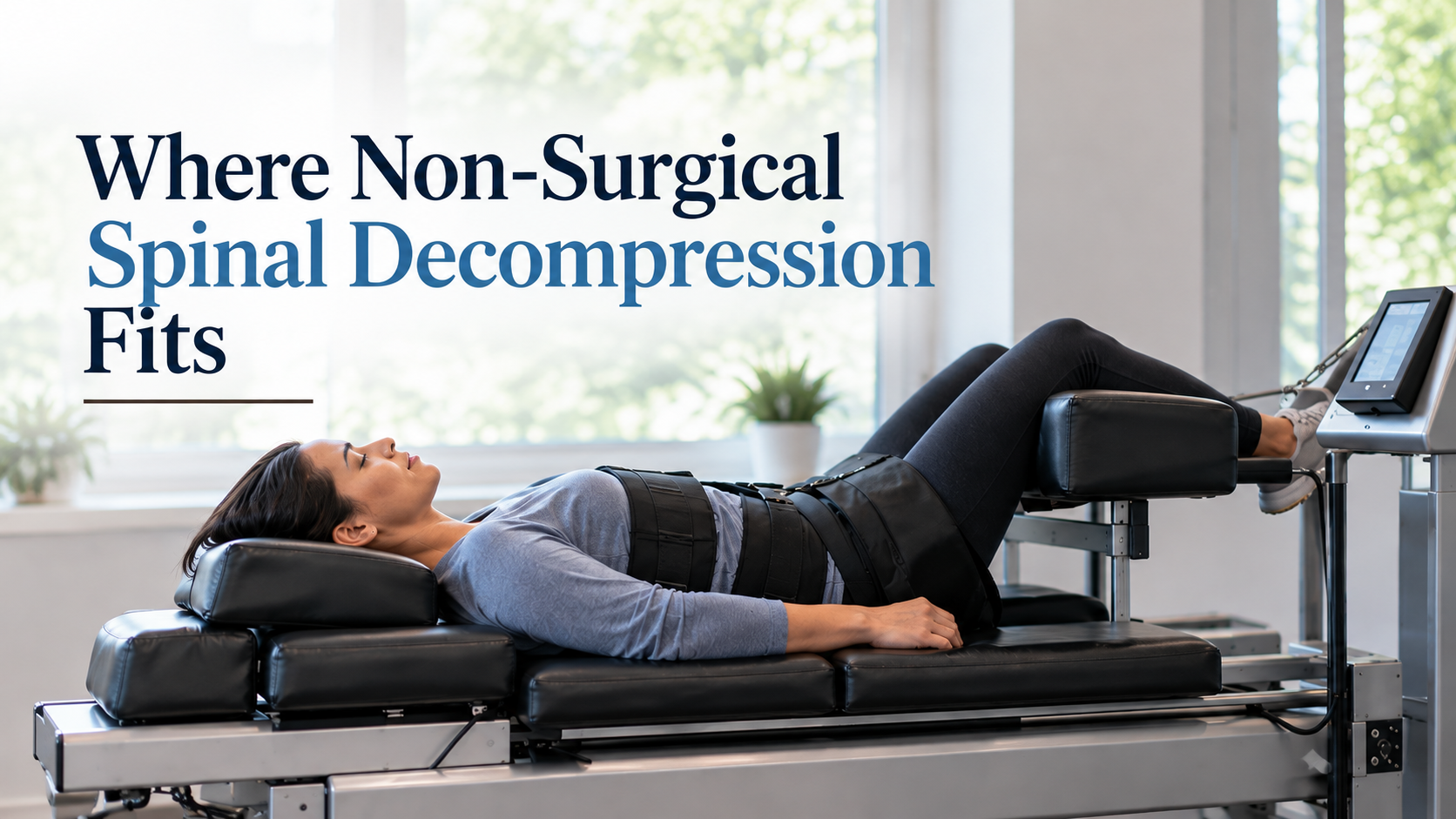
On the DRX9000, you lie on a padded table with a harness. A computer controls a gentle pull and release on your lower spine. The idea is to ease the pressure inside the disc, which may take the strain off the nerve and give the area room to settle.
At DRX Chicago, sessions last about 30 minutes, and most plans run 20 to 25 sessions over four to six weeks. If you’re wondering how this differs from basic traction, we explain it in DRX9000 vs. a traction table.
So why try it first?
Because the case for non-surgical care rests on two facts: most discs improve (on their own even), and waiting is low-risk.
Decompression is a safe, hands-off way to use that time. You’re doing something active for your back, and you aren’t taking on the risks of an operation to do it. The bonus? It might very well also reduce the need for pain medication.
Red Flags: When Surgery Shouldn’t Wait
The AAOS says surgery is typically considered when non-surgical care fails, or when there is:
-
- Difficulty walking
- Loss of bladder or bowel control
- Muscle weakness, like a foot that catches
Loss of bladder or bowel control needs urgent medical attention.
Set a checkpoint for yourself too. If your pain hasn’t improved after a few months of real effort, ask for a surgical opinion. The AAOS notes that surgery results appear less beneficial when it is delayed to 9 to 12 months, compared with surgery before 9 months.
At DRX Chicago, we screen our own red flags before treatment. This includes ruling out recent spinal fractures, spine infection, surgically repaired aneurysms and moderate to severe osteoporosis.
Discover Non-Surgical Treatment at DRX Chicago
If you’re weighing spinal decompression vs spinal fusion near Lakeview or Lincoln Park, the most useful next step is finding out whether you’re a candidate for non-surgical care. You can start with our Candidate survey or call (773) 868-0347.
DRX Chicago is at 2828 N Clark St, lower level. Our office is also a short walk from the Wellington and Belmont CTA stops. For many herniated discs, though, it is a sound first step before surgery.
Additional useful information: spinal decompression vs spinal fusion, start with our herniated disc page and our guide to non-surgical back surgery alternatives.