
Patients searching for “back pain that won’t go away Chicago” often want to know whether persistent symptoms are still normal. Sleeping, commuting, working at a desk, or walking around Lakeview and Lincoln Park may all become reminders that something is not improving. If your pain has lasted longer than expected, keeps returning, or now includes numbness, tingling, or weakness, it is time to stop guessing and arrange a professional evaluation. A focused examination can help identify whether the problem is muscular, disc-related, joint-related, or connected to a spinal nerve. For a broader overview of available options, read DRX Chicago’s guide to back pain treatment in Chicago.
Schedule your free consultation with DRX Chicago to discuss back pain that will not go away.
Persistent back pain deserves an evaluation when it lasts more than a few weeks, worsens, limits daily activity, or travels into the buttocks or legs. New bowel or bladder changes, saddle numbness, progressive weakness, fever, unexplained weight loss, or pain after significant trauma require prompt medical attention.
How Long Is Too Long to Live with Back Pain Before Seeking Help?
If back pain is not clearly improving after a few weeks of reasonable self-care, schedule an evaluation. Seek help sooner when pain is severe, repeatedly returns, disrupts sleep, or interferes with normal movement.
Many short episodes of back pain improve with gentle activity, appropriate rest, and guidance from a qualified provider. A sore back after an unfamiliar workout or a minor strain may settle as irritated tissues recover. However, waiting indefinitely can make it harder to understand the original trigger, especially when a person changes the way they walk, sit, lift, or sleep to avoid discomfort.
Duration is only one part of the decision. The pattern matters too. Pain that is steadily worsening, appears at night, spreads below the knee, or returns every time you resume normal activity deserves more attention than a mild ache that is steadily fading. A Chicago spine specialist can also help when you have already tried home care, medication, stretching, or general chiropractic treatment without lasting improvement.
Mayo Clinic advises contacting a healthcare professional when back pain lasts longer than a few weeks or becomes severe and does not improve with rest. That guidance is not a diagnosis, but it is a useful reason to stop postponing an assessment. The goal is to identify the next appropriate step, not to assume that every case needs advanced treatment.
Which Symptoms Indicate That Your Back Pain Needs a Spine Specialist?
Persistent pain combined with nerve symptoms, functional limitations, repeated flare-ups, or unexplained changes in your health is a reason to consult a spine-focused provider. The more a symptom affects strength, sensation, sleep, or movement, the sooner it should be assessed.
Consider scheduling a spine evaluation if you notice one or more of these patterns:
- Pain that persists or worsens: Symptoms continue beyond several weeks, intensify, or return quickly after temporary relief.
- Pain traveling into a leg: Burning, electric, or shooting discomfort may follow an irritated nerve, often through the buttock and leg.
- Numbness, tingling, or weakness: These symptoms can indicate that a nerve is being compressed or irritated.
- Reduced function: Back pain keeps you from walking, exercising, working, sleeping, or completing normal household tasks.
- Repeated episodes: Flare-ups happen often, even when they improve between episodes.
- Pain after an injury: A car accident, fall, sports injury, or lifting incident warrants careful assessment, particularly when pain is severe.
Lower back pain can have many causes, including muscle or tendon strain, arthritis, disc injury, and nerve irritation. Cleveland Clinic notes that symptoms may include persistent pain, stiffness, reduced motion, and pain radiating into the buttock or leg. A symptom pattern can guide an evaluation, but it cannot identify the cause by itself.
Contact DRX Chicago for a no-pressure conversation about your symptoms and possible next steps.
When Should Back Pain Be Treated as an Urgent Warning?
Seek urgent medical care for back pain with new bowel or bladder problems, numbness in the saddle area, progressive leg weakness, fever, unexplained weight loss, or significant trauma. These symptoms need medical triage before elective chiropractic or decompression care.
Some symptoms should not wait for a routine consultation. Go to urgent or emergency care when back pain occurs with:
- New loss of bladder or bowel control, difficulty urinating, or urinary retention.
- Numbness around the inner thighs, buttocks, or groin, sometimes called saddle numbness.
- Progressive weakness in one or both legs, trouble walking, or rapidly changing sensation.
- A fever, chills, or feeling acutely ill, particularly when the pain is severe.
- Unexplained weight loss, a history of cancer, or a known condition that weakens the immune system.
- Severe pain after a fall, collision, or other significant trauma.
These warning signs do not tell you which condition is present. They do mean that prompt medical assessment is more important than scheduling elective treatment. A spine specialist can help coordinate the next step after urgent concerns have been evaluated and cleared.
Do not try to push through new neurological changes because the pain level seems manageable. Nerve-related symptoms can change over time, and an in-person examination is more useful than trying to diagnose yourself from a search result.
What Conditions Can Cause Back Pain That Will Not Go Away?
Ongoing back pain may be related to a disc problem, nerve irritation, spinal stenosis, joint changes, arthritis, muscle injury, or more than one issue. The same diagnosis can also produce different symptoms in different people.
A comprehensive evaluation considers how the pain started, what makes it better or worse, and whether symptoms travel beyond the back. Common possibilities include:
- Herniated or bulging discs: A disc can irritate nearby tissue or a nerve root, causing back pain with leg pain, tingling, or numbness.
- Degenerative disc changes: Discs can lose hydration and height over time, changing how the spine absorbs load.
- Spinal stenosis: Narrowing around the spinal cord or nerve roots can cause pain, heaviness, numbness, or weakness, often with standing or walking.
- Facet joint irritation: The small joints at the back of the spine can become painful with injury, repetitive loading, or age-related changes.
- Muscle, ligament, or tendon strain: A lifting injury, sports activity, or sudden movement can strain supporting tissues.
There may also be contributors outside the spine, such as hip problems or referred pain. This is why a useful evaluation looks beyond the exact spot that hurts. DRX Chicago’s pages on sciatica and herniated discs explain two common patterns that can send symptoms into the leg.
What Does a Comprehensive Spine Evaluation in Chicago Include?
A spine evaluation usually combines a detailed history, movement and neurological screening, review of prior care, and a candidacy discussion. Testing or imaging is considered when it adds useful information, rather than ordered automatically for every patient.
At a first visit, expect questions about when the pain began, whether an injury preceded it, how it affects work and sleep, and what you have already tried. Bring a list of medications and relevant medical records. If you have prior imaging, bringing those reports or images can help the provider understand what has already been evaluated.
The physical portion may include posture, walking, range of motion, reflexes, strength, sensation, and movements that reproduce or relieve symptoms. The provider may also examine nearby joints and muscles to determine whether the pain is coming from the spine or being referred from another area.
Imaging is not a substitute for an examination. When imaging is appropriate, an MRI or other study may help clarify disc, nerve, or stenosis findings. The results should be interpreted alongside your symptoms and physical findings. A scan can show a structural change that is not the actual source of pain, so the clinical picture remains important.
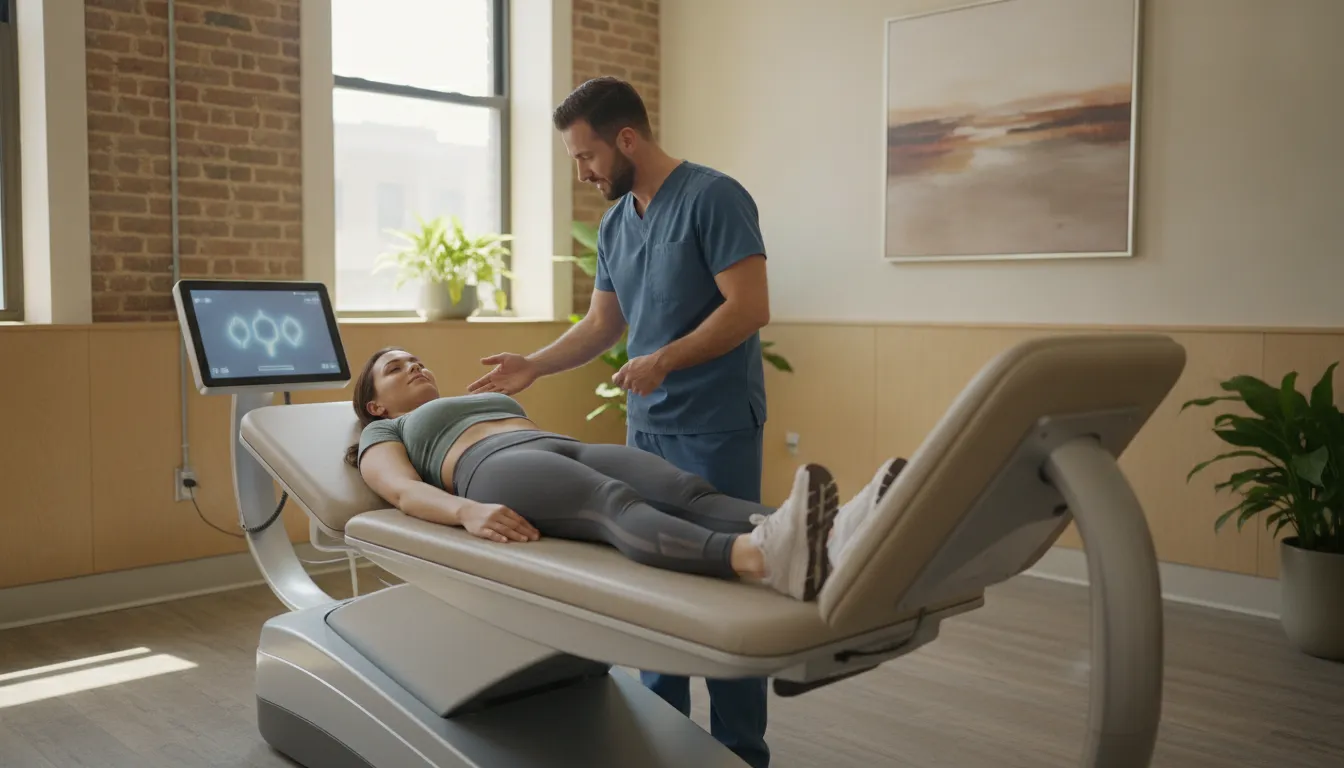
DRX Chicago also screens for factors that may make decompression inappropriate or require a different referral. Examples include pregnancy, severe osteoporosis, spinal fracture, tumor, infection, ankylosing spondylitis, or surgical hardware at the treatment level. Candidacy is determined after evaluation. No treatment should be presented as a guaranteed cure or as a replacement for medically necessary surgery.
What Happens After You See a Chicago Spine Specialist?
After evaluation, your provider should explain the likely pain pattern, what needs medical follow-up, and which conservative or non-surgical options may be reasonable. Treatment should be individualized and adjusted according to your response.
Your next step may be home-care guidance, exercise or rehabilitation, supportive chiropractic care, referral for additional medical evaluation, or a discussion of non-surgical spinal decompression. The right option depends on the condition, severity, health history, and examination findings. A responsible plan should also explain when to stop treatment and seek a different level of care.
For qualified candidates with disc-related back pain, DRX Chicago provides computer-controlled DRX9000 spinal decompression as a non-invasive treatment option. The system uses a graduated protocol intended to reduce loading at a targeted spinal level. Learn more about the DRX9000 mechanism and treatment process, including why candidacy screening matters.
Treatment planning is not one-size-fits-all. A typical DRX9000 program may involve 20 to 28 sessions over four to seven weeks, with visits lasting about 30 to 45 minutes. The schedule and treatment parameters are adjusted by the clinical team. DRX9000 is FDA cleared, not FDA approved, and it is not appropriate for every patient.
Most insurance plans do not cover the decompression therapy itself, although consultation, examination, and supportive services may have different coverage. Ask the practice to explain current fees and payment options, including whether CareCredit is available. Exact pricing should be discussed directly with DRX Chicago rather than assumed from a general online article.
How Can You Prepare for Your First Spine Appointment?
Bring a concise symptom timeline, a medication list, prior imaging, and your questions. Clear information about what you feel and what you have tried helps the specialist make a safer, more useful recommendation.
- Write down when the pain began and whether it followed a fall, collision, workout, or lifting event.
- Note whether symptoms travel into the buttock, thigh, calf, or foot.
- Record numbness, tingling, weakness, sleep disruption, or changes in walking.
- List prior treatments, medications, injections, therapy, chiropractic care, and how long relief lasted.
- Bring imaging reports, surgical history, and information about osteoporosis, cancer, infection, pregnancy, or implanted hardware.
- Ask which findings would require urgent medical care and when you should follow up.
Preparation does not need to be complicated. A short timeline and honest description of your limitations can be more useful than trying to use medical terms. If symptoms change before the visit, update the provider or seek urgent care when warning signs appear.
Back pain that will not go away is a reason to seek clarity, not a reason to assume the worst. The earlier you understand the pattern, the sooner you can choose an appropriate next step and avoid cycling through temporary fixes without a plan.
Contact DRX Chicago today to take the next step toward understanding your back pain.
Frequently Asked Questions About Persistent Back Pain in Chicago
Persistent back pain should be evaluated when it lasts beyond a few weeks, worsens, limits activity, or includes nerve symptoms. Emergency warning signs require urgent care rather than elective treatment.
Should I see a spine specialist for back pain that lasts two weeks?
Consider an appointment if pain is not clearly improving, keeps returning, or limits your normal activities. Seek care sooner for leg weakness, numbness, severe pain, trauma, fever, or bowel and bladder changes.
Is persistent back pain always caused by a disc?
No. Persistent pain can involve muscles, joints, discs, nerves, the hips, or more than one structure. An examination helps narrow the possibilities.
Can a chiropractor diagnose the cause of my back pain?
A qualified chiropractor can assess movement, neurological signs, and musculoskeletal patterns within the scope of practice. If findings require another level of care, the appropriate next step may be referral or additional testing.
Is DRX9000 treatment appropriate for everyone with chronic back pain?
No. DRX9000 is intended for carefully screened candidates and is not appropriate for every condition or health history. A comprehensive evaluation is required before treatment is considered.
When is back pain an emergency?
Seek urgent medical care for new bowel or bladder changes, saddle numbness, progressive weakness, fever with severe pain, or significant trauma. Do not wait for a routine consultation when these symptoms appear.