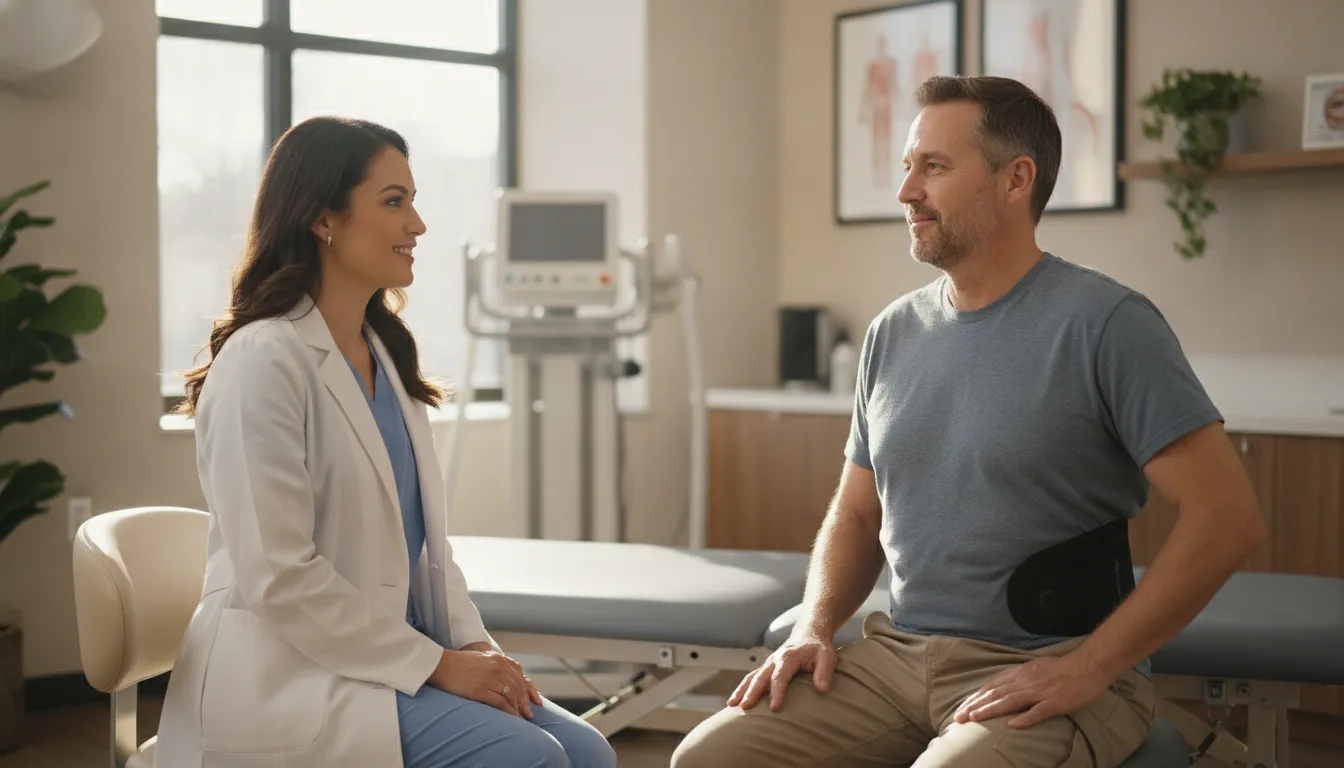
Work injury back pain treatment Chicago workers can trust starts with a careful evaluation, not a rushed return to heavy lifting or a promise that one therapy will solve every problem. A strain, disc injury, or nerve-related symptom can affect your ability to stand, sit, drive, lift, or complete a normal shift. If pain began at work or worsened because of job duties, understanding the injury and documenting your care are important first steps.
This guide explains common workplace back injuries, questions to ask about workers compensation care, warning signs that need prompt medical attention, and how a Chicago spine clinic may evaluate non-surgical options. For the broader context, read DRX Chicago’s guide to spinal conditions and back pain treatment options in Chicago. It is educational information, not legal advice or a substitute for an individualized medical examination.
What workplace back injuries commonly cause lasting pain?
Short answer: Workplace back pain may follow a single lifting event, a fall, repetitive bending, prolonged sitting, vibration, or gradually increasing strain. The symptoms may come from muscles and joints, discs, or irritated nerves, so the same job-related complaint can require a different care plan for each person.
A sudden load can irritate a muscle or ligament, aggravate a facet joint, or contribute to a bulging or herniated disc. A worker may notice lower back pain immediately, while nerve-related symptoms such as tingling, numbness, or leg pain may appear later. Repetitive tasks can also build symptoms over time, especially when the work involves frequent bending, twisting, reaching, lifting, or awkward positions.
Common work-related complaints include sprains and strains, disc-related back pain, sciatica, neck pain, and pain that travels into an arm or leg. A job does not have to involve construction or warehouse work to affect the spine. Office workers, drivers, health care workers, retail employees, and people who stand or sit for long periods can all develop job-related symptoms.
Because symptoms do not identify the cause by themselves, a useful evaluation considers when the pain started, which movements change it, whether symptoms travel, and what tasks you can no longer perform. DRX Chicago’s existing work-related injury treatment page provides service-specific information, while this article focuses on the decisions workers face before and during care.
How should Chicago workers respond after a back injury at work?
Short answer: Report the injury through your employer’s process, seek appropriate medical evaluation, follow safety guidance, and keep copies of relevant records. Do not use a blog post to decide whether you can safely work through severe or worsening symptoms.
After an injury, write down what happened while the details are fresh. Include the date, task, location, movement or event that triggered symptoms, body areas affected, and whether anyone witnessed it. Follow your employer’s reporting procedure and ask how to access authorized medical care. If symptoms developed gradually, describe the job duties and timeline rather than trying to identify a diagnosis yourself.
Bring useful information to an appointment, such as a list of medications, prior spine injuries or surgeries, imaging reports, and a description of the work movements that increase pain. Ask the clinician to explain the working diagnosis, recommended restrictions, and what should prompt a follow-up visit. Clear records can help your care team make safer decisions and give you a practical recovery plan.
Illinois workers compensation rules can be complicated. The Illinois Workers’ Compensation Commission handbook is an official overview of benefits and responsibilities, and it states that it is not legal advice. For a dispute about reporting, authorization, wage benefits, or claim handling, consider speaking with a qualified Illinois workers compensation attorney.
What questions should you ask about workers compensation spine care?
Short answer: Ask who can authorize treatment, which services may be covered, what records are needed, and how work restrictions will be communicated. Coverage and authorization depend on the claim and plan, so the clinic and insurer should confirm details directly.
Patients often want to know whether an appointment, imaging review, decompression therapy, rehabilitation, or supportive care will be covered. Do not assume that a treatment is covered because the injury occurred at work. At DRX Chicago, the consultation, examination, and supportive therapies may have different coverage rules from spinal decompression itself. Ask for a clear explanation of your financial responsibility before beginning a program.
- Which provider or network rules apply to my claim?
- Does the insurer require a referral, authorization, or utilization review?
- Which examination, imaging, rehabilitation, or supportive services are eligible for coverage?
- How will work restrictions and progress notes be sent to the appropriate parties?
- What should I do if the claim or a requested service is delayed or denied?
Most insurance plans do not cover the decompression therapy itself, but consultation, examination, and supportive therapies may be covered. DRX Chicago also offers CareCredit as a financing option for eligible patients. Confirm current benefits, authorization, and financing terms with the clinic and the responsible payer because those details can change.
When does a work injury need prompt medical evaluation?
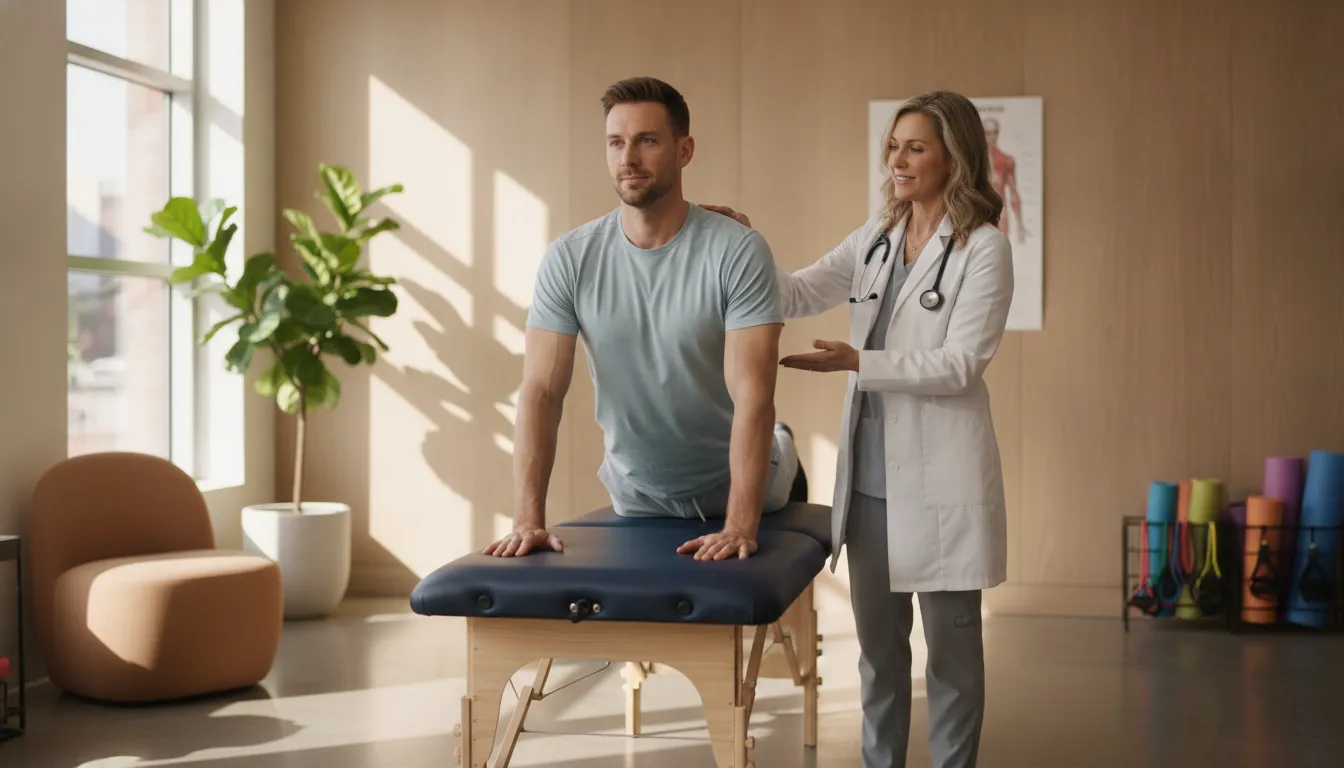
Short answer: Seek prompt evaluation for severe or worsening pain, new weakness or numbness, pain after major trauma, fever with back pain, or changes in bladder or bowel control. Emergency symptoms should be assessed urgently rather than managed through routine scheduling.
Some symptoms suggest that a back problem needs more than home care or a delayed appointment. New or progressive weakness, significant loss of sensation, difficulty walking, or pain that travels with neurological changes deserves prompt attention. Loss of bladder or bowel control, numbness in the saddle area, or rapidly worsening weakness can indicate a serious emergency.
Also seek timely care after a significant fall, collision, or crush injury, especially if you have severe tenderness, difficulty bearing weight, or a history of osteoporosis. Fever, unexplained weight loss, a history of cancer, or feeling systemically ill alongside back pain should be reported to a medical professional. These signs do not prove a specific condition, but they should not be ignored.
A non-emergency appointment is still worthwhile when pain persists, keeps returning, limits work duties, or causes leg symptoms. Early evaluation can clarify whether the next step is activity modification, rehabilitation, imaging review, spinal decompression, another conservative approach, or referral for a different level of care.
How do lifting injuries differ from repetitive motion injuries?
Short answer: Lifting injuries often have a recognizable triggering event, while repetitive motion injuries may build gradually through repeated loading and limited recovery. Both can involve similar symptoms, but the history of the injury changes the evaluation and prevention plan.
A lifting injury may begin when a worker picks up, carries, pushes, or pulls a heavy object. Bending and twisting under load can add stress, and a person may feel a sharp pain or immediate limitation. DRX Chicago’s lifting injury treatment page discusses care for this type of complaint, including evaluation of movement mechanics and complementary rehabilitation.
Repetitive motion injuries can develop through many smaller exposures, such as repeated lifting, assembly work, typing, prolonged driving, or sustained awkward posture. Symptoms may start as stiffness or fatigue, then become more persistent. The repetitive motion injury treatment page covers that service path, including ergonomic guidance and exercise-based support.
The distinction is useful, but it is not a diagnosis. A lifting event can aggravate a condition that was already developing, and repetitive work can cause a sudden flare. A clinician should connect the symptom pattern to the examination and any available imaging rather than relying only on the job title or the worker’s assumption about the cause.
Can spinal decompression help after a workplace back injury?
Short answer: DRX9000 spinal decompression may be considered for selected patients with certain disc-related or nerve-related symptoms after a comprehensive evaluation. It is not appropriate for every injury, and candidacy should be determined by a qualified clinician.
DRX Chicago uses the FDA-cleared DRX9000 system as part of a non-surgical approach to spinal care. The clinic describes computer-controlled, logarithmic decompression intended to create negative intradiscal pressure and reduce mechanical stress around selected discs. Treatment may be combined with rehabilitation, ergonomic education, soft-tissue care, or other supportive therapies when clinically appropriate.
A typical DRX9000 program may involve 20 to 28 sessions over four to seven weeks, with session length and frequency adjusted to the patient’s response. That is a general protocol, not a promise that every worker needs the same schedule. A consultation should determine whether the symptoms, examination findings, medical history, and goals fit the treatment.
Screening matters after an injury. Pregnancy, severe osteoporosis, spinal fracture, tumor, infection, surgical hardware at the treatment level, ankylosing spondylitis, and other conditions may make decompression inappropriate or require a different plan. DRX Chicago should evaluate candidacy before treatment, and medically necessary surgical or specialist care should not be delayed when it is indicated.
For a broader overview of treatment choices, read DRX Chicago’s guide to spinal conditions and back pain treatment options in Chicago.
How can DRX Chicago support a safe return to work?
Short answer: A responsible plan connects the diagnosis, symptoms, work demands, treatment response, and restrictions. The goal is not simply to reduce pain for one day, but to help the worker understand what activities are safe and what follow-up is needed.
At DRX Chicago, the evaluation can help identify whether non-surgical spinal care is reasonable for the worker’s presentation. The team can discuss symptoms, review available imaging, assess movement, and explain how DRX9000 therapy and complementary care may fit into a broader plan. Work demands, lifting mechanics, posture, and recurrence risks should be part of that conversation.
Patients should ask how progress will be measured and what changes should be reported between visits. A plan may include gradual activity progression, ergonomic education, strengthening, mobility work, and communication about temporary restrictions. The correct pace depends on the injury and the person’s response, not on a fixed promise to return by a particular date.
If you are in Lakeview, Lincoln Park, or another part of greater Chicago and work-related back pain is keeping you from normal activities, bring your questions to a free consultation. DRX Chicago can explain whether an evaluation is appropriate and which options may be reasonable for your situation.
What should Chicago workers remember before choosing treatment?
Short answer: Choose evaluation and treatment based on the injury history, clinical findings, safety screening, and confirmed coverage information. A non-surgical option can be worth discussing, but it should never be presented as a guaranteed cure or a replacement for medically necessary care.
- Report and document the work-related event or symptom timeline.
- Get evaluated when pain persists, limits work, or includes neurological symptoms.
- Ask which services require authorization and what your financial responsibility may be.
- Compare treatment options based on your examination and candidacy, not marketing claims.
- Seek urgent care for emergency warning signs or major trauma.
Work injury back pain treatment Chicago workers choose should be individualized, medically appropriate, and clear about what is known and what still needs to be evaluated. DRX Chicago’s role is to assess whether its non-surgical spinal approach may fit your needs and to help you understand the next step.
Frequently asked questions about work injury back pain treatment in Chicago
Short answer: The right treatment depends on the injury, symptoms, examination, safety factors, and coverage rules. A consultation can help clarify the next step without assuming that every work injury needs the same therapy.
Does workers compensation cover spinal decompression?
Coverage depends on the claim, authorization requirements, payer, and service. Do not assume that workers compensation or private insurance covers decompression therapy itself. Ask DRX Chicago and the responsible payer to confirm coverage for the consultation, examination, supportive therapies, and any decompression program before treatment begins.
Can I keep working with back pain after a workplace injury?
That decision should come from an appropriate medical evaluation and your employer’s workplace process. A clinician can discuss activity limits and warning signs, but a blog cannot determine whether a specific lifting, driving, or standing task is safe for you.
Is DRX9000 appropriate for every work injury?
No. The DRX9000 is not appropriate for every patient or every injury. DRX Chicago should screen for contraindications and determine candidacy after reviewing your symptoms, examination, medical history, and available imaging.
What should I bring to a Chicago work injury consultation?
Bring identification, medication information, prior imaging or reports, details about the injury or symptom timeline, and any work restrictions or authorization information you have received. A clear description of the duties that worsen symptoms can also help the clinician understand your needs.
When should I seek emergency care instead of scheduling a consultation?
Seek urgent evaluation for new or worsening weakness, major loss of sensation, difficulty walking, loss of bladder or bowel control, saddle numbness, severe trauma, or fever with serious back pain. These symptoms need prompt medical attention.