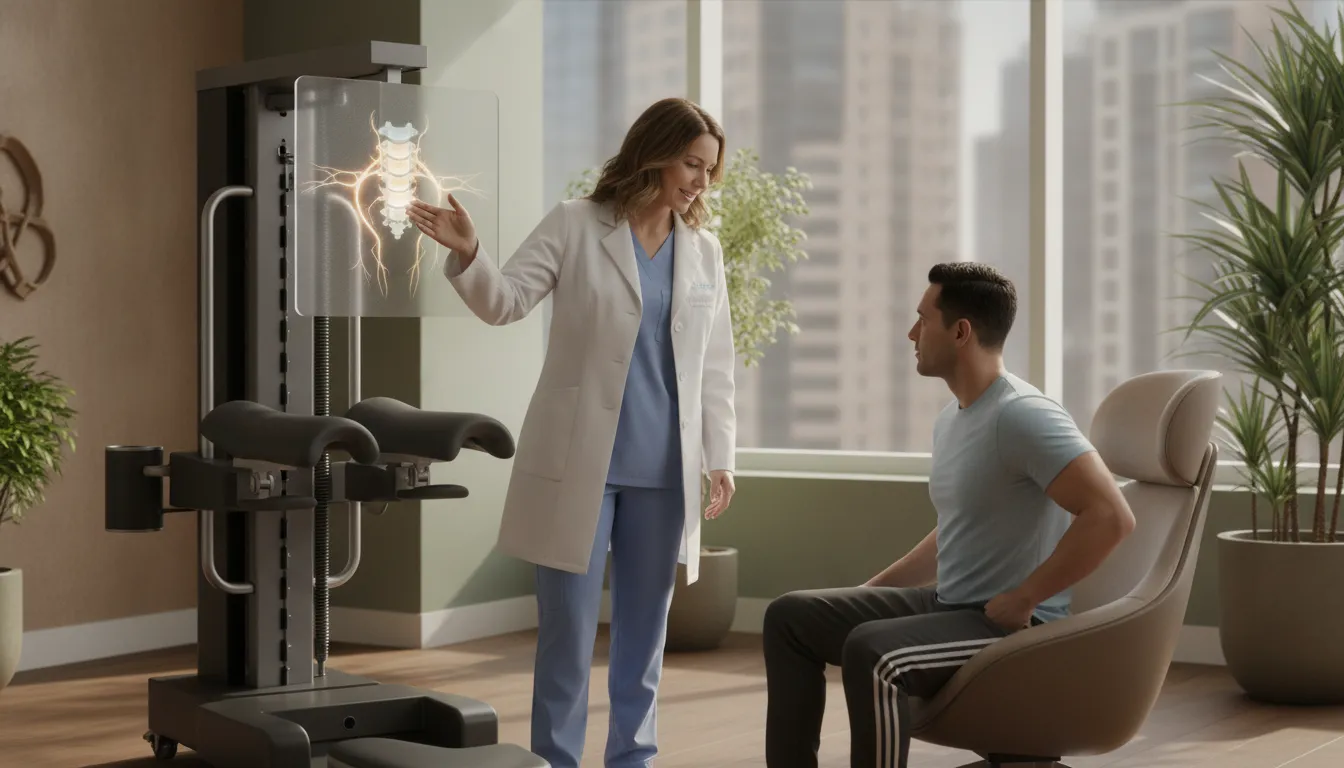
Back pain that shoots, tingles, or feels numb can make ordinary activities difficult, but the phrase “pinched nerve” does not identify the exact structure causing those symptoms. Disc changes, inflammation, muscle spasm, or narrowing may affect a nerve, and the right next step depends on an evaluation rather than symptoms alone.
For people researching pinched nerve back treatment chicago, an evaluation can clarify the likely source and screen for warning signs. It can also determine whether FDA-cleared DRX9000 spinal decompression may be appropriate for a qualified candidate. Treatment response varies, and decompression is not a substitute for emergency care.
Schedule Your Free Consultation to discuss your symptoms and possible next steps with DRX Chicago, serving patients throughout greater Chicago, including Lakeview and Lincoln Park.
Before considering treatment, it helps to understand what can irritate a spinal nerve and how those symptoms may present. For broader context, read this Chicago spinal decompression guide. That foundation makes it easier to see why a careful examination guides the treatment plan.
What Causes a Pinched Nerve in the Back and What Does It Feel Like?
A pinched nerve is a description of pressure or irritation affecting a nerve, not a diagnosis by itself. In the back, the irritation may affect how signals travel for movement and sensation. The same symptom pattern can come from different structures, so symptoms alone cannot identify the source or determine which treatment is appropriate.
What can contribute to nerve compression?
Several changes may narrow the space around a spinal nerve or place pressure on it. A herniated disc or bulging disc can extend beyond its usual boundary and irritate a nearby nerve. Bone spurs, which may develop with degenerative changes, can also encroach on a nerve pathway.
Muscle spasms and inflammation in surrounding tissues may add to the pressure. These contributors can occur alone or together, and the location of the irritation matters. A clinical evaluation is needed to connect the symptoms with the likely structure involved. For a related overview, see DRX Chicago’s pinched nerve treatment overview.
What does a pinched nerve in the back feel like?
People may describe the discomfort as sharp, aching, burning, or radiating along the affected nerve’s pathway. Numbness and tingling, sometimes called pins and needles, can occur alongside pain. Some people also notice weakness or difficulty using the muscles served by that nerve.
The pattern is not identical for everyone. Symptoms may stay near the back, travel into the buttock or leg, or change with movement and position. Radiating symptoms can be concerning, but their presence does not prove that a specific disc or other structure is responsible.
Why is the symptom description not enough?
Back pain and leg symptoms have multiple possible causes. A clinician may consider your history, symptom distribution, neurological function, movement, and other findings before deciding whether imaging or additional assessment is warranted. An MRI can show discs and nearby structures, but it must be interpreted alongside the examination rather than treated as an explanation by itself.
That evaluation-led approach helps separate a temporary irritation from a problem that may need focused care. It also helps identify situations that require medical attention instead of a routine treatment consultation. If pain, numbness, tingling, or weakness is new, persistent, or worsening, arrange an assessment rather than attempting to diagnose the cause from an online description.
How Is a Pinched Nerve Evaluated in Chicago?
A careful evaluation starts by identifying what may be irritating or compressing the nerve, rather than treating the phrase “pinched nerve” as a final diagnosis. Back and leg symptoms can have several causes, and the right treatment depends on the underlying cause and the severity of the problem. The goal is to connect your symptoms with examination findings and, when appropriate, imaging before discussing whether non-surgical care may be suitable.
What Does the Initial History Cover?
Expect questions about when your symptoms began, where pain travels, and whether numbness, tingling, or weakness affects a particular area. A clinician may also ask what aggravates or relieves your symptoms, how they affect walking. Sleep, work, or exercise, and whether you have experienced an injury or prior spine treatment.
This history provides context, but it does not confirm the source by itself. Symptoms that feel similar can arise from a disc, bone, muscle, inflammation, or another structure. A professional assessment is needed to determine which possibilities fit your presentation.
Which Neurological and Movement Checks May Be Used?
An evaluation may include neurological testing, range-of-motion assessment, posture review, and movement checks. These steps help the clinician observe strength, sensation, coordination, mobility, and how your back and limbs respond to specific positions or movements. Findings are considered together instead of relying on one symptom or one test.
For patients visiting DRX Chicago from Lakeview, Lincoln Park, or elsewhere in greater Chicago, this evaluation-led approach helps keep the discussion practical. It can clarify whether the pattern calls for routine conservative care, additional medical assessment, or a different type of referral.
When Is Imaging Helpful?
Digital X-rays or an MRI review may be considered when clinically indicated. MRI can help a clinician assess discs and structures around nerve roots, but an image should be interpreted alongside your history and examination findings. A scan alone does not establish that a particular finding is causing your symptoms.
Evaluation also supports candidacy decisions for decompression. DRX Chicago uses safety screening before discussing the FDA-cleared DRX9000 with qualified patients. Factors such as pregnancy, severe osteoporosis, fractures, tumors, infection, ankylosing spondylitis, or surgical hardware at the treatment level may require avoiding treatment, modifying care, or obtaining further assessment. Treatment variables should be customized only after evaluation, based on factors such as spinal level, force, angle, duration, and patient tolerance.
Because back pain treatment depends on its cause and severity, an evaluation should guide the next step rather than promise a particular result. NIAMS explains why back pain treatment is cause-dependent.
How Can Pinched Nerve Back Treatment Chicago Patients Consider Decompression?
When an evaluation suggests that a disc-related problem may be contributing to nerve compression, decompression can be one non-surgical option to discuss. It is not selected from symptoms alone. DRX Chicago first considers the suspected source, the patient’s health history, and whether the person is an appropriate candidate.
How does the DRX9000 approach the pressure around a disc?
DRX Chicago uses an FDA-cleared DRX9000 system for qualified patients with disc-related conditions and associated nerve compression. The device applies computer-controlled, targeted distraction. Its logarithmic ramp is designed to ease force in gradually and may help reduce muscle guarding during the session.
The treatment model is intended to create reported negative intradiscal pressure, approximately -100 to -200 mm Hg. In appropriate cases, that pressure may support disc hydration and retraction of herniated or bulging disc material, which may reduce pressure-related symptoms. These are proposed treatment effects, not a promise that every nerve will be decompressed or that every patient will improve. You can review how DRX9000 decompression works for a more detailed explanation.
How does decompression differ from ordinary traction or supportive care?
People sometimes use “traction” and “decompression” as if they mean the same thing. The distinction described in this treatment approach is the computer-controlled, logarithmic application of force and the reported goal of creating negative intradiscal pressure. Conventional traction may provide a stretching force. But a treatment plan should not assume that every traction method creates the same pressure pattern or is appropriate for the same condition.
Decompression may also be paired with supportive care when indicated. That can include mobility work, core stabilization, soft-tissue techniques, or other clinician-selected services. The purpose is to address the person’s movement and tolerance while the underlying concern is monitored, rather than to treat a label in isolation.
| Option | What it may involve | Important consideration |
|---|---|---|
| DRX9000 decompression | Computer-controlled distraction with settings adjusted for the patient. | Considered only after screening confirms appropriate candidacy. |
| Supportive care | Movement, stabilization, soft-tissue, or other conservative services when indicated. | Selected according to the suspected source, symptoms, and tolerance. |
| Medical or surgical evaluation | Further assessment when symptoms, findings, or safety concerns require it. | Non-surgical care does not replace urgent care or medically necessary surgery. |
The safest next step is a qualified assessment, not a self-diagnosis. Results vary, and the treatment plan should change if examination findings or symptoms indicate that another type of medical care is needed.
Pinched Nerve vs. Sciatica: Are They the Same?
Pinched nerve and sciatica overlap, but they are not the same term. A pinched nerve describes pressure or irritation affecting any nerve, while sciatica describes symptoms that follow the path of the sciatic nerve. Usually from the lower back through the buttock and into the leg. In other words, sciatica can result from nerve irritation in the lower back, but not every pinched nerve is sciatica.
How Does Sciatica Differ From a General Pinched Nerve?
The word “sciatica” refers to a symptom pattern and nerve distribution. Because the sciatic nerve is connected to the lower back and travels through the buttock and leg. Symptoms may include pain that radiates down one side, along with tingling, numbness, or weakness in the leg or foot. The exact location and intensity can vary, and symptoms do not automatically identify the structure causing them.
A general pinched nerve is a broader description. Compression or irritation may involve a nerve in the back, neck, shoulder, or another area. It can produce sharp, aching, burning, or radiating pain, as well as numbness, tingling, or weakness along that nerve’s pathway. Disc herniation, a bulging disc, a bone spur, muscle spasm, or inflammation may contribute to compression, but symptoms alone cannot confirm which cause is present.
What Should You Do If Symptoms Resemble Sciatica?
Start with an evaluation rather than assuming that radiating leg pain is sciatica or that sciatica has one standard treatment. A clinician may consider your symptom history, neurological findings, movement, and the structures involved. Back pain and leg symptoms can have several causes, so treatment selection should reflect the underlying cause and the severity of the problem.
For a focused explanation of symptom patterns and care considerations, review Chicago sciatica treatment. If symptoms are new, persistent, worsening, or accompanied by weakness, an in-person medical assessment is especially important. An article cannot diagnose a pinched nerve, sciatica, or the source of nerve irritation, and an evaluation is the appropriate way to determine what care may be suitable.
What Does the DRX9000 Treatment Timeline Look Like?
A DRX9000 program is usually planned as a structured course rather than a single visit. For qualified candidates, a typical plan includes 20 to 28 sessions over approximately 4 to 7 weeks. The exact schedule depends on the evaluation, the spinal level involved, your symptoms, and how your body tolerates treatment.
How often are the visits scheduled?
Visits are commonly 30 to 45 minutes long. The frequency is graduated so the care team can monitor your response and adjust the plan as needed:
- Early phase: Many programs begin with daily sessions for about the first two weeks.
- Middle phase: Visits may decrease to three times per week for the following two weeks.
- Later phase: The schedule may move to twice weekly during the final two weeks.
This outline is a typical protocol, not a promise that every patient will follow the same calendar. Missed visits, symptom changes, examination findings, and individual tolerance can affect the pace.
What is adjusted during treatment?
Each session is tailored after the initial assessment. The treatment team may adjust the spinal level, force, angle, and duration, while also considering your comfort and tolerance. These changes are intended to keep the program responsive instead of applying one fixed setting to every person.
Depending on the evaluation and treatment goals, supportive care may also be recommended. This can include core stabilization, neural mobilization, soft-tissue work, chiropractic adjustments, or other appropriate modalities. You can review the conditions that may be considered for care in the guide to conditions DRX9000 may treat.
When might patients notice progress?
Response varies, and a treatment timeline cannot guarantee a particular result. DRX Chicago materials report figures for qualified candidates that include 76% to 88% clinical success, 80% average pain reduction, and 95% patient satisfaction. These are reported clinical figures, not predictions for an individual patient.
Some cited clinical material also reports MRI-verified disc-height increases of 1.0 to 1.6 mm. If imaging or follow-up measures are appropriate, your clinician can explain what those findings mean in the context of your symptoms and examination. The goal is to track meaningful functional progress while confirming that the care plan remains appropriate.
When Should a Pinched Nerve Be Treated as Urgent?
Most back pain, tingling, or radiating symptoms call for a careful evaluation rather than an immediate conclusion about the cause. However, certain neurological changes can signal a problem that should not wait for a routine pinched nerve consultation. A symptom description alone cannot identify whether a disc, bone, muscle, or another structure is involved. So use the warning signs below as safety guidance, not as a self-diagnosis.
Which symptoms require emergency care?
Seek urgent medical assessment if you develop new loss of bowel or bladder control. Numbness in the saddle area around the inner thighs or groin, or weakness that is rapidly worsening. These changes may indicate significant neurological involvement and should be evaluated promptly. Do not wait to see whether routine stretching, medication, or a decompression appointment improves these symptoms.
Major trauma is another reason to seek immediate medical attention. A serious fall, vehicle collision, or other substantial impact can involve a fracture or another injury that requires medical imaging and treatment decisions beyond a scheduled conservative-care visit. If severe neurological symptoms occur after trauma, emergency evaluation is especially important.
When should you arrange prompt medical evaluation?
Contact a physician or qualified healthcare professional promptly when weakness is new, function is changing. Pain is severe and persistent, or numbness is spreading, even if you have not experienced bowel or bladder changes. A clinician can review your history, perform neurological and movement checks, and determine whether imaging or another form of evaluation is appropriate. These symptoms do not establish a diagnosis on their own, and treatment should be guided by the underlying cause and severity.
Safety screening also matters before any spinal decompression treatment. Conditions such as a fracture, infection, tumor, severe osteoporosis, pregnancy, ankylosing spondylitis, clotting disorder, or surgical hardware at the treatment level may make decompression inappropriate or require modification. Tell the evaluating clinician about prior surgery, major health conditions, and any recent injury rather than assuming a non-surgical treatment is automatically suitable.
When is a routine consultation reasonable?
If symptoms are stable and there are no emergency warning signs, a scheduled evaluation may be reasonable. Bring a clear timeline of your pain, numbness, tingling, or weakness, along with information about activities that worsen or relieve it. An evaluation-led plan can then distinguish routine care from situations requiring referral or more urgent medical attention.
For more detail about symptom patterns and possible causes, review DRX Chicago’s pinched nerve treatment overview. It should supplement, not replace, an in-person medical assessment when symptoms are severe or changing.
How Can Chicago Patients Choose a Non-Surgical Spine Evaluation?
Choosing where to begin can feel difficult when back pain, tingling, or weakness is interfering with work, sleep, or daily movement. Patients in Lakeview, Lincoln Park, and nearby Chicago neighborhoods may prefer an evaluation close to home that starts with the cause of their symptoms. Not an assumption about the diagnosis. A pinched nerve is a symptom description, so the right care plan depends on the findings from a professional examination.
What Should Patients Look for in a Chicago Spine Practice?
Look for a practice that explains its scope clearly, reviews your history, and separates appropriate non-surgical care from situations that require another medical opinion. Experience matters, but it should support careful decision-making rather than promise a particular result. DRX Chicago has more than 25 years of practice experience serving the Chicago area, with particular attention to patients from Lakeview and Lincoln Park. The team includes Dr. Jason Ingham, DC, CCSP, a Doctor of Chiropractic and Certified Chiropractic Sports Practitioner.
Ask how the evaluation will assess your symptoms, movement, neurological function, and relevant imaging. You should also understand what happens if the findings do not support decompression. A trustworthy evaluation makes room for supportive care, referral, or additional medical assessment when those options are more appropriate.
Who May Be a Candidate for Non-Surgical Decompression?
DRX9000 spinal decompression is intended for qualified patients with certain disc-related conditions and associated nerve compression. Candidacy is not established by a symptom checklist alone. The clinician may consider your examination findings, imaging, medical history, spinal level, and overall tolerance before deciding whether this approach is suitable.
Safety screening is essential. Pregnancy, severe osteoporosis, a fracture, tumor, infection, ankylosing spondylitis, or surgical hardware at the treatment level may make decompression inappropriate or require modification. Prior surgery or advanced degeneration also deserves careful assessment. Even when a patient is interested in non-surgical care, emergency symptoms or rapidly worsening neurological changes should be addressed through urgent medical evaluation instead of a routine consultation.
How Can Patients Plan for Coverage and Treatment Costs?
Coverage varies by service. Most insurance plans do not cover the decompression therapy itself, while a consultation, examination, or supportive service may have different benefits. Ask the practice to explain which services are being considered and what your plan may or may not cover. CareCredit is also referenced as a financing option for eligible patients. These practical questions can help you compare care choices without assuming that insurance approval or a particular treatment response is guaranteed.
Frequently Asked Questions
Do I need an MRI for a pinched nerve evaluation?
Not always. A clinician may begin with your history, neurological checks, range-of-motion assessment, and posture review. MRI may be recommended when clinically indicated to assess discs and structures near nerve roots, but imaging should be interpreted alongside your symptoms and examination findings. An MRI alone does not establish the cause of your pain or determine your treatment.
What type of doctor should I see for a suspected pinched nerve in my back?
Start with a qualified healthcare professional who can evaluate your symptoms and determine whether they may relate to nerve irritation, a disc problem, muscle tension, or another condition. Depending on the findings, care may involve a chiropractor, primary care clinician, physical therapist, or medical spine specialist. The right next step depends on your history, examination, severity, and any relevant imaging, not on symptoms alone.
Can medication or conservative care help a pinched nerve?
Conservative care may be appropriate depending on the suspected cause and severity. A clinician may discuss activity changes, rehabilitation, mobility or strengthening work, and other supportive options. Medication decisions should be made with a licensed medical professional who knows your health history. Non-surgical decompression is considered only after evaluation and safety screening, and candidacy varies.
Does insurance cover pinched nerve treatment or spinal decompression?
Coverage depends on the service and your individual plan. Insurance may cover some consultations, examinations, or supportive therapies, but the decompression therapy itself is generally not covered. Confirm benefits and out-of-pocket responsibility with your insurer and the clinic before beginning care. CareCredit may also be available as a financing option.
When is a pinched nerve an emergency?
Seek urgent medical assessment for new loss of bowel or bladder control, numbness in the saddle area, rapidly worsening weakness, or symptoms after major trauma. Do not wait for a routine consultation when these warning signs occur. Less severe or stable symptoms can still merit prompt professional evaluation, especially if numbness, tingling, pain, or weakness persists or worsens.
Ready to Discuss Your Next Step?
If back or nerve symptoms are affecting your daily life. An evaluation can help you understand your options and whether DRX9000 spinal decompression may be appropriate for your situation. Candidacy varies, so the right next step starts with a conversation about your symptoms and goals.