Looking for a sciatica doctor Chicago patients can actually reach is a North Side problem as much as a medical one. The useful version of that search starts with an evaluation, not a neighborhood slogan. If pain already travels from your low back or buttock into a leg, you need two answers. What is driving it, and which provider will say no when another type of care should come first?
Schedule a free consultation with DRX Chicago to review your symptoms and whether a non-surgical evaluation is a reasonable next step.
What should you look for in a sciatica doctor on Chicago’s North Side? Look for a licensed clinician who takes a full history and examines nerve findings. They should review imaging when it is needed, screen for conditions that change the plan, and explain both non-surgical options and when a medical or surgical referral is safer. A nearby office helps you keep follow-up visits. It does not replace that screening.
DRX Chicago is a Lakeview clinic at 2828 N Clark St, Lower Level, with the entrance off Clark. The practice focuses on non-surgical spinal decompression for selected patients. This guide is about how to compare providers. It is not a promise that one treatment fits every case of leg pain.
What a North Side sciatica evaluation should cover
A useful first visit starts with your story, not a treatment menu. The clinician should ask when the pain started, whether it stays above the knee or travels into the calf or foot, and whether one side or both sides are involved. Numbness, tingling, weakness, a change in walking, a recent fall, and any prior spine procedure all change what “sciatica” might mean.
The exam should look at strength, sensation, reflexes, gait, and how movement affects the pain. Imaging is not automatic. An MRI or another study may matter when symptoms are severe, are not improving, include clear nerve changes, or need to be separated from another cause. A provider who recommends a plan from the word sciatica alone has skipped the step that protects you.
MedlinePlus describes sciatica as pain that runs along the sciatic nerve, often from pressure on a nerve root in the lower spine, and notes that most people improve with non-surgical care. That overview is a starting point, not a diagnosis. Read the MedlinePlus sciatica page for the general picture, then use your visit to apply it to your own findings.
Use this numbered order before you compare clinics:
- Map the pain. Write down where it travels and what has changed since it started.
- Gather the records. Bring imaging reports, therapy notes, and any prior spine-surgery records.
- List the limits. Note health issues that can change a plan, including pregnancy, bone loss, infection, cancer history, and implanted hardware.
- Check the trip. Decide which North Side office you can actually reach on a bad pain day.
- Book the exam, not a package. Choose the visit that will examine you, and skip any offer that starts with a price.
Bring what you already have:
- A short timeline of when symptoms started and what makes them better or worse.
- Imaging reports and discs, not just a verbal summary of what someone told you.
- A list of therapy, injections, medication, and any prior spine surgery.
- Current medicines and health conditions, including bone health and pregnancy.
- The activities you want back, such as walking, work, sleep, or exercise.
For the condition overview itself, use the DRX Chicago sciatica page. This article stays on the provider decision: who evaluates you, what they should explain, and how a North Side office fits the follow-up.
How to compare a sciatica doctor Chicago patients can reach
Compare the process, not the slogan. A clinic can sit near Lakeview, Lincoln Park, or Andersonville and still be a poor fit. That happens when it cannot explain who examines you, what would make you a poor candidate, or when the plan should stop.
| What to compare | Ask this | A careful answer sounds like |
|---|---|---|
| Who evaluates you | Which licensed clinician examines me, and what is their spine-care background? | A named doctor of chiropractic or physician, not an unnamed protocol. |
| How the cause is sorted | How do you separate disc-related nerve pressure from hip, joint, or other causes? | History, exam, and imaging only when the findings call for it. |
| Safety limits | Which histories would make you refer me elsewhere? | Pregnancy, fracture, tumor, infection, severe bone loss, hardware, and urgent nerve signs are named up front. |
| Treatment limits | What can this care do, and what will it not do? | No cure claim, no promise that surgery is never needed. |
| Follow-up | How do you decide to continue, change, or stop? | Symptom and exam changes drive the plan, not a fixed sales package. |
| Practical access | Can I reach this office on a bad pain day and keep the visit schedule? | Location, hours, and parking or transit are clear before you commit. |
Credentials are part of that comparison. At DRX Chicago, care is provided by Dr. Jason Ingham, DC, CCSP, and Dr. Erin Schey, DC. Both are Illinois-licensed chiropractors. The practice has focused on non-surgical spinal care in Chicago for more than 25 years. Experience is context. It does not decide whether you are a candidate.
You can meet the spinal therapy chiropractors before you call, and you can read about the Lakeview practice if you want the clinic background rather than a treatment walkthrough.
Why North Side access changes the plan you can actually finish
Sciatica often flares with sitting, driving, and long walks. A plan that looks right on paper fails if you cannot get to the office when symptoms are worst. That is the practical reason North Side patients look for a local sciatica doctor instead of a downtown referral they will not keep.
DRX Chicago sees patients from Lakeview, Lincoln Park, and nearby North Side neighborhoods at 2828 N Clark St, Lower Level, Chicago, IL 60657. Confirm directions with the office before you come. The entrance is off Clark, on the lower level.
Neighborhood fit is not the same as clinical fit. Someone in Lincoln Park who wants a decompression clinic nearby can start with the Lincoln Park spinal decompression clinic guide. Someone farther north, toward Andersonville, can use the Andersonville North Side clinic page for location context. Those pages answer where the office is. This one answers how to judge the doctor.
If your search is broader than sciatica, start with a different guide. A reader who mainly needs a non-surgical back-pain doctor near Wicker Park should use the Wicker Park back pain doctor guide. Do not treat every neighborhood page as the same article. Use the one that matches the decision you are making.
What non-surgical care a sciatica doctor may discuss
Non-surgical does not mean one device. Depending on the exam, a clinician may talk about staying active, guided exercise, chiropractic care within scope, or a supervised decompression plan. Some patients need a physician, a neurologist, or a surgeon before any of that. A careful office will say so.
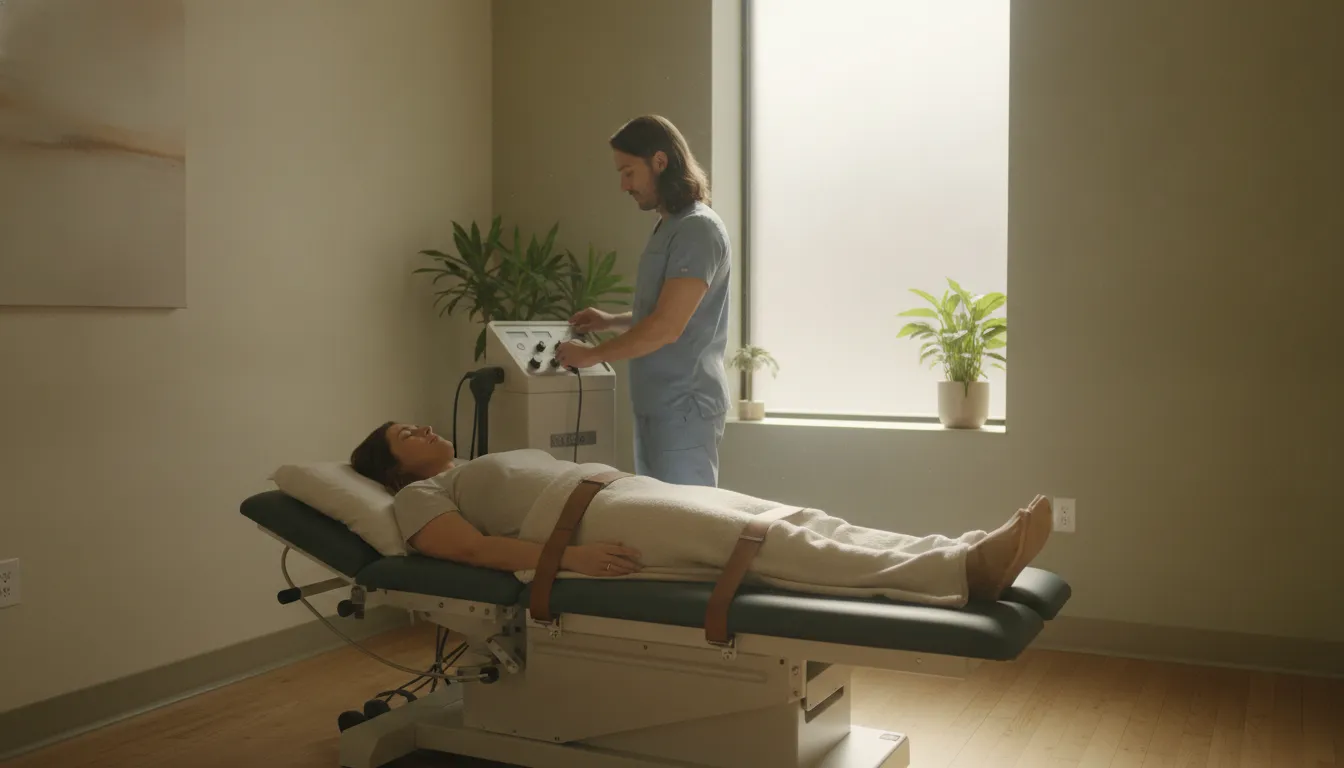
DRX Chicago’s main technology is the FDA-cleared DRX9000. Cleared is the correct word. The FDA’s 510(k) pathway reviews whether a device is substantially equivalent to a legally marketed device. It is not the same as FDA approval of every outcome claim, and it is not a guarantee for an individual patient. The FDA explanation of 510(k) clearance is the regulatory background.
For patients who pass screening, a typical DRX9000 plan at this clinic is about 20 to 28 sessions over 4 to 7 weeks, with sessions of roughly 30 to 45 minutes. That schedule is a clinic protocol, not a result you are owed. Your history, imaging, and response can shorten, lengthen, or rule out that plan.
If you want the machine-level explanation, read how DRX9000 spinal decompression works. If you want how Chicago treatment options compare, including session expectations, use the sciatica treatment guide for Chicago. This page stops at the selection decision so those two pages can own the mechanics.
How candidacy screening protects you
Screening is the part of a sciatica visit that should make a clinic willing to turn you away. Ask what would change the recommendation before you ask what the treatment costs.
A careful screen is willing to turn you away. DRX Chicago screens for situations in which decompression is not appropriate or needs a different clinician first. Examples include pregnancy, severe osteoporosis, spinal fracture, spinal tumor, active spinal infection, ankylosing spondylitis, and surgical hardware at the level being considered. Prior surgery, advanced degeneration, and grade 2 or higher spondylolisthesis need extra judgment. This is not a checklist you can complete at home. It is a reason to disclose your full history.
Questions worth asking in the room:
- Which finding makes you think a non-surgical plan might fit?
- Which finding would send me to another provider first?
- Do you need imaging before you recommend anything?
- How will you judge whether sessions are helping?
- When should I stop and get a medical or emergency evaluation?
- What will I pay, and what does insurance usually not cover?
Most plans do not cover the decompression therapy itself. The clinic can often bill insurance for a consultation, an examination, and some supportive therapies, but benefits vary. Ask for your own financial responsibility before you start. CareCredit may be available for qualified applicants. Approval and terms come from CareCredit, not from the clinic.
The detailed safety list lives on the DRX9000 contraindications page. Read it before a consult if you already know you have hardware, a fracture history, or a complex prior surgery.
When sciatica should not wait for a routine visit
Most radiating leg pain is not an emergency. Some patterns are. Do not use a North Side consultation, or any scheduled clinic visit, as the plan for symptoms that need same-day medical care.
Do not wait for a routine North Side visit if these signs appear. Get emergency care for new loss of bowel or bladder control, trouble urinating with numbness, numbness in the groin or inner thighs, or weakness that is spreading or worsening quickly in the legs. Also get prompt medical care for back pain with fever, pain after a major injury, unexplained weight loss with new spine pain, or a history of cancer plus new spinal pain. Those signs do not prove a diagnosis. They change how fast you should be seen.
MedlinePlus flags loss of bladder or bowel control and significant leg weakness as reasons to seek medical help quickly. Use that as a public reference, then follow the clinician or emergency department in front of you. A decompression clinic is the wrong first stop for those symptoms.
Start with DRX Chicago’s candidacy survey if your symptoms are stable and you want to see whether a non-surgical evaluation is even the right conversation.
What to expect at a DRX Chicago consultation
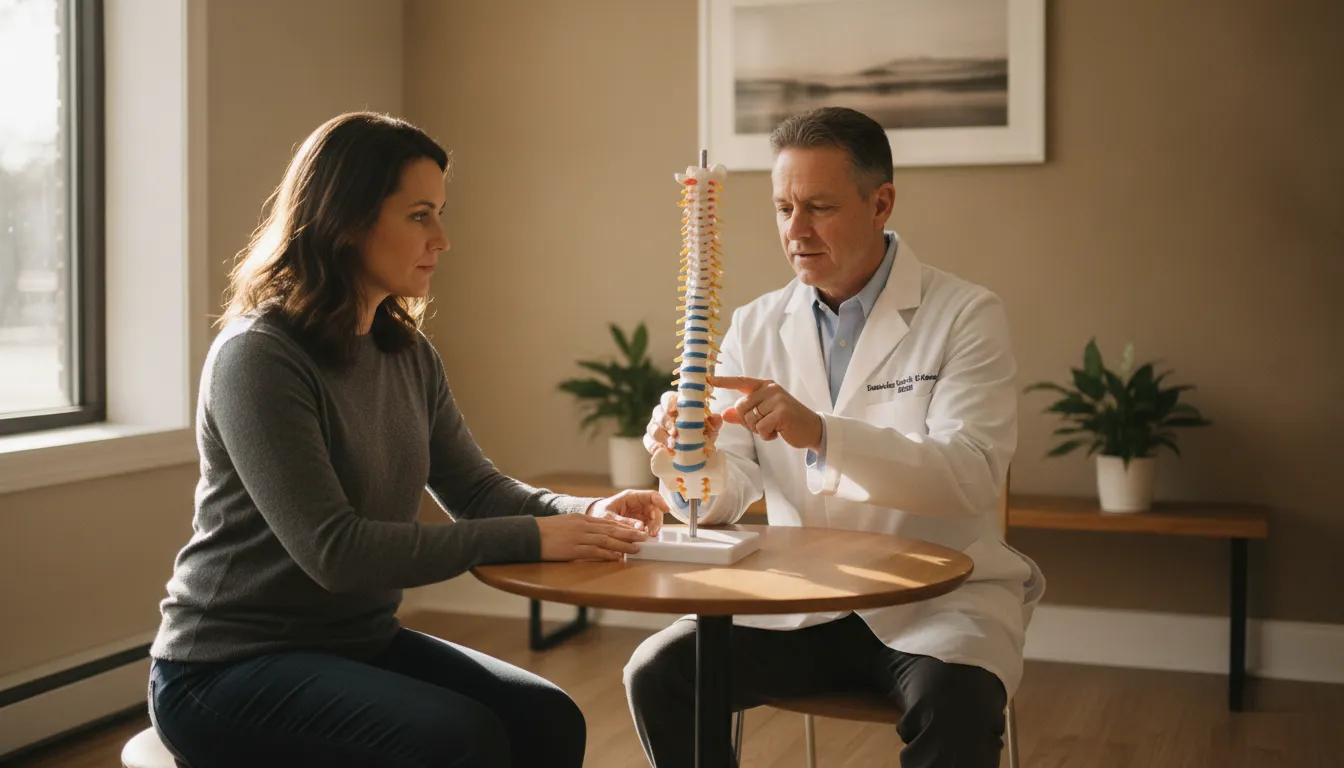
A consultation should connect your history to a yes, a no, or a “not yet.” Bring medication lists, imaging, and the questions above. Say what you are trying to get back to. A plan that ignores work, sleep, and walking is hard to follow even when the technology is appropriate.
Use the visit to judge the office. You should hear who examines you, what the DRX9000 can and cannot do, which red flags would redirect you, and what the visits would demand if you qualify. You should also hear a plain answer on cost. DRX Chicago’s own site invites patients to schedule a free consultation to discuss symptoms and next steps. That offer covers the conversation, not free treatment and not a guaranteed outcome.
Call 773-868-0347 or use the contact form if you want that visit. The office is at 2828 N Clark St, Lower Level, Chicago, IL 60657. If the consult shows that decompression is a poor fit, the useful result is a clear referral path, not a package you feel pressed to buy.
Nothing on this page replaces an examination. DRX9000 care is FDA-cleared technology used for selected patients after screening. It is not described here as FDA-approved, and it is not a cure.
Frequently asked questions
How do I choose a sciatica doctor on Chicago’s North Side?
Judge the evaluation, the clinician’s license, the safety screen, the treatment limits, the follow-up plan, and whether you can reach the office during a flare. A Lakeview or Lincoln Park address is useful only after those clinical questions have a clear answer.
Can a chiropractor be the sciatica doctor I see first?
A licensed chiropractor can evaluate many spinal and musculoskeletal problems within scope. The visit should also identify symptoms that belong with a physician, a neurologist, a surgeon, or an emergency department. Ask how the office makes that handoff.
Does non-surgical relief mean I will avoid surgery?
No. Non-surgical options are a starting point for many people with sciatica, and some patients do need surgery or another medical procedure. A provider should tell you which findings would move you out of a decompression plan.
Is the DRX9000 FDA-approved for sciatica?
No. Describe it as FDA-cleared, not FDA-approved. Clearance is a device-review pathway. It does not approve marketing claims about your personal result, and candidacy still depends on an exam.
Will insurance pay for a North Side decompression plan?
Usually it does not pay for the decompression therapy itself. An exam and some supportive care may be covered under your own policy. Confirm benefits with the clinic and your insurer before you start, and ask about CareCredit only if you need a financing option.
Where do I go for the evaluation?
DRX Chicago is at 2828 N Clark St, Lower Level, Chicago, IL 60657, entrance off Clark. Call 773-868-0347 to confirm access and hours before you travel.