For Andersonville patients comparing non-surgical options for persistent back pain, the nearest-sounding clinic is not always the most important consideration. Verify the provider’s location and evaluation process. Ask what technology is used. Confirm that the treatment plan fits your symptoms and medical history.
When evaluating drx9000 spinal decompression near andersonville north side clinic options, look for a North Side provider that uses FDA-cleared DRX9000 technology. The provider should explain the evidence honestly, screen for contraindications, and offer an individualized consultation. It should not promise a guaranteed result.
DRX Chicago serves the North Side from its Lakeview-area location, so Andersonville readers should compare practical access with clinical fit. The sections below outline the questions that can help you assess a provider before scheduling.
What Should Andersonville Patients Look For in a DRX9000 Spinal Decompression Near Andersonville North Side Clinic?
For Andersonville patients, the right clinic clearly identifies its location and evaluation process. It also confirms whether non-surgical spinal decompression fits the individual condition. DRX Chicago provides DRX9000 spinal decompression at 2828 N Clark St in Chicago. That is a North Side address, not an Andersonville address.
That distinction matters when comparing local search results. The verified DRX Chicago location is on the North Side, with a lower-level entrance off Clark. Confirm the address before scheduling. Also consider whether the clinic’s service, evaluation standards, and communication match your needs.
Which location details should Andersonville patients verify?
Look for a clinic that publishes a specific street address and identifies the treatment offered. DRX Chicago’s published information lists 2828 N Clark St, Chicago, Illinois 60657. It identifies the service as DRX9000 and non-surgical spinal decompression. Treat this as a Lakeview-area North Side location, not an Andersonville office.
- Confirm the clinic address and entrance instructions before your first visit.
- Verify that the practice provides the DRX9000 service described in its patient materials.
- Ask how the evaluation determines whether decompression is appropriate for your condition.
How is this different from other North Side pages?
This Andersonville-focused guide helps readers evaluate a North Side clinic from their neighborhood. It is not a replacement for the separate Rogers Park access page, which addresses that neighborhood’s treatment-access intent. It also differs from a broad Chicago spinal decompression guide. Its focus is location accuracy and clinic fit for Andersonville patients.
Patients considering care from farther north can review the DRX Chicago North Side evaluation article for additional context. Regardless of neighborhood, the key question is not whether decompression sounds promising. It is whether an evaluation supports this treatment for your specific condition.
How Does DRX Chicago’s DRX9000 Spinal Decompression Work?
Answer: The DRX9000 uses controlled spinal traction. This non-surgical approach applies carefully directed, computer-guided forces to the spine. It aims to provide a measured treatment experience for appropriately screened patients. It does not promise the same result for everyone.
Controlled spinal traction means the force, direction, and timing of the pull are adjusted through a treatment program. The system is not applied as one continuous stretch. DRX Chicago describes its DRX9000 therapy as non-surgical, controlled, and computer-guided. Learn more about how the DRX9000 works before deciding whether an evaluation is appropriate.
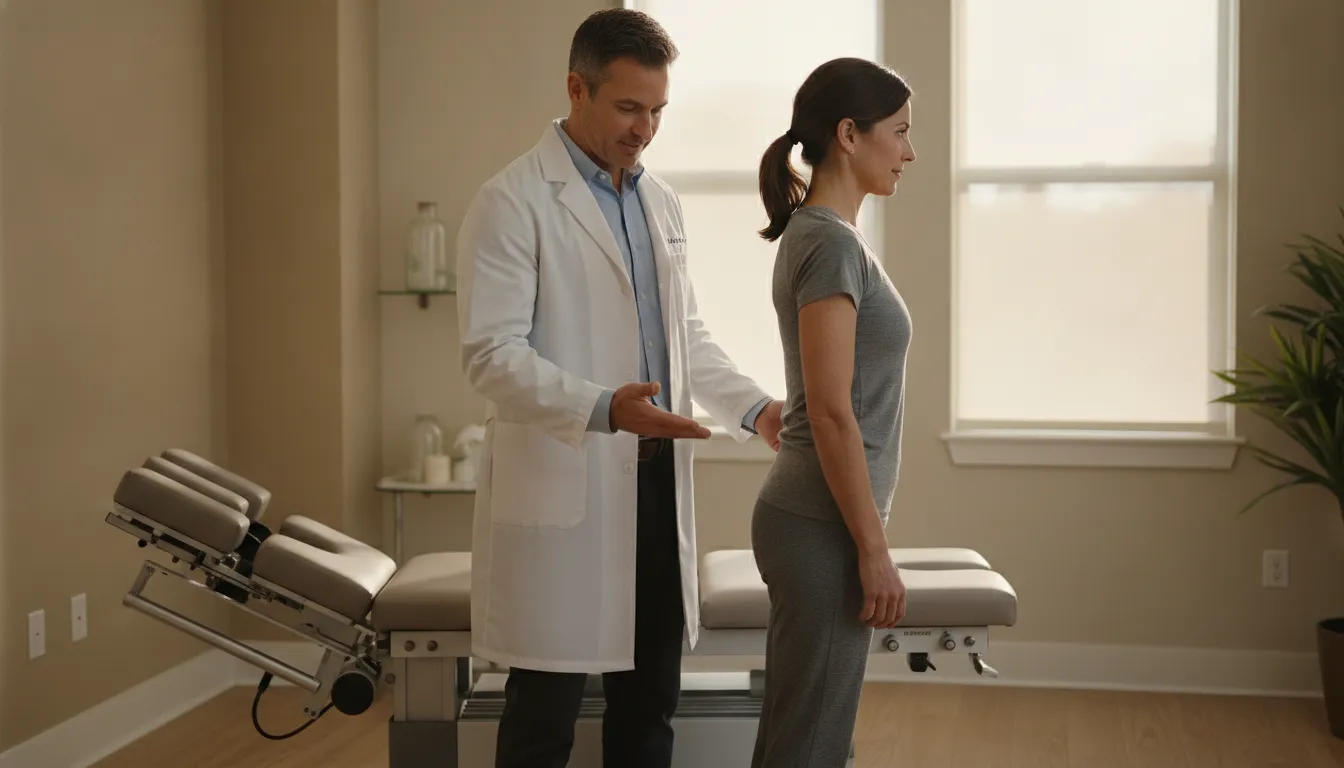
During a session, the patient is positioned on the table while the system delivers the programmed traction pattern. The treatment is intended to be non-invasive. It still belongs within a complete evaluation, medical history, examination, and any appropriate imaging. A clinician must determine whether it fits the patient’s symptoms and health history.
What does FDA clearance mean for the DRX9000?
The FDA lists the DRX9000 TRUE SPINAL DECOMPRESSION SYSTEM as a powered traction device under 510(k) K060735. The listing received a substantially equivalent decision in 2006. The FDA also lists the newer DRX9000-SL system under 510(k) K243775. See the FDA 510(k) record for the original device listing.
These devices are FDA-cleared, not FDA-approved. FDA clearance describes the regulatory pathway and device classification. It does not guarantee treatment results or establish universal candidacy. It does not replace a clinician’s assessment. For someone searching for a drx9000 spinal decompression near andersonville north side clinic, the practical next step is a consultation about treatment mechanics and individual safety.
Who May Be a Candidate, and What Safety Screening Is Required?
Answer: DRX9000 spinal decompression is considered only after a focused evaluation. The evaluation confirms whether treatment fits the patient’s condition and whether important contraindications are present. A history, physical and neurological exam, and imaging review when indicated help determine whether non-surgical care is reasonable.
How is candidacy evaluated?
DRX Chicago does not determine candidacy from a search term or a single symptom. For someone researching a drx9000 spinal decompression near Andersonville North Side clinic, the appropriate next step is an individualized assessment rather than self-diagnosis. The clinician reviews the medical history, asks how symptoms began and behave, and performs an examination.
For suspected herniated disk, Mayo Clinic explains that an examination may check reflexes, muscle strength, walking, and sensation. A history and physical exam diagnose many cases. Imaging or nerve testing may be used when appropriate. An MRI can help confirm the disk’s location and show which nerves are affected. Mayo Clinic’s herniated-disk diagnosis guidance provides additional medical context.
What safety issues must be screened?
Proper patient selection is essential, and not everyone qualifies for spinal decompression treatment. Screening should identify conditions that could make treatment inappropriate or require a different medical plan. Important considerations include:
- Pregnancy
- Severe osteoporosis
- Spinal fractures
- Tumors or metastatic cancer
- Active spinal or disc-space infection
- Ankylosing spondylitis
- Surgical hardware at the treatment level
These considerations are not a substitute for a medical diagnosis. Review the complete DRX9000 safety and candidacy guidance and discuss relevant conditions, medications, prior procedures, and imaging with a qualified clinician.
Does considering decompression mean surgery is unnecessary?
No. Many people with a herniated disk do not need surgery. A healthcare professional may recommend it when symptoms persist or other clinical criteria are present. Serious spinal stenosis may also require surgery. DRX9000 is a possible non-surgical option for qualified candidates. It is never a replacement for medically necessary surgical care.
What Can Andersonville Patients Expect From the Evaluation and Treatment Schedule?
Answer: A typical process begins with an individual evaluation. If treatment is appropriate, sessions last about 30 to 45 minutes. DRX Chicago’s published schedule describes a general six-week progression. The appropriate plan can vary with the patient’s condition, goals, and clinical findings.
For someone researching care from Andersonville or another North Side neighborhood, the schedule is best understood as a framework. It is not a promise of a fixed number of visits. The evaluation comes first because not everyone qualifies for decompression. Treatment should not be selected through symptoms alone.
- Begin with an evaluation. The clinical team reviews your history, symptoms, and relevant records, then assesses whether decompression fits your specific condition. This step helps separate a potentially appropriate non-surgical option from situations that require another form of medical care or further evaluation.
- Review the recommended plan. If you appear to be a candidate, the team explains what the treatment schedule may involve and answers questions about visit frequency and session length. Patients remain on the DRX9000 system for approximately 30 to 45 minutes per session, according to the clinic’s treatment FAQ.
- Progress through the general six-week schedule. The published schedule starts with daily sessions for the first two weeks. It then moves to three sessions per week for two weeks. The final two weeks involve two sessions per week. This progression is a general description, not an assurance that every patient will follow the same timing or frequency.
- Reassess as care continues. Your response and clinical status help guide the ongoing plan. Before scheduling around work, family responsibilities, or travel from Andersonville, ask the team how the general schedule may apply to your circumstances. The clinic’s spinal decompression treatment schedule page provides additional planning context.
A consultation can clarify whether the expected commitment is realistic for you and whether the treatment is clinically appropriate. Call DRX Chicago at 773-868-0347 or discuss your questions during an evaluation rather than assuming that a standard schedule guarantees a particular result.
What Does the Evidence Say About DRX9000 and Spinal Decompression?
Answer: Research on motorized spinal decompression is mixed. Some studies report improvement in pain and disability, but older reviews found limited evidence. Comparative trials have not established that DRX9000 produces better outcomes than conventional motorized traction. The evidence supports a careful consultation. It does not support a guaranteed result or a claim that one device is best for every patient.
DRX Chicago presents the treatment as an option for qualified candidates after evaluation. The FDA records describe the DRX9000 as a powered traction device with a substantially equivalent 510(k) decision. That is not proof that treatment will work for every condition or person. See the FDA 510(k) record for the device classification.
| Question | What the research says | Practical meaning |
|---|---|---|
| Is motorized decompression proven? | A 2006 review of 10 studies found that six of seven randomized trials reported no difference from comparison groups. The authors concluded efficacy remained unproved and noted low study quality and varied patient groups. Read the systematic review. | Evidence should be discussed honestly, with realistic expectations and individualized screening. |
| What did an older review conclude? | A 2007 review described the clinical evidence as limited and questioned routine use while more research was needed. Review the clinical evidence. | Decompression should not be presented as a universal first-line treatment. |
| Does DRX9000 outperform conventional traction? | In a randomized trial of 48 people with lumbar disc herniation, both groups improved after 20 sessions over six weeks. But there was no significant difference between DRX9000 decompression and conventional motorized traction. View the 48-person trial. | Improvement in a study does not prove superiority. Compare options with a clinician. |
| What does broader traction research show? | A 2023 review found no significant short-term difference among traction types for low-back pain with radiculopathy, based on very low- to low-quality evidence. See the 2023 review. | The treatment choice should consider diagnosis, safety, goals, and response, not marketing claims alone. |
For a plain-language discussion of how the treatment compares with another approach, read DRX9000 versus conventional traction. A consultation can help determine whether the available evidence, your diagnosis, and your goals align.
How Can You Decide Whether a North Side Consultation Makes Sense?
Answer: A consultation can help determine whether non-surgical spinal decompression is appropriate for your condition, goals, and medical history. It is not a promise that treatment will be recommended or that it will produce a specific result. DRX Chicago evaluates fit rather than asking patients to rely on symptoms or advertising alone.
For someone searching for drx9000 spinal decompression near andersonville north side clinic, the practical question is whether the provider offers a careful evaluation and a realistic explanation of options. DRX Chicago is at 2828 N Clark St in Chicago, serving patients from the North Side. Andersonville can be part of your search area, but the clinic should not be represented as being located in Andersonville.
- Consider a consultation if you have persistent or recurring back pain, a disc-related diagnosis, sciatica, or nerve-compression symptoms and want to discuss whether a non-surgical approach may fit.
- Bring relevant records, including imaging reports, prior diagnoses, treatment history, and a list of medications. The evaluation should consider your history and physical findings, with imaging review or additional testing when appropriate.
- Ask about candidacy and alternatives, including what findings would make decompression unsuitable and what other care may be more appropriate for your situation.
- Seek appropriate medical care first when symptoms suggest serious spinal stenosis or another condition requiring urgent assessment. Serious spinal stenosis may require surgery, and DRX9000 is not a replacement for medically necessary surgical care. Mayo Clinic explains spinal stenosis and treatment considerations.
Most insurance plans do not cover the decompression treatment itself. Consultation, examination, or supportive therapies may have separate coverage, so verify benefits directly with your plan. CareCredit may be available as a financing option, but approval and terms are determined by the financing provider.
Schedule a free consultation with DRX Chicago to discuss whether DRX9000 may be appropriate for you.
Frequently Asked Questions
How much does spinal decompression therapy cost per session?
DRX Chicago does not publish a universal per-session price because the recommended plan depends on your evaluation, condition, and treatment needs. Most insurance does not cover decompression therapy itself, so ask about current fees, payment options, and whether consultation or supportive services may be covered before beginning care.
Do chiropractors do spinal decompression?
Some chiropractors provide spinal decompression as part of a non-surgical care program. DRX Chicago describes DRX9000 treatment as controlled spinal traction using computer-guided forces. The FDA lists the DRX9000 as a powered traction device cleared through the 510(k) pathway, not as a guaranteed treatment outcome (FDA 510(k) database).
How do I know whether I may be a candidate?
Candidacy cannot be determined from symptoms alone. An evaluation may include your history, a physical examination, and nervous-system checks such as strength, reflexes, walking, and sensation; imaging may be considered when indicated (Mayo Clinic). Not everyone qualifies, and conditions such as pregnancy, severe osteoporosis, cancer that has spread, or disc-space infection may rule out treatment.
How long does a typical treatment schedule take?
Individual plans vary, but DRX Chicago reports sessions lasting about 30 to 45 minutes. Its published example begins with more frequent visits and tapers over several weeks. So Andersonville and North Side patients should discuss travel, scheduling, and the recommended frequency during the consultation.
Ready to Schedule a Free Consultation?
A consultation gives you the opportunity to discuss your symptoms, review whether DRX9000 spinal decompression may fit your condition, and understand what evaluation involves. Individual candidacy and treatment planning require a clinical assessment. So an in-person conversation is the appropriate next step for Andersonville and North Side patients considering care at DRX Chicago. Schedule a free consultation to talk with the team about your questions and options.