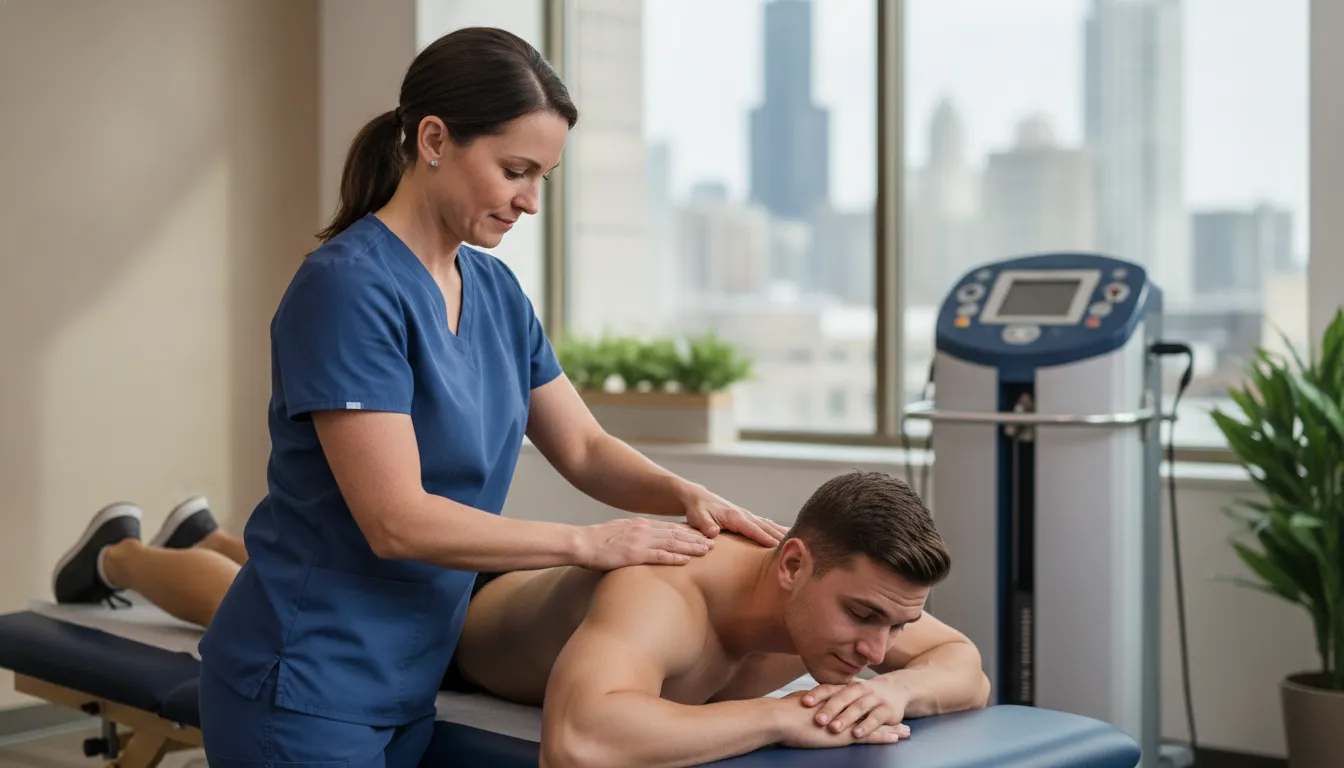
A back or neck injury can change how you train, compete, and move through an ordinary Chicago day. Pain after contact, repeated extension, lifting, or rotation deserves more than a guess about when you can safely resume activity. A careful evaluation can distinguish muscle strain from disc irritation, nerve compression, or an injury that needs prompt medical attention.
Schedule a free consultation with DRX Chicago to discuss your injury and activity goals.
Sports injury spine treatment chicago should begin with a clinical evaluation, not a return-to-play promise. Qualified athletes may benefit from a non-surgical plan that combines targeted spine care, rehabilitation, and progressive loading, while red flags and contraindications are screened first.
Because athletes place different demands on the spine than people at rest, the injury pattern, symptoms, and sport all matter. The next step is understanding why those demands can shape both evaluation and recovery.
What makes sports-related spine injuries different for Chicago athletes?
Answer: Sports-related spine injuries can result from one sudden event, repeated loading, or a combination of both. The right next step depends on the injury pattern, neurological symptoms, functional limitations, and safety concerns. Not simply on how athletic you are or how quickly you want to return.
A basketball landing, a collision during contact sports, or a hard fall can produce an acute injury with immediate pain and restricted movement. Other problems build gradually. Repeated sprinting, rotation, lifting, extension, or poor recovery can overload the muscles, joints, discs, and supporting tissues of the back or neck. Spinal injuries and wear and tear can contribute to neck and back pain, and sports-related back and neck injuries are recognized within spine care programs. Sources: spine injury information and Northwestern Medicine’s spine care overview.
This distinction matters for both competitive athletes and active Chicago adults. A weekend runner, recreational lifter, youth athlete, or adult returning to exercise may need a different evaluation and progression than a professional training daily. Sports medicine is designed for athletes at every level, including weekend athletes and active adults. An evaluation should consider what movement triggers symptoms, whether pain travels into an arm or leg, and how the problem affects walking, lifting, sitting, standing, or sport-specific activity.
Seek prompt medical evaluation after an injury involving severe swelling, deformity, inability to bear weight, or a popping sound. Spinal trauma, suspected fracture, severe neurological symptoms, fever with back pain, or rapidly worsening weakness also should not be managed as a routine training strain. Do not attempt decompression or return-to-play planning until serious causes have been considered. For less urgent symptoms that persist or repeatedly return, a structured assessment can help distinguish a muscle or ligament problem from disc irritation, nerve compression, or another condition. DRX Chicago serves athletes and active adults in Lakeview, Lincoln Park, and greater Chicago, with care selected after evaluation rather than assumed from a sport or diagnosis.
For broader context on local options, review Chicago back pain treatment options. The goal is not merely to reduce symptoms for one workout. It is to understand the likely pain source, address contributing factors, and build a safe path toward normal activity when clinically appropriate.
Which sports injuries and spine conditions may need evaluation?
Not every sore back after training indicates a serious injury, but persistent, recurring, or function-limiting symptoms deserve a closer look. Sports-related spine concerns can involve muscles and ligaments, discs, joints, or the nerves that travel from the spine into the arms and legs. A hard landing, collision, sudden twisting motion, repetitive lifting, or increasing training load may all contribute to back or neck pain.
Some athletes notice localized soreness or stiffness after a strain. Others develop pain that travels into the buttock, leg, shoulder, or arm, along with tingling, numbness, or weakness. Disc irritation or a herniated disc can affect nearby nerves and may resemble sciatica. Spinal stenosis and other conditions can also create nerve-related symptoms. These possibilities cannot be confirmed from symptoms alone. Mayo Clinic notes that an evaluation may include a medical history, physical examination, and neurological checks of reflexes, strength, walking, and sensation. MRI may help show a herniated disc and affected nerves when imaging is appropriate: Mayo Clinic’s herniated disk diagnosis guidance.
- Back or neck pain that persists, returns with activity, or limits normal movement
- Pain that radiates into an arm or leg, or symptoms such as tingling, numbness, or weakness
- Symptoms after a collision, fall, awkward landing, or other traumatic event
- Reduced ability to sit, stand, walk, lift, rotate, or perform sport-specific movements
- Severe swelling, deformity, inability to bear weight, or a popping sound at injury, which warrants prompt evaluation
Evaluation does not automatically mean surgery or spinal decompression. Depending on the findings, care may involve activity modification, rehabilitation, or other conservative options. Mayo Clinic explains that X-rays can help rule out broken bones, tumors, infections, or alignment problems. MRI or CT may identify issues involving discs, bones, muscles, nerves, and ligaments. Seek urgent medical attention for a suspected fracture, major trauma, severe or worsening neurological symptoms, or other red flags rather than attempting to self-treat.
This broader overview includes strains, neck and back injuries, and nerve-related conditions. For a more focused discussion of disc-related concerns in active people, read about spinal disc recovery for athletes. The goal in either case is an appropriate evaluation first, followed by care matched to the actual condition and your activity goals.
How does DRX9000 support non-surgical spine care for athletes?
Answer: DRX9000 may support non-surgical spine care for qualified athletes by applying computer-controlled decompression to the spine, while rehabilitation addresses strength, mobility, coordination, and sport-specific movement. It is one part of an evaluation-guided plan, not a guaranteed shortcut back to competition.
Athletes often need more than temporary symptom relief. A back or neck injury can affect how you brace, rotate, land, lift, or transfer force through the body. After a clinical evaluation, DRX Chicago may combine spinal decompression with sports chiropractic, core stabilization, progressive resistance training, proprioceptive training, neural mobilization, and soft-tissue therapies when indicated. This broader approach helps address both the irritated area and the movement patterns that may continue to load it.
The DRX9000 is FDA-cleared technology. During treatment, computer-controlled logarithmic ramping gradually applies and releases force. The system also uses biofeedback monitoring and can automatically reduce force if muscle guarding or an adverse response is detected. Sessions commonly last 30 to 45 minutes, with frequency adjusted over time according to the treatment plan. You can review the DRX9000 treatment process and mechanism for a more detailed explanation.
| Care component | Primary role | Why it matters for athletes |
|---|---|---|
| Evaluation | Reviews history, symptoms, neurological findings, imaging, goals, and candidacy. | Helps determine whether the injury is appropriate for conservative care and identifies issues requiring referral. |
| DRX9000 decompression | Uses controlled, monitored loading as part of a non-surgical treatment plan. | May help qualified patients manage disc-related symptoms without assuming every injury has the same cause. |
| Rehabilitation | Builds strength, mobility, control, and tolerance for progressively higher demands. | Connects symptom improvement to safer running, lifting, rotation, contact, or other sport-specific activity. |
Rehabilitation remains important even when decompression is included. Feeling better does not automatically mean the spine and surrounding tissues are ready for maximal training. Progress should account for symptoms, strength, control, and functional demands rather than a preset return date. Severe neurological symptoms, suspected fracture, deformity, infection, or other urgent concerns require appropriate medical evaluation before considering this type of care.
How does a safe return-to-activity plan work?
Answer: A safe return to activity is based on how your spine and nervous system respond to progressively greater demands, not on a fixed calendar. The process typically moves from symptom control and basic movement to strength, coordination, sport-specific loading, and functional testing. Feeling less pain is encouraging, but it does not automatically mean you are ready for full-speed play or competition.
For many athletes, the first goal is to settle the acute response without losing all conditioning. Depending on the injury and the evaluation, that may involve temporarily avoiding painful movements, modifying training, and using appropriate early-care measures. Prompt assessment is especially important after severe swelling, deformity, inability to bear weight, or a popping sound. Those signs can indicate an injury requiring care beyond a routine return-to-activity plan. Sports medicine guidance also emphasizes objective strength, stability, neuromuscular control, and functional testing rather than time alone.
- Establish a safe baseline. Your provider reviews your history, symptoms, neurological findings, movement tolerance, and relevant imaging. The baseline should identify what you can do comfortably and which activities reproduce pain, numbness, weakness, or radiating symptoms.
- Restore controlled movement. Begin with movements and exercises that support mobility, trunk control, and confidence without provoking a significant symptom response. DRX Chicago may combine spinal decompression with core stabilization, progressive resistance training, proprioceptive training, neural mobilization, and soft-tissue care when clinically indicated.
- Build strength and capacity. Increase resistance, range, duration, and repetition gradually. A response during the session and over the following day matters. A flare, new weakness, or increasing radiating symptoms is a reason to pause and reassess, not to push through.
- Reintroduce sport-specific demands. Progress from controlled drills to the cutting, lifting, rotating, running, or contact demands of your activity. If running is part of your sport, review guidance on return to running with a disc injury rather than assuming a general walking improvement equals running readiness.
- Confirm functional readiness. Return-to-play decisions should consider strength, stability, coordination, sport-specific tolerance, and provider assessment. Your clinician can determine whether the next stage is appropriate and whether another evaluation is needed.
Schedule a consultation with DRX Chicago to discuss your injury, goals, and return-to-activity plan.
DRX9000 sessions are commonly 30 to 45 minutes, and a graduated schedule may change over time. That schedule is not a promised recovery timeline. The DRX9000 uses computer-controlled ramping, biofeedback monitoring, and automatic force reduction when guarding or an adverse response is detected. But candidacy and progression still depend on a comprehensive evaluation. A plan for an athlete in Lakeview may differ from one for an active adult in Lincoln Park, even when their symptoms sound similar.
Who may be a candidate for sports injury spine treatment in Chicago?
Answer: A potential candidate is an athlete or active adult with a spine-related sports injury whose symptoms and examination suggest that non-surgical care may be appropriate. Candidacy is never assumed from the sport, age, or pain level alone. A thorough evaluation must identify the likely pain source, clarify the athlete’s goals, and rule out conditions that require a different level of care.
Dr. Jason Ingham, DC, holds Certified Chiropractic Sports Practitioner (CCSP) credentials and works with athletic injuries using specialized return-to-play protocols. That experience can be relevant whether you compete regularly, train recreationally, or participate in weekend activities. Back and neck injuries may involve more than one structure, including muscles, joints, discs, and irritated nerves. If disc symptoms are part of the picture, you can also review DRX Chicago’s guidance on spinal disc recovery for athletes, while recognizing that this article addresses a broader range of sports-related spine concerns.
The evaluation may include your medical history, a physical and neurological examination, imaging review, a discussion of your activity goals, and candidacy screening. Depending on the findings, the provider may assess strength, movement, sensation, reflexes, walking, and how symptoms respond to specific positions or loads. Imaging or referral for additional testing may be appropriate when the clinical picture is unclear.
Safety screening is essential before considering spinal decompression or other treatment. Fractures, severe osteoporosis, tumors, active infection, pregnancy, surgical hardware at the treatment level, ankylosing spondylitis, and other relevant risks may make decompression inappropriate or require medical coordination. Severe neurological symptoms, significant trauma, deformity, or rapidly worsening function should be evaluated urgently rather than managed as routine sports rehabilitation.
For athletes in Lakeview, Lincoln Park, and greater Chicago. DRX Chicago can use this process to determine whether its combination of spinal decompression, sports chiropractic, rehabilitation, and supportive therapies fits the individual case. The goal is not to qualify every athlete. It is to identify an appropriate, evidence-informed path toward improved function and a safer progression back to activity.
Frequently Asked Questions
Do I need to be a professional athlete to seek spine treatment?
No. Care can be appropriate for weekend athletes, youth and school athletes, college athletes, and active adults. The important question is how your symptoms affect movement, training, work, and daily activities, not your competitive level. (Source: https://www.rushortho.com/specialties-services/sports-medicine/)
What should I do immediately after a sports-related back or neck injury?
Stop the activity that causes pain and avoid testing the injury by continuing to play. For many acute injuries, initial care may include rest, ice, compression, and elevation. Seek prompt evaluation for severe swelling, deformity, inability to bear weight, or a popping sound at the time of injury. (Source: https://www.rushortho.com/specialties-services/sports-medicine/)
What happens during an evaluation?
A thorough evaluation may include your medical history, physical and neurological examination, imaging review, treatment goals, and candidacy screening. Depending on your symptoms, testing may help identify nerve involvement or other causes of pain. The goal is to determine whether conservative care is appropriate and whether referral for different or urgent care is needed. (Source: https://drxchicago.com/non-surgical-spinal-decompression/is-spinal-decompression-therapy-safe/)
How will I know when it is safe to return to my sport?
Return should depend on restored strength, stability, neuromuscular control, and functional testing, rather than a calendar date alone. Your progression may move from comfortable daily activity to controlled exercise and then sport-specific loading. Relief of pain is encouraging, but it does not automatically mean you are ready for full competition. (Source: https://www.rushortho.com/specialties-services/sports-medicine/)
Can every athlete receive spinal decompression?
No. Candidacy requires an individual evaluation. Screening may identify reasons to avoid or modify treatment, including fractures, severe osteoporosis, tumors, active infection, pregnancy, hardware at the treatment level, or ankylosing spondylitis. If an injury involves serious neurological symptoms or another red flag, urgent medical assessment takes priority. (Source: https://drxchicago.com/non-surgical-spinal-decompression/is-spinal-decompression-therapy-safe/)
Ready to Schedule Your Free Consultation?
If sports-related back or neck symptoms are limiting your training, an evaluation can help clarify your options and whether non-surgical care may fit your goals. DRX Chicago can discuss your symptoms, activity demands, and candidacy during a consultation. Athletes in Lakeview, Lincoln Park, and throughout Chicago can take the next step without assuming a specific treatment or return-to-activity timeline.