Hearing those words from a doctor, “you might need surgery” tends to stop most people cold. Not because surgery is always the wrong answer, but because it’s a decision that holds a lot of weight and risk.
Avoid Back Surgery With Advanced Non-Surgical Spinal Decompression Therapy at DRX Chicago
If you’re dealing with a herniated disc, degenerative disc disease, or persistent sciatica that hasn’t responded to other treatments, you’re probably trying to figure out what comes next. This article won’t tell you surgery is never necessary, because sometimes it is. What it will do is walk you through what most patients in this situation explore first, and what that decision actually looks like in practice.
What “You Might Need Surgery” Actually Means
In most spinal disc-related cases, surgery isn’t being prescribed; it’s being named as a possibility.
The pathway from “you might need surgery” to “you need surgery now” typically passes through a meaningful window of time and usually includes a trial of conservative care first. Imaging findings, even significant ones, don’t always correlate with symptom severity.
An MRI that shows disc herniation is not a surgical verdict; it’s a data point.
Research published in the New England Journal of Medicine has shown that a significant proportion of people with no back symptoms at all have disc abnormalities visible on MRI, which underscores why imaging findings must be interpreted alongside symptoms, not in isolation.
Most disc conditions such as herniated discs, bulging discs, degenerative disc disease, or spinal stenosis, don’t require immediate surgical intervention.
What matters is:
- How long you’ve been dealing with them
- How the findings align with your symptoms
- Whether conservative approaches have been tried and given adequate time to work
The word “surgery” often enters the conversation when conservative care has stalled or when a clinician wants to make sure you understand what’s on the table if things don’t improve.
What Back Surgery for a Disc Problem Actually Involves
If surgery does become necessary, the specific procedure matters.
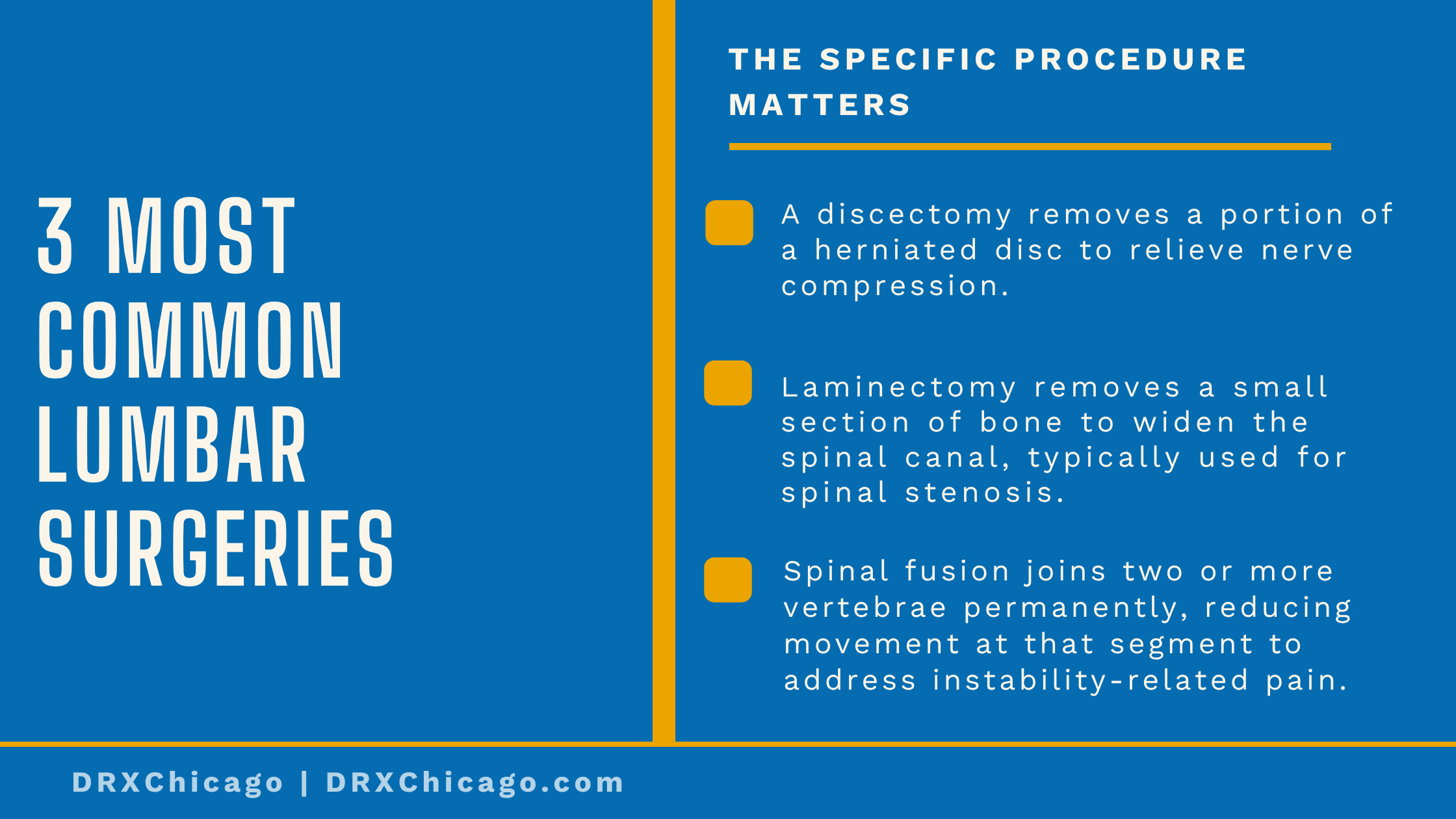
The most common lumbar surgeries for disc-related conditions are discectomy, laminectomy, and spinal fusion, each targeting a different aspect of the problem.
- A discectomy removes a portion of a herniated disc to relieve nerve compression.
- Laminectomy removes a small section of bone to widen the spinal canal, typically used for spinal stenosis.
- Spinal fusion joins two or more vertebrae permanently, reducing movement at that segment to address instability-related pain.
Each of these procedures has a legitimate clinical purpose. None of them is without trade-offs.
Recovery timelines vary significantly depending on the procedure and the individual, restricted activity for six to twelve weeks is common after lumbar surgery, and some patients take considerably longer to return to their previous level of function.
A 2024 randomized clinical trial published in the Bone & Joint Journal found that adding fusion to decompression surgery for lumbar spinal stenosis did not improve outcomes at five years compared to decompression alone.
This reflects a broader pattern in spinal surgery research: more intervention doesn’t reliably mean better results.
There’s also the longer-term question of how adjacent spinal segments are affected over time.
How Non-Surgical Spinal Decompression Works And Who It’s Right For
Non-surgical spinal decompression is a conservative, non-invasive treatment approach designed to reduce pressure within spinal discs without surgery, anesthesia, or hospital recovery time.
The DRX9000 system used at DRX Chicago is FDA 510(k)-cleared for the treatment of lumbar pain conditions, including herniated discs, bulging discs, degenerative disc disease, and posterior facet syndrome.
It is important to understand what that means precisely: FDA 510(k) clearance indicates the device is substantially equivalent to a predicate device already on the market. It is not the same as FDA approval based on independent clinical trials proving efficacy, and patients considering this treatment deserve to know that distinction upfront.
How the DRX9000 Works
The DRX9000 applies controlled, graduated distraction forces to the lumbar spine.
This is theorized to create a reduction in intradiscal pressure; a negative-pressure environment that may allow herniated disc material to shift toward a more neutral position and that may encourage fluid and nutrient exchange back into dehydrated discs.
These mechanisms are biologically plausible and consistent with the physics of spinal loading, but the causal chain from device use to disc healing has not been independently confirmed in large, high-quality randomized controlled trials.
The evidence base is real but still developing.
- A 2025 retrospective study published in Military Medicine by University of South Florida researchers documented improvements in pain scores and neurological function in patients treated with the DRX9000, including MRI-visible disc height changes in some cases.
- A randomized controlled trial published in PMC found that combining non-surgical spinal decompression with physical therapy produced significantly better outcomes than physical therapy alone for lumbar radiculopathy patients.
- Earlier systematic reviews, however, have noted that rigorous large-scale RCT evidence remains limited and that results across studies are mixed. Patients weighing this option should factor that context into their decision.
Who is Non-Surgical Decompression For?
Not everyone qualifies, and candidacy is taken seriously.
Patients are typically excluded if:
- Had lumbar fusion surgery within the past six months
- You have spinal implants such as pedicle screws or rods
- Have severe osteoporosis, unstable spondylolisthesis, recent lumbar compression fractures, or active metastatic cancer.
These criteria are based on clinical safety considerations and are assessed individually through a thorough evaluation, including a thorough review of imaging and symptom history before treatment begins.
For those who do qualify, a typical course involves approximately 20 sessions over four to six weeks, with each session lasting around 30 minutes. Some patients notice gradual symptom improvement within the first several sessions; others may experience mild muscle soreness early on as the spine adjusts.
Results vary by individual and by condition severity, and no outcome can be guaranteed.

When Is Back/Spine Surgery the Best Choice?
Surgery is the appropriate choice in certain situations, and that shouldn’t be minimized.
- If you’re experiencing progressive neurological deficits (worsening weakness in a leg, loss of bladder or bowel control, or significant functional decline) surgery may not be something that can wait.
- Cauda equina syndrome, which involves compression of the nerve roots at the base of the spine, causing bowel and bladder dysfunction, is a recognized surgical emergency requiring immediate intervention.
- Severe structural spinal instability, significant deformity, or cases where nerve compression is severe enough that conservative care cannot meaningfully address the underlying problem are also contexts where surgery is the right first move, not the last.
The goal of exploring non-surgical options isn’t to avoid surgery indefinitely.
It’s to make sure surgery is chosen because it’s the right tool for the problem, not because more conservative approaches weren’t considered or given adequate time.
Find Out If You’re a Candidate
The first appointment at DRX Chicago is a candidacy evaluation, not a treatment session. Drs. Jason Ingham and Erin Schey review your imaging, take a detailed clinical history, and assess how your symptoms and findings align with what spinal decompression is designed to address.
You leave that appointment with a clear answer on whether you qualify, and what a realistic course of treatment would look like if you do. There’s no obligation to begin care the same day.
DRX Chicago is located at 2828 N Clark St in Lakeview, accessible from Lincoln Park, Wrigleyville, and surrounding North Side neighborhoods.
If you’ve been told surgery might be in your future and you haven’t yet explored non-surgical spinal decompression, a candidacy evaluation is a reasonable next step.
Call 773-868-0347 or schedule a consultation today at DRXChicago.com.