Chiropractic adjustments help many people with back pain but they don’t treat every condition the same way.
If you’re dealing with a herniated disc, degenerative disc disease, or sciatica that hasn’t responded to adjustments alone, non-surgical spinal decompression may be the next step. Here’s how these two treatments differ, what each one does, and how to know which approach fits your situation.
Why Adjustments Alone May Not Be Enough for Disc Problems
If you’ve been seeing a chiropractor and still dealing with chronic back pain, radiating leg pain, or numbness, the issue may not be something an adjustment can fully address. That doesn’t mean your chiropractic care was wasted, it means the root of the problem may be structural, inside the disc itself.

When Biomechanical Adjustments Aren’t Enough
When a disc is herniated, bulging, or breaking down, the problem goes deeper than alignment. The disc’s inner material has pushed through its outer wall. That displaced tissue presses on a spinal nerve (like a pinched nerve), which is what causes sciatica, radiating leg pain, or numbness. Adjustments can ease some of the surrounding muscle tension, but they are not designed to pull disc material back into place or restore hydration to a worn-down disc. This is where non-surgical spinal decompression enters the picture.
A standard chiropractic adjustment applies a high-velocity, low-amplitude (HVLA) thrust to specific spinal joints. This is highly effective for correcting subluxations, restoring facet joint mobility, and relieving acute muscle tension. It addresses how the vertebrae are positioned relative to one another. However, traditional chiropractic care is not designed to alter the internal structural integrity of a spinal disc. When a disc is herniated or bulging, the problem is discogenic. The tough outer wall (annulus fibrosus) has failed, allowing the gel-like center (nucleus pulposus) to extrude and physically compress a spinal nerve root. While an adjustment can relieve the surrounding muscular spasms, it cannot pull extruded disc material off the nerve or restore hydration to a desiccated, degenerated disc. For that, you need targeted axial distraction.
A chiropractic adjustment applies controlled force to specific joints in the spine. The goal is to correct misalignments, restore normal joint movement, and reduce nerve irritation caused by shifted vertebrae. It works well for many conditions like joint stiffness, acute muscle tension, headaches, postural problems, and general mobility issues.
The Science of the DRX9000: Bypassing the Guarding Reflex
The most critical distinction between standard physical therapy “traction” and the DRX9000 is how the body responds to the pulling force. Standard linear traction pulls the spine at a fixed rate. The human body perceives this as a threat, triggering the proprioceptive guarding reflex—your paraspinal muscles instantly spasm and tighten to protect the spine, effectively blocking the joints from separating.
The DRX9000 circumvents this reflex. Utilizing an FDA-cleared, computerized biofeedback system, the machine reads your muscle tension thousands of times per second. It applies a logarithmic stretch curve, constantly adjusting the pulling force to keep your muscles completely relaxed.
By successfully separating the specific vertebrae (e.g., L4 and L5), the DRX9000 creates a vacuum effect inside the disc—clinically known as negative intradiscal pressure. This negative pressure mechanically retracts the herniated disc material off the pinched nerve while simultaneously pulling oxygen, water, and nutrient-rich fluids back into the disc to accelerate cellular repair.
Standard traction pulls at a fixed rate, which often triggers the body’s natural muscle guarding response. The DRX9000 works differently. It uses a sophisticated computer system to apply force without triggering muscle guard (a reflex where your muscles tense up to protect the spine). The result is a treatment that works with your body rather than against it. This is the most important distinction to understand. A chiropractic adjustment works on the joint, but spinal decompression works on the spinal disc itself.
At DRX Chicago, we use the DRX9000, an FDA-cleared, computer-controlled spinal decompression system. It applies carefully controlled, variable force to stretch the lumbar spine.
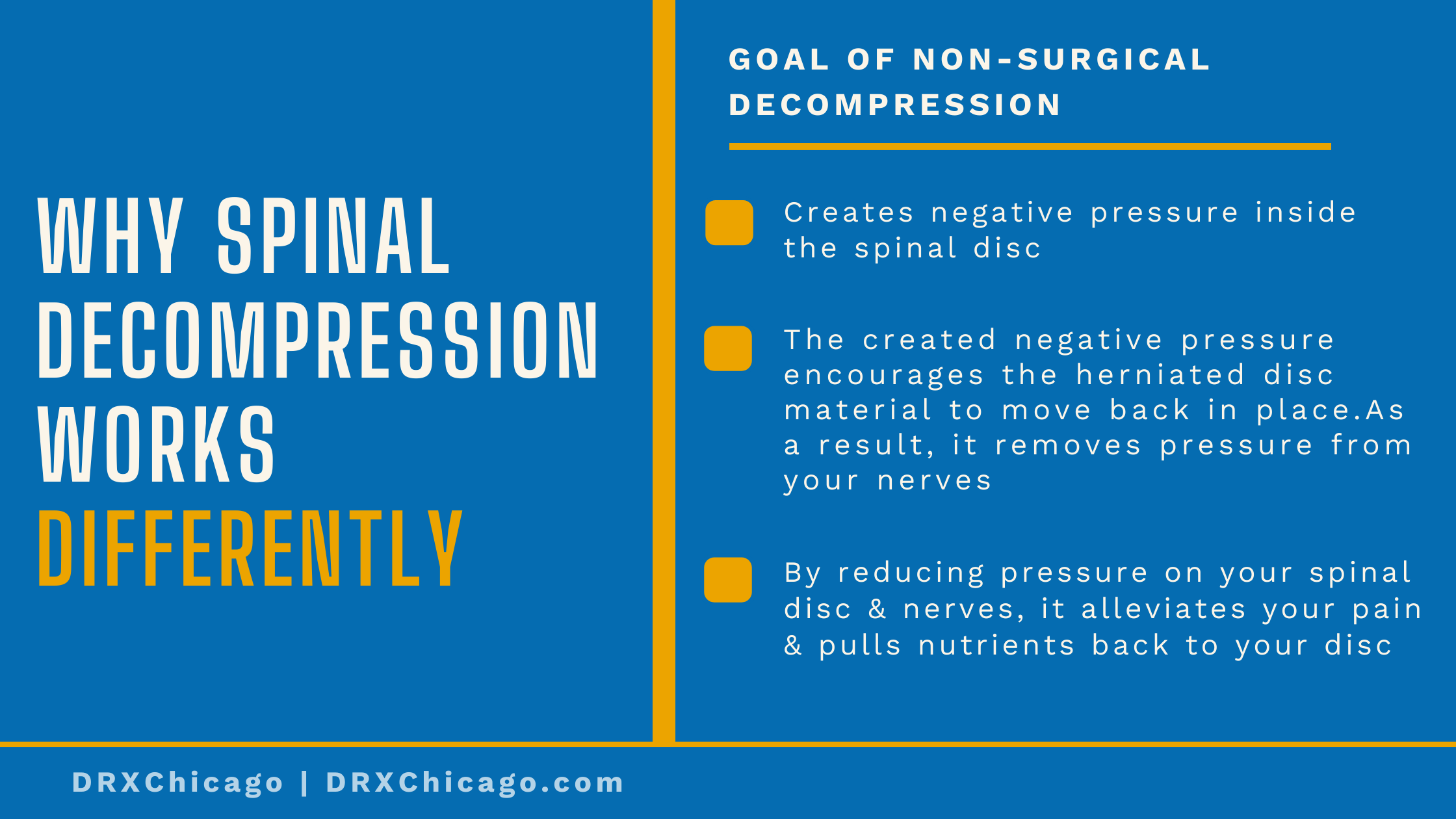
The goal is to create negative pressure inside the targeted disc. That negative pressure does two things.
- First, it helps draw bulging or herniated disc material back toward its normal position. This takes pressure off the nearby spinal nerves that are causing pain, sciatica, or numbness.
- Second, it pulls oxygen, water, and nutrients back into the disc. Spinal discs have very limited blood supply, so this flow of nutrients is essential for healing.
The DRX9000 also allows for level-specific treatment.
Using angular positioning, it can direct force to a specific disc between L1 and L5 rather than pulling on the entire lumbar spine at once. This precision is one of the key differences between the DRX9000 and basic traction tables.
Injuries Non-Surgical Decompression Can Treat
Non-surgical decompression therapy can treat a wide range of injuries, such as:
- Lifting Injuries
- Auto Accidents
- Slip & Fall Accidents
- Work-Related Injuries
- Post-Surgical Back Pain
- Athletic & Sports Injuries
- Repetitive Motion Injuries
- Sports Concussion & Whiplash Related Injuries
It’s also worth mentioning what the evidence shows for non-surgical decompression.
Clinical studies have documented real pain reduction in patients treated with the DRX9000. One pilot study presented at the American Academy of Pain Management followed patients whose chronic low back pain had lasted an average of ten years. The results showed significant improvement after completing the treatment protocol.
Patients in our own practice have also reported substantial relief, and many have been able to avoid surgery altogether.
That said, spinal decompression is not a solution for everyone. Results vary based on the severity of the condition, the patient’s overall health, and whether they are a good candidate. That is why a thorough evaluation is always the first step.
Conditions Where Decompression May Be More Appropriate Than Adjustments
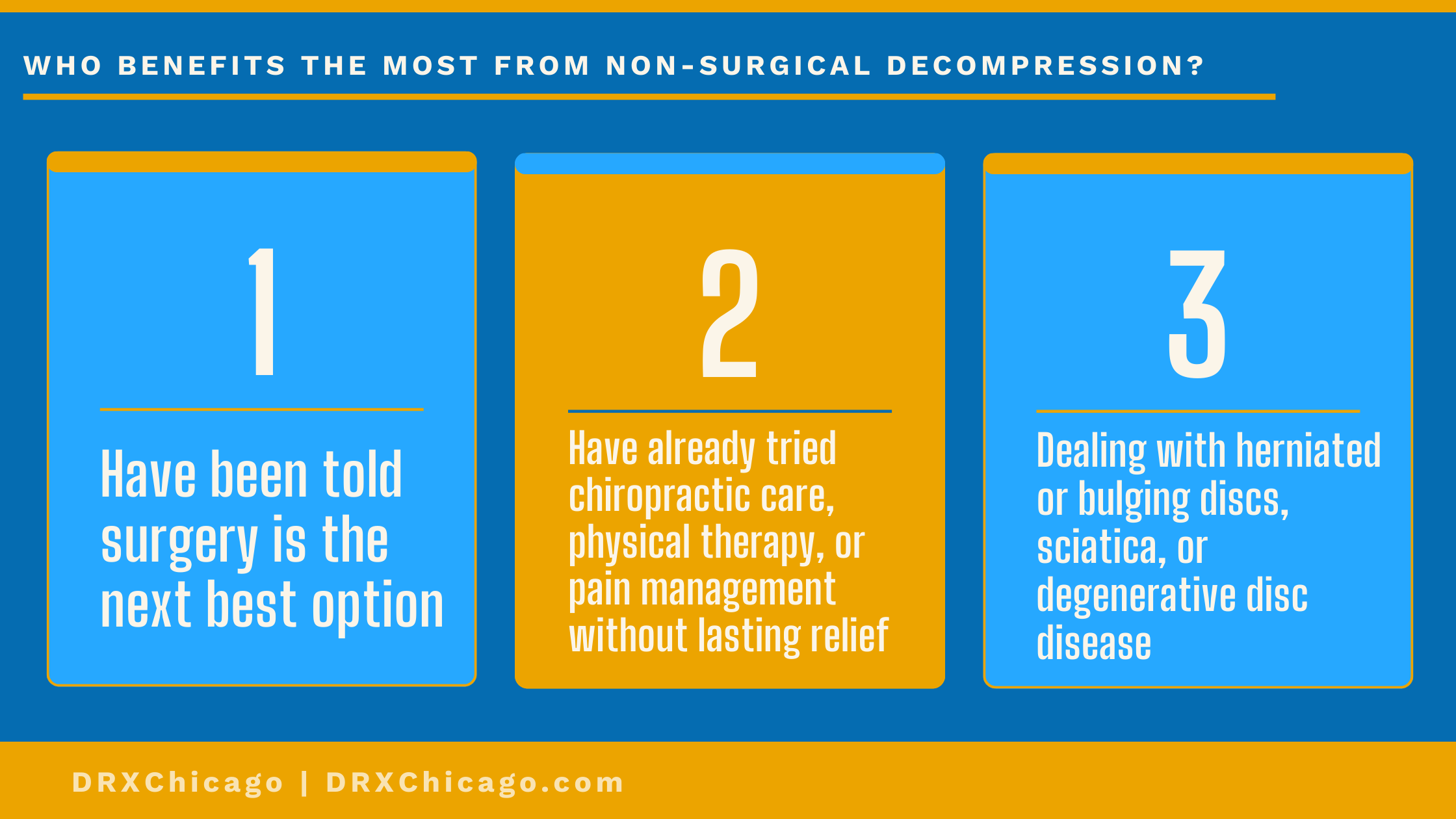
Non-surgical spinal decompression with the DRX9000 is typically recommended for patients…
- Have been told that surgery is their next option
- Have already tried chiropractic care, physical therapy, or pain management without lasting relief
- Dealing with herniated or bulging discs in the lumbar spine, degenerative disc disease, sciatica caused by disc compression, and posterior facet syndrome.
Traditional Chiropractic Care is Best For:
Traditional chiropractic adjustments tend to be the better fit for joint stiffness, acute or mechanical back pain, tension headaches, limited range of motion, and postural problems.
These are real and significant conditions, and chiropractic care is one of the most effective non-surgical treatments available for them.
It’s also worth noting that these two approaches are not mutually exclusive.
Many patients at DRX Chicago receive both chiropractic adjustments and decompression therapy as part of a coordinated treatment plan. Adjustments address the alignment and mobility of the surrounding joints while decompression targets the damaged disc directly. Used together, they can work on different layers of the same problem.
Who Shouldn’t Get Spinal Decompression Therapy?
There are some patients for whom decompression is not appropriate.
Contraindications include recent spinal fractures, spinal implants or hardware, pregnancy, severe osteoporosis, and certain spinal tumors. These are identified during the evaluation process before any treatment begins.
What to Expect During DRX9000 Treatment in Chicago
If you have never experienced spinal decompression, knowing what the process actually looks like can make the decision easier.
Each DRX9000 session at our Lakeview clinic lasts about 30 minutes. You lie comfortably on the decompression table while a harness is placed around your hips. The system then begins its controlled cycles, gently stretching and releasing the targeted segment of your lumbar spine.
Most patients describe it as a deep stretch. It is not painful.
A standard treatment plan involves around 20 sessions over four to six weeks. Many patients begin to notice improvement within the first two weeks, though this depends on the condition and how long it has been present.
Treatment at DRX Chicago is also supervised by Dr. Jason Ingham, DC, CCSP, who has been treating spinal conditions in Chicago for over a decade. Dr. Ingham and Dr. Erin Schey evaluate each patient individually.
We review your imaging, medical history, and prior treatment outcomes before recommending a course of care.
The goal is never to start a patient on decompression unless there is a clear clinical basis for expecting improvement.
Our clinic is located at 2828 N Clark St in the Lakeview neighborhood, with convenient access for patients coming from Lincoln Park, Wrigleyville, Roscoe Village, North Center, and the greater Chicago area. Complimentary validated garage parking is available.
How to Know If You’re NSSD Candidate

A quick way to find out if you’re a candidate for spinal decompression therapy is by taking our survey.
Spinal decompression is a condition-specific treatment, and candidacy depends on factors that can only be assessed through imaging review and clinical examination.
You may be a good candidate if you have been diagnosed with a herniated or bulging disc on MRI. The same applies if you have chronic low back pain that radiates into the leg, or if you experience numbness and tingling caused by sciatica.
Patients who have tried chiropractic care or physical therapy without lasting relief often find that the DRX9000 addresses what other treatments could not. And if you have been told that surgery is your next option, a candidacy evaluation is a reasonable step before making that decision.
Get a Proper Evaluation at DRX Chicago
At DRX Chicago, our evaluation process includes a detailed review of your MRI findings, your pain history, and your treatment history. If decompression is not appropriate for your condition, we will tell you directly and discuss alternative options. If your back pain is driven by joint stiffness or alignment issues, chiropractic adjustments remain one of the most effective options available. But if the issue is a damaged disc that is compressing a nerve and hasn’t responded to other conservative care, non-surgical spinal decompression with the FDA-cleared DRX9000 may offer the targeted relief your spine actually needs.
If you are unsure where to start, a consultation can help clarify which approach. Contact us today to secure a spot.
Clinical FAQs: The DRX9000 & Spinal Decompression
Inversion tables rely on gravity and body weight, which triggers your muscles to spasm and guard the spine. The DRX9000 uses computerized biofeedback to bypass the proprioceptive guarding reflex, allowing for true separation of the vertebrae and targeted disc decompression.
Yes. Many patients who were told surgery was their only remaining option find lasting relief with the DRX9000. By mechanically retracting the herniated disc material off the nerve root, the neurological symptoms (sciatica, numbness) are resolved without the permanent alteration of spinal fusion.
No. The treatment is entirely non-invasive and painless. Because the computer system prevents muscle spasms, most patients find the 30-minute sessions deeply relaxing. It is common for patients to fall asleep during treatment.
A standard clinical protocol typically involves 20 to 24 sessions administered over 4 to 6 weeks. However, the exact number depends on the severity of your discogenic pathology, as determined during your MRI review with Dr. Ingham.
It is the vacuum effect created inside your spinal disc when the DRX9000 gently separates the vertebrae. This vacuum physically pulls extruded disc gel (the nucleus pulposus) back into the center of the disc, pulling it away from the pinched nerve.
Yes, it is highly effective for DDD. Degenerative discs are severely dehydrated. The negative pressure created during decompression acts like a sponge, pulling water, oxygen, and nutrients back into the disc space to promote cellular rehydration and healing.
Patients with surgical hardware (screws/plates) in the lumbar spine, severe osteoporosis, recent spinal fractures, or pregnant women are contraindicated for this therapy. A thorough evaluation is required before any treatment begins.
Absolutely. They are highly complementary. At DRX Chicago, we frequently use chiropractic adjustments to ensure proper joint mobility and alignment, while utilizing the DRX9000 to heal the structural damage inside the spinal disc itself.
The goal of the DRX9000 is structural healing, not temporary symptom masking. By retracting the disc material and allowing the annulus wall to heal, the results are designed to be long-lasting, provided you follow the prescribed post-treatment core stabilization protocols.
Yes. The DRX9000 allows us to target specific spinal levels (e.g., L4-L5 vs. L5-S1). An MRI is required to clinically pinpoint exactly which disc is herniated or bulging so the computer can be programmed with exact angular precision.