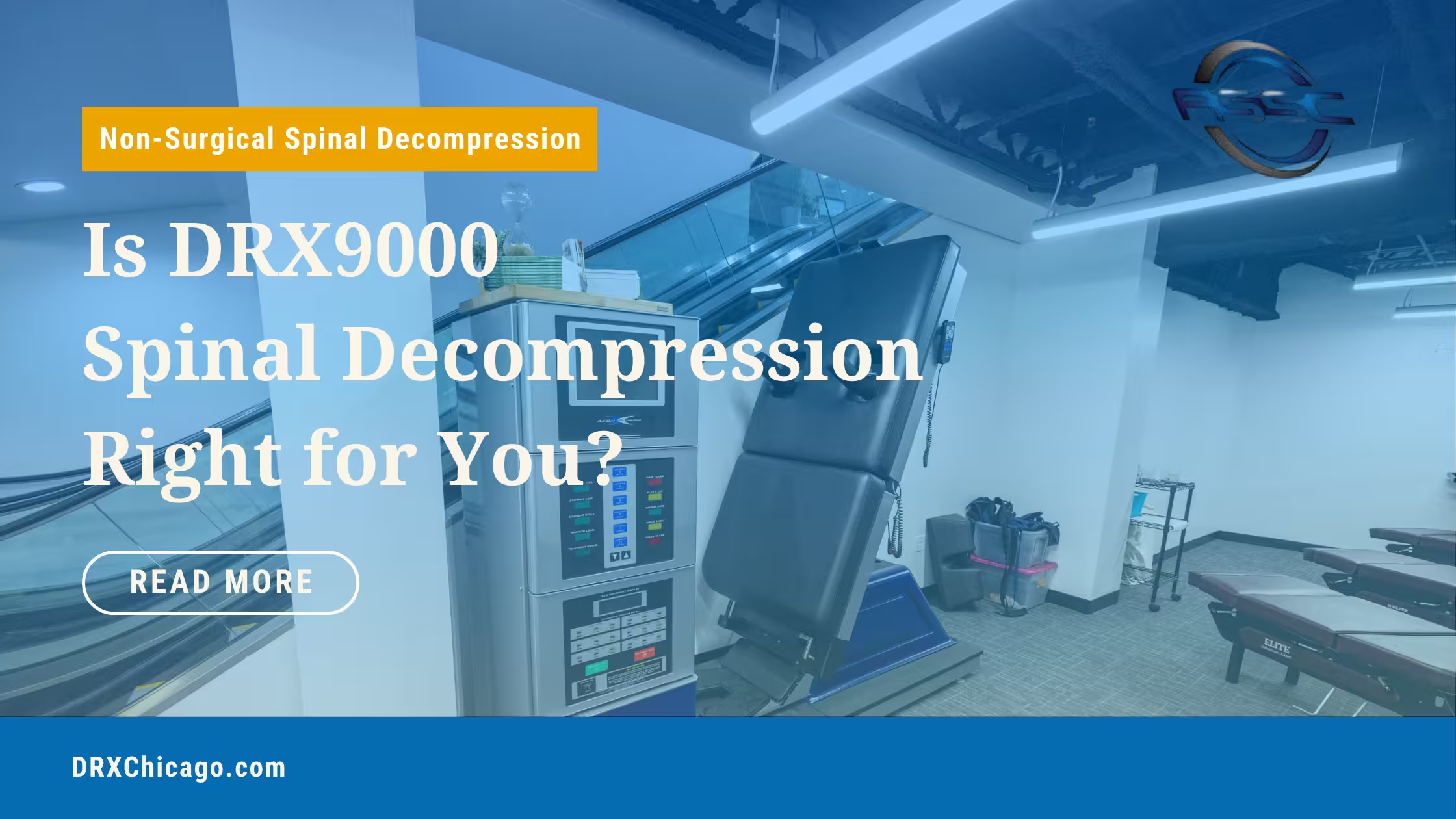
DRX9000 spinal decompression treatment might work for you if you’ve been living with chronic back pain for months (or years), and have found no significant improvements in physical therapy and consistent medication.
That said, spinal decompression can be caused by several factors, and there’s no one straight answer for it all. At DRX Chicago, we’ve worked with several patients to relieve chronic lower back pain and reduce the need for medication.
>Ultimately, we’ve created this guide to answer whether DRX9000 treatment is likely a good fit for your situation, and what happens if it isn’t.
What Conditions Does DRX9000 Spinal Therapy Often Treat?
The DRX9000 is built for a specific type of back pain: damaged or compressed spinal discs.
Not all back pain fits that description. This is why figuring out whether you’re a candidate matters before anything else. The DRX9000 is FDA-cleared to treat the following conditions:
Each of these conditions involves spinal discs, the nerves around them, or both being under too much pressure.
A herniated disc happens when the soft inner material of a disc pushes through its outer wall and presses on a nearby nerve. That pressure is what causes sharp pain, tingling, and numbness in the lower back, hips, or legs.
Degenerative disc disease is a related but different problem. Over time, spinal discs dry out and lose their cushioning. The bones end up sitting closer together than they should, which causes pain and stiffness.
Sciatica is not a condition on its own. It is a symptom. Specifically, it is pain that travels from the lower back down through the leg, following the path of the sciatic nerve. When a disc is pressing on that nerve, non-surgical spinal decompression can often help by relieving that pressure at its source.

Signs You Are Likely a Good Candidate for DRX9000 Spinal Decompression Treatment
Most good candidates for DRX9000 spinal decompression treatment have a disc-related diagnosis, and (more importantly) standard treatments have not resolved it.
Other signs that make you a good candidate include the following:
- MRI or X-ray confirmation. If an MRI or X-ray confirmed a herniated disc, bulging disc, or degenerative disc disease
- No noticeable improvement in various therapies. You have been through several weeks of physical therapy or chiropractic care without lasting relief, you fit the profile that tends to respond well to non-surgical spinal decompression.
- The pain has lingered for a long time. Pain that has persisted for more than four weeks is a sign that the underlying problem has not healed on its own. That kind of chronic, disc-related pain is exactly what the DRX9000 was designed for.
- Other health concerns. Additional signs that point toward candidacy include being in otherwise reasonable health, not having had spinal fusion surgery with metal hardware, not being pregnant, and having no active spinal infection or unstable fracture in your spine.
These are the safety factors Dr. Ingham reviews at your first appointment.
One group worth highlighting: patients who have had back surgery that did not fully solve the problem. This is sometimes called failed back surgery syndrome. If your surgery did not involve spinal fusion or hardware, and it has been at least six months since the procedure, DRX9000 spinal decompression may still be worth exploring. A thorough evaluation is the only way to know for sure.
See if you’re a candidate for DRX 9000 Treatment right now.
Who Is Not a Good Candidate for Spinal Decompression?
Not every patient is a good fit for DRX9000 treatment. At DRX Chicago, being honest about that is crucial to prevent complications or worsening a patient’s condition.
A couple of red flags worth mentioning if you’re considering spinal decompression include:
- Pregnancy is a firm disqualifier. The positioning required during spinal decompression treatment makes it unsafe, full stop.
- Severe osteoporosis is another. When bone density has dropped significantly, the spine cannot safely handle the traction forces involved, even gentle ones.
- Patients with an active spinal fracture, a recent compression fracture, or an active infection in the spine are also not candidates until those issues are fully treated and resolved.
- Prior spinal fusion with metal hardware generally disqualifies treatment at the levels that were fused. This does not automatically mean the DRX9000 is off the table. It depends on where the hardware sits and which parts of the spine are affected. That determination has to be made in person, through a proper evaluation.
Other conditions that disqualify patients include a known abdominal aortic aneurysm, neurological symptoms that are getting progressively worse, and cancer that has spread to the spine. These are not common situations, but they are important to identify before any treatment begins.
If any of these apply to you, Dr. Ingham will tell you clearly at your consultation. The goal is not to treat every patient who comes through the door. It is to treat the right patients safely.
What Makes DRX9000 Treatment Different From Other Spinal Treatments?
Think of the DRX9000 as a guided stretch session, except…
Instead of you trying to crack your own back, a machine does it with the exact right amount of pressure, at exactly the right angle, every single time. It’s a precision machine that gently stretches your spine in exactly the right way, creating space between the discs that are causing your pain, without triggering the muscle tension that makes older traction devices uncomfortable.
This is what makes the DRX9000 Treatment significantly different from other spinal treatments.
See, when a disc is compressed, the pressure inside it cuts off the supply of oxygen, water, and nutrients that disc needs in order to heal. By gently stretching the spine in a controlled way, the DRX9000 creates a brief drop in pressure inside the disc.
That drop draws nutrients back in and, in cases of herniation, can encourage displaced disc material to shift away from the nerve it was pressing on.
Now for the technical features.
- The DRX9000 is a computer-controlled decompression table that applies a precisely measured pulling force to the lower back.
- It is also a non-invasive procedure with sessions lasting between 30 to 45 minutes. Most patients describe the experience as comfortable (sometimes, relaxing).
- A built-in servo motor monitors and adjusts that force throughout the session so the treatment stays accurate and consistent.
This is different from older traction therapy.
Standard traction applied a constant, fixed pull. The DRX9000 uses a variable pattern that builds, holds, and releases in a way that avoids triggering the muscle-tightening response that older devices often caused. The result is a gentler, more precise treatment.
For more information on how the DRX9000 works, we have a free resource guide.
What Happens at Your First DRX9000 Appointment
Your first visit at DRX Chicago is an evaluation of your candidacy, along with several questions related to your medical background and current condition.
Dr. Ingham will review your medical history, look over any imaging you have had such as MRI, X-ray, or CT scans, and perform a physical and neurological examination. The goal is to understand exactly what is happening in your spine, confirm whether a disc-related condition is causing your symptoms, and determine whether DRX9000 spinal decompression is a safe and appropriate option for your specific case.
If you do not have recent imaging, Dr. Ingham will discuss whether new scans are needed before starting.
Not every patient requires new imaging, but for certain conditions, having a current picture of the spine is essential for planning the right treatment. By the end of your first appointment, you will have a clear answer. If you are a good candidate, you will also have a personalized treatment plan in hand.
What If You Have Already Had Back Surgery?
This is one of the most common questions we hear at DRX Chicago, and one worth explaining.
Surgery does not always deliver the relief patients hoped for. Sometimes the pain comes back. Sometimes a different part of the spine develops problems after the original procedure. Patients in that situation often feel like every option has been exhausted.
But that’s not always the case.
Read this before considering back surgery for your spine.
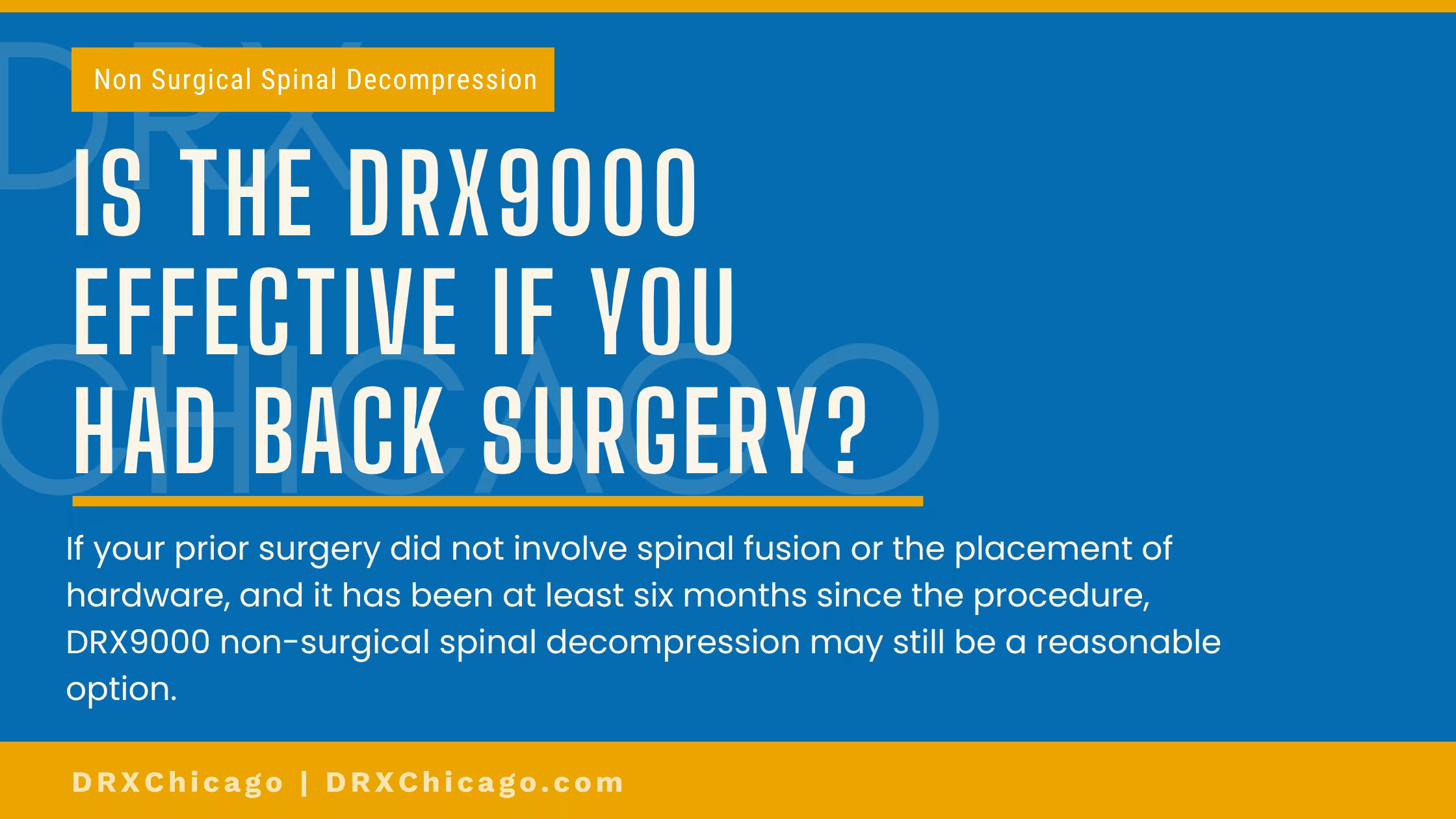
If your prior surgery did not involve spinal fusion or the placement of hardware, and it has been at least six months since the procedure, DRX9000 non-surgical spinal decompression may still be a reasonable option. What matters is a careful review of your surgical history, your current symptoms, and your most recent imaging.
If hardware was placed during surgery, spinal decompression is not safe at those fused levels. However, depending on where the pain is coming from, other parts of the spine may still be treatable. This is not a question that can be answered with a checklist. It is a conversation that requires an in-person assessment at our clinic.
DRX9000 Spinal Decompression Therapy – (FAQs)
How is DRX9000 different from regular traction?
Standard traction applies a constant, fixed pull to the spine. The DRX9000 uses a computer-controlled motor to deliver a variable decompression that adjusts throughout the session in real time. That precision is what creates the drop in disc pressure that encourages disc healing and nerve relief. It is also what makes the DRX9000 more comfortable for most patients than traditional traction.
How long does a DRX9000 spinal decompression treatment plan take?
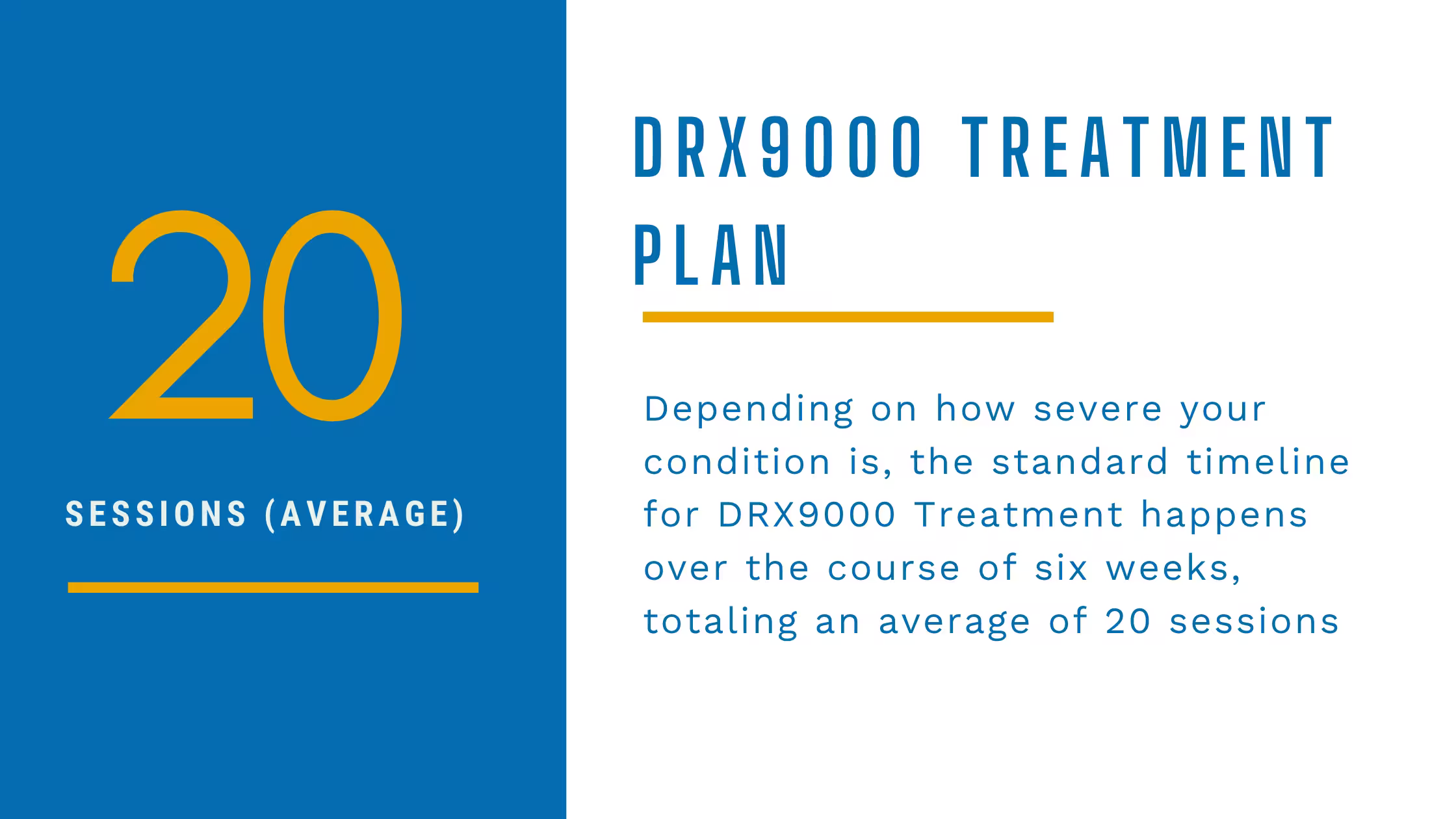
A standard protocol involves around 20 sessions over six weeks. Sessions run about an average of 30 minutes each. The schedule typically starts at five visits per week for the first two weeks, then tapers to three, then two. Many patients notice some improvement within the first several sessions, but the full course of treatment is designed to give the disc enough time to genuinely heal, not just feel better temporarily.
Does DRX Chicago serve patients from Lincoln Park, Wrigleyville, and other nearby neighborhoods?
Yes. DRX Chicago is located at 2828 N Clark St in Lakeview, with an entrance off Clark Street on the lower level. The clinic is easy to reach from Lincoln Park, Wrigleyville, Roscoe Village, Lake View East, and most of Chicago’s North Side. Street parking is available nearby, and the location is served by several CTA bus routes along Clark.
Ready to Find Out If You Qualify for DRX9000 Non-Surgical Spinal Therapy?
A consultation about your condition is the simplest way to get an accurate evaluation and clear answer.
At DRX Chicago, we’ll review your imaging, assess your symptoms, and tell you directly whether DRX9000 spinal decompression is a safe and likely effective option for your situation. Schedule your candidacy evaluation at DRX Chicago today.